



USED EarthQuaker Devices Aurelius Tri-Voice Chorus


USED EarthQuaker Devices Aurelius Tri-Voice Chorus
Price$120
+ $25 Shipping

Listed:3 days ago
Views:25
Saves:4

Champaign, IL, United States
Our users rate Reverb
EQD built its reputation on knowing the difference between a chorus pedal and a chorus pedal, and the Aurelius is them going after the holy grail of the breed: the 1970s Boss CE-1 Chorus Ensemble. They didn't clone it, they took it apart and built three distinct voices around what made it work, which is the kind of overkill you expect from a company that's picked up NAMM Best in Show wins for exactly this.
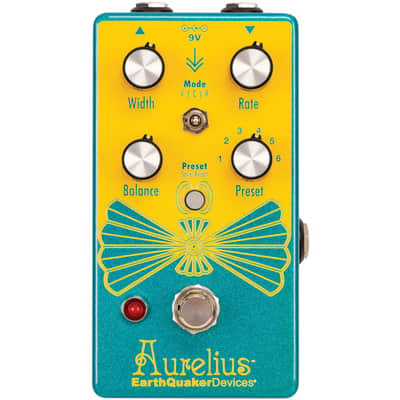
Mode V gives you a traditional CE-1-style chorus leaning toward vibrato, and crank the Balance knob fully clockwise and the dry signal disappears entirely, leaving a genuinely unsettling, seasick pitch vibrato on its own. Mode C blends chorus with flanger, warmer and slower than Mode V, and pushing Width past center gradually adds feedback for a more pronounced, aggressive flange character. Mode R is the one that'll actually surprise you: a rotary chorus modeling a real Leslie cabinet's amplitude and frequency modulation, with lower Width settings accentuating the woofer frequencies and higher settings pushing toward the horn. All three modes share the same three knobs, Width, Rate, Balance, so once you learn the Aurelius you've effectively learned three pedals.
Six onboard preset slots store every parameter, the Mode switch position, and whatever you've mapped to the expression jack, so you can build a vibrato patch, a flanger patch, and a rotary patch and flip between them with the Save/Recall switch instead of kneeling down to twist knobs mid-set. A green LED on that switch means you're in Live Mode with the physical knobs controlling the sound directly; red means Preset Mode, locked into your saved settings until you switch back.
The Flexi-Switch footswitch gives you true bypass either way you want it: tap once for standard latching on/off, or hold it down for momentary swells that bypass the instant you let go.
Worth knowing: like every EQD pedal using this relay-based switching, it needs power to pass signal at all, so a dead battery or disconnected supply means dead silence, not a passive bypass. Run a TRS expression pedal into the EXP jack and map it to Width, Rate, or Balance for real-time control, or feed it 0–3.3V control voltage if that's how your board is wired.
This is digital circuitry doing an analog pedal's job better than most analog pedals manage, and EQD built it to be worked on a real board, not admired on a shelf.
USED, VERY GOOD condition. No velcro on the back.
Mode V gives you a traditional CE-1-style chorus leaning toward vibrato, and crank the Balance knob fully clockwise and the dry signal disappears entirely, leaving a genuinely unsettling, seasick pitch vibrato on its own. Mode C blends chorus with flanger, warmer and slower than Mode V, and pushing Width past center gradually adds feedback for a more pronounced, aggressive flange character. Mode R is the one that'll actually surprise you: a rotary chorus modeling a real Leslie cabinet's amplitude and frequency modulation, with lower Width settings accentuating the woofer frequencies and higher settings pushing toward the horn. All three modes share the same three knobs, Width, Rate, Balance, so once you learn the Aurelius you've effectively learned three pedals.
Six onboard preset slots store every parameter, the Mode switch position, and whatever you've mapped to the expression jack, so you can build a vibrato patch, a flanger patch, and a rotary patch and flip between them with the Save/Recall switch instead of kneeling down to twist knobs mid-set. A green LED on that switch means you're in Live Mode with the physical knobs controlling the sound directly; red means Preset Mode, locked into your saved settings until you switch back.
The Flexi-Switch footswitch gives you true bypass either way you want it: tap once for standard latching on/off, or hold it down for momentary swells that bypass the instant you let go.
Worth knowing: like every EQD pedal using this relay-based switching, it needs power to pass signal at all, so a dead battery or disconnected supply means dead silence, not a passive bypass. Run a TRS expression pedal into the EXP jack and map it to Width, Rate, or Balance for real-time control, or feed it 0–3.3V control voltage if that's how your board is wired.
This is digital circuitry doing an analog pedal's job better than most analog pedals manage, and EQD built it to be worked on a real board, not admired on a shelf.
USED, VERY GOOD condition. No velcro on the back.
Reverb Buyer Protection
Reverb has your back if your item is lost, damaged, or doesn't match its description. Simply report any issues within 7 days and we'll help you get a full refund.Learn more about Reverb Buyer Protection.
| Listed | 3 days ago |
|---|---|
| Condition | Very Good (Used) Very Good items may show a few slight marks or scratches but are fully functional and in overall great shape.Learn more |
| Brand | |
| Model |
|
| Categories | |
| Made In |
|
| Pedal Format |
|
Product safety information may be available here.

