

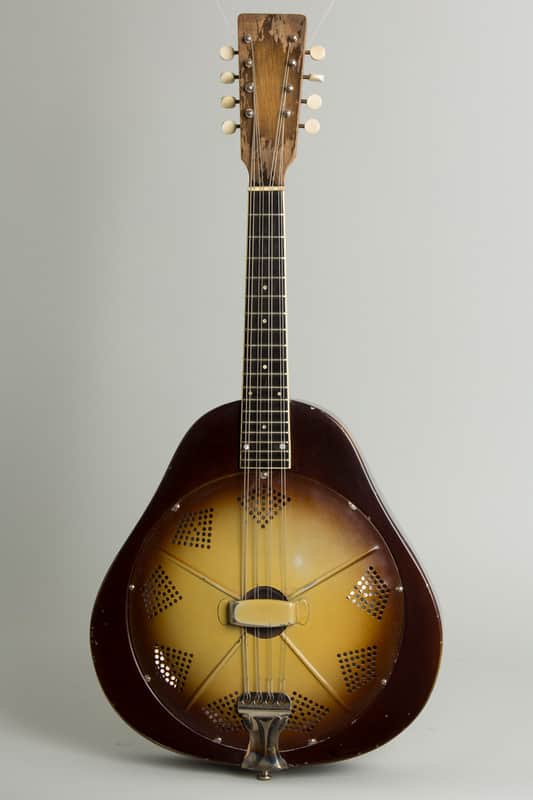
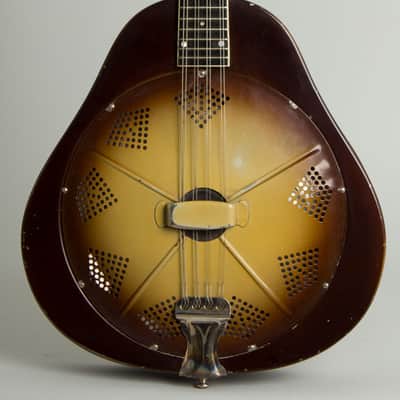
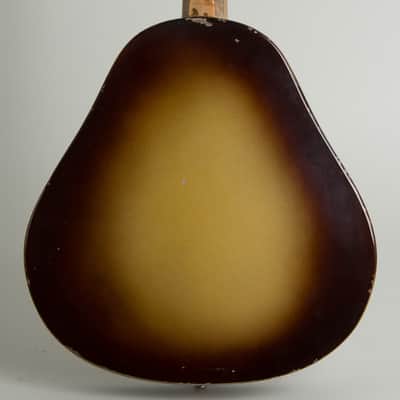
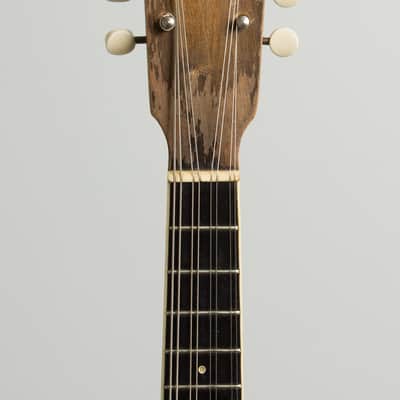
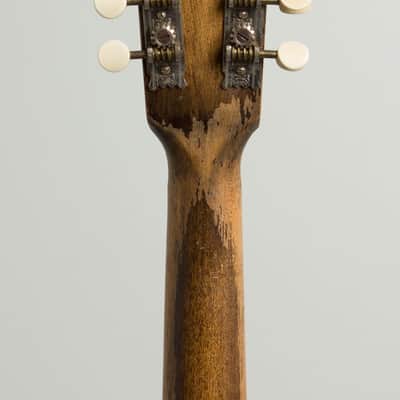
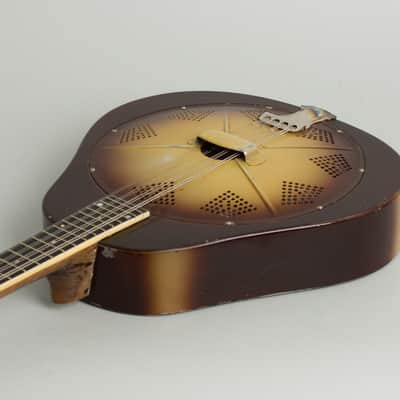
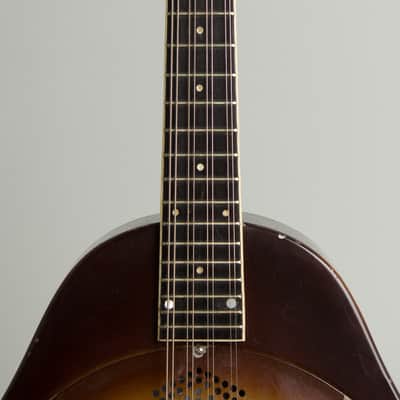
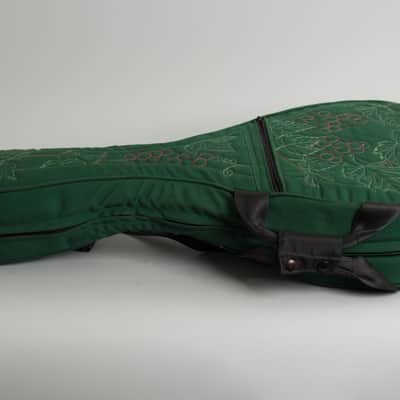
National Triolian Resophonic Mandolin (1930), ser. #503W, gig bag case.
Price$2,500
+ $150 Shipping
Listed:18 days ago
Views:143
Saves:18
Offers:0

Brooklyn, NY, United States
Our users rate Reverb
National Triolian Model Resophonic Mandolin (1930), made in Los Angeles, California, serial # 503W, brown sunburst enamel finish, steel body, basswood neck with ebonized fingerboard, gig bag case.
This is a moderately well-used but fine playing early example of a walnut-finish National Tirolian Mandolin, from 1930, not long after these were introduced. The Triolian Mandolin was the most popular of the California company's depression-era 8-string creations, although none of them are exactly common. With a retail price of $40.00 in the early 1930's, this steel-bodied machine offered a lot of sonic firepower for the player's hard-earned money and sold decently considering the limited market for mandolins at the time.
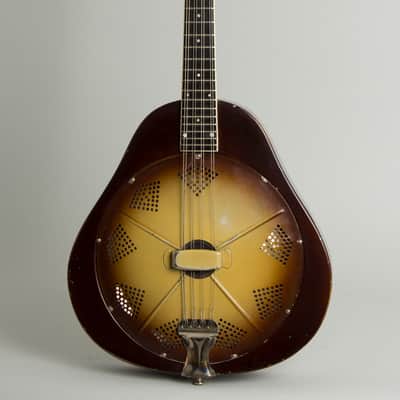
The design is simple with a somewhat pear-shaped steel body carrying a single resonator cone with a basswood neck topped by a bound ebonized fingerboard. The sprayed shaded brown enamel finish was described as "Walnut" by National, beginning their quirky tradition of finishing metal-bodied instruments to look vaguely like wood! This early example still has nicer '20s style strip tuners on the simple squared-odd headstock. When pushed hard this is one of the loudest mandolins you will ever hear, but played more softly has a surprisingly rich bell-like tone. It is perfect for ragtime and jugband styles, and really any non-bluegrass mandolin applications.
Overall length is 27 1/2 in. (69.8 cm.), 12 3/4 in. (32.4 cm.) width, and 2 3/4 in. (7 cm.) deep. Scale length is 15 in. (381 mm.). Width of nut is 1 1/4 in. (32 mm.).
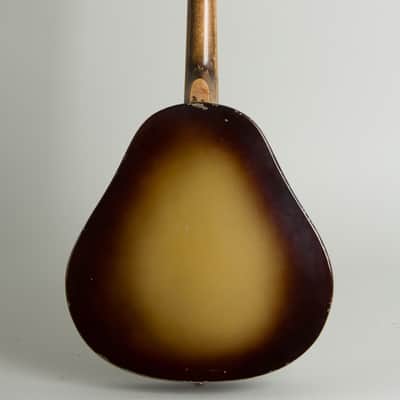
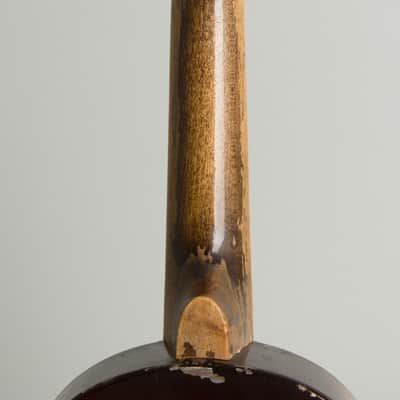
This is a decently well preserved instrument overall, a fine player that is well worn in some areas and fairly clean in others. The thin lacquer neck finish has worn and flaked away heavily in an odd pattern, gone from both sides and the heel, as well as much of the headstock likely due to exposure to moisture long ago. Oddly enough the center of the back of the neck and both sides of the headstock survived; the headstock decal is entirely gone.
The enamel body finish has survived in cleaner shape; there are dings, chips and some small areas of rubbing down to the metal but no large areas of loss. The handrest has lost just a bit of the enamel finish off of its edges, less than most and there is also only light pickwear to the coverplate. The hardware remains original, the tailpiece has been repaired along the bend at the body as most have; that habitually shear there. The metalwork on that fix is solid but not the prettiest.
The original frets have some light wear but play fine; the neck has been recently reset making this an excellent player, very loud yes but with a rounder and more fluid tone than some. It includes a curious green gig bag that is quite functional (these are hard to fit in conventional cases). Overall Very Good + Condition.
This is a moderately well-used but fine playing early example of a walnut-finish National Tirolian Mandolin, from 1930, not long after these were introduced. The Triolian Mandolin was the most popular of the California company's depression-era 8-string creations, although none of them are exactly common. With a retail price of $40.00 in the early 1930's, this steel-bodied machine offered a lot of sonic firepower for the player's hard-earned money and sold decently considering the limited market for mandolins at the time.
The design is simple with a somewhat pear-shaped steel body carrying a single resonator cone with a basswood neck topped by a bound ebonized fingerboard. The sprayed shaded brown enamel finish was described as "Walnut" by National, beginning their quirky tradition of finishing metal-bodied instruments to look vaguely like wood! This early example still has nicer '20s style strip tuners on the simple squared-odd headstock. When pushed hard this is one of the loudest mandolins you will ever hear, but played more softly has a surprisingly rich bell-like tone. It is perfect for ragtime and jugband styles, and really any non-bluegrass mandolin applications.
Overall length is 27 1/2 in. (69.8 cm.), 12 3/4 in. (32.4 cm.) width, and 2 3/4 in. (7 cm.) deep. Scale length is 15 in. (381 mm.). Width of nut is 1 1/4 in. (32 mm.).
This is a decently well preserved instrument overall, a fine player that is well worn in some areas and fairly clean in others. The thin lacquer neck finish has worn and flaked away heavily in an odd pattern, gone from both sides and the heel, as well as much of the headstock likely due to exposure to moisture long ago. Oddly enough the center of the back of the neck and both sides of the headstock survived; the headstock decal is entirely gone.
The enamel body finish has survived in cleaner shape; there are dings, chips and some small areas of rubbing down to the metal but no large areas of loss. The handrest has lost just a bit of the enamel finish off of its edges, less than most and there is also only light pickwear to the coverplate. The hardware remains original, the tailpiece has been repaired along the bend at the body as most have; that habitually shear there. The metalwork on that fix is solid but not the prettiest.
The original frets have some light wear but play fine; the neck has been recently reset making this an excellent player, very loud yes but with a rounder and more fluid tone than some. It includes a curious green gig bag that is quite functional (these are hard to fit in conventional cases). Overall Very Good + Condition.
Reverb Buyer Protection
Reverb has your back if your item is lost, damaged, or doesn't match its description. Simply report any issues within 7 days and we'll help you get a full refund.Learn more about Reverb Buyer Protection.
| Listed | 18 days ago |
|---|---|
| Condition | Very Good (Used) Very Good items may show a few slight marks or scratches but are fully functional and in overall great shape.Learn more |
| Brand | |
| Model |
|
| Finish |
|
| Categories | |
| Year |
|
Product safety information may be available here.

