


Tomkat Cloudy, 2020ish • Clouds of granular mutability!

Our users rate Reverb
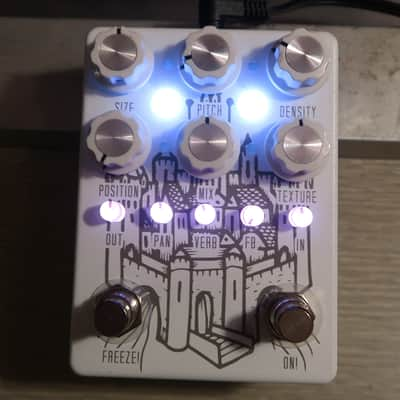
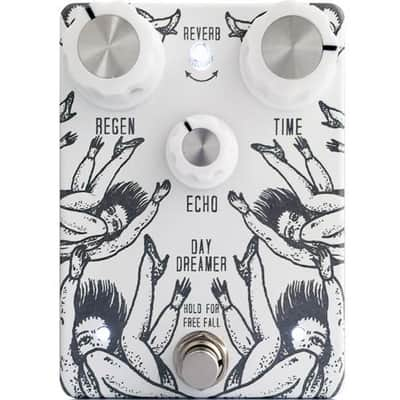
Absolutely mint, as new, in original packaging. Aesthetically beautiful pedal, with subtle matte pebble texture finish and complementary knobs, castle graphic in gloss grey, clear and legible labels, classy logotype, numerous backlit knobs. Super build quality.
And I guess I have it priced so high because I don't think I've played with it enough to wring it out, and I really don't want to sell it. Consider this an ad for the Tomkat in general, and buy one from someone selling it a reasonable price.
But what is it?
In short, it's a pedal-based implementation of Mutable Instrument's Clouds Eurorack synth module, offering granular synthesis, pitch shifting, delay, and reverb with filters and resonators. It is focused on realtime granularization of incoming audio signals and their transformation into amorphous textures. Grains of adjustable size, pitch and envelope are extracted at controllable time offsets from the input signal. Grains are dropped back into the flow randomly, periodically, or whenever the module receives a trigger.
In other words, it turns your signal into grains of adjustable size, then lets you do all manner of seemingly magical things with them, creating everything from pitch clouds to ever-shifting harmonic rainbow bridges. In beautiful stereo!
If you're a sonic experimenter, ready and willing to go deep, this one will reward your time and effort. And because it's such a deep and rich ride, it deserves full description here. Nothing said so far gives the full picture. So I'm appending a streamlined version of the manual. Reading it will give you some ideas - and if you can't stick with reading it through, this pedal is probably not for for you. (Random knob twisting on this one is a road to frustration.)
_____
Functions common to all modes:
• IN sets the input level; OUT sets the output volume
• PAN: Sets the amount of random panning/balance applied to the grains. Only noticeable with stereo output.
• VERB: Adds reverb to both wet and dry signal. It’s a global effect so even when mix is 100% dry you can still control the amount of reverb.
• FB: Amount of signal feedback. Noticeable with higher POSITION value. Watch out because things can get out of hand. If you have tons of crazy feedback happening and the pedal seems like its getting away from you, just turn FB all the way down.
Mode 1: GRANULAR PROCESSOR
Cloudy is a granular audio processor. It creates textures and soundscapes by combining multiple overlapping, delayed, transposed and enveloped segments of sound taken from an audio recording buffer.
• DENSITY: This is the main control knob for the density of grains produced. At 12 o’clock it produces no grains, which means you won’t hear any effect. Turn clockwise and grains will be sown randomly, counter-clockwise and they will be played at a constant rate. The further you turn in either direction, the more overlap between grains. By setting grain DENSITY to 12:00 and sending a trigger input, Cloudy can be controlled like a micro-sample player.
• SIZE: Controls the size of the grains produced. Clockwise the grains are larger; counter clockwise they get very tiny.
• POSITION: Selects from which part of the recording buffer the audio grains are played. Acts like a delay time control.
• TEXTURE: Morphs through various shapes of grain envelopes. Before 12:00 the grains are noisier. Passing 2:00 activates a diffuser which smears transients.
• PITCH: Changes the pitch (transposition) of the grains. 12 o’clock is normal pitch.
• MIX: Dry signal CCW; wet signal CW
In normal quality setting (best quality stereo) there is one second of recorded audio buffer, basically up to one second of delay time if the POSITION knob is turned all the way clockwise. In other quality modes the delay can be longer and in the lowest quality mode (low quality mono) the buffer is 8 seconds and if the POSITION knob is all the way clockwise you won’t hear you repeats until after 8 seconds of playing. This gets a little confusing, but it's fun too. This low quality has a real tape-like feel to it, for adventures in early Frippertronics.
Mode 2: PITCH SHIFTER/TIME STRETCHER
This mode is similar to the granular mode, except that it uses two overlapping grains synchronized with the most salient period of the sound. The grains are carefully spliced so that they mesh well with each other (a technique similar to the “deglitching” of early pitch-shifters).
• POSITION: modulating this when recording is frozen will “scrub” through the audio buffer. Clouds uses classic time-domain methods, unsuitable for polyphonic or percussive material (unless this percussive material is breakbeats and you liked Akai samplers.) If you turn POSITION all the way down, MIX all the way up (100% wet) and change the PITCH, it will transpose what you're playing.
• DENSITY creates a granular diffusion effect based on all-pass filters.
• TEXTURE acts as a low-pass/high-pass filter. 12 o’clock there is no filter.
• SIZE controls the width of the overlapping windows used for pitch-shifting and time-stretching – from an extremely grainy “drilling” sound to smooth bits of loops.
Mode 3: LOOPING DELAY
This mode continuously plays back audio from the buffer without any kind of granularization.
• POSITION controls the distance between the playback head and the recording head (in other words, the delay time). Modulating POSITION will create effects similar to vinyl scratching or manual manipulation of tape.
• FREEZE, when activated, loops the content of the audio buffer for a stutter effect. POSITION controls the loop start and SIZE the loop duration. While FREEZE is active, if you press and hold the FREEZE switch until the small pink knobs start blinking, the loop will play back in reverse. (To go back to forward direction just hold FREEZE until the knobs stop blinking.)
• DENSITY creates a granular diffusion effect based on all-pass filters.
• TEXTURE acts as a low-pass/high-pass filter (off at 12 o’clock).
• SIZE controls the width of the overlapping windows used for pitch-shifting – fully clockwise for a smooth result that might smear transients, fully counterclockwise for a grainy, almost ring-modulated sound.
• When FREEZE is enabled, sending a trigger on the TRIG input creates a clock-synchronized stuttering loop. Otherwise, the period of the trigger pulses sets the delay time – provided this delay is shorter than the recording buffer size.
Mode 4: SPECTRAL MADNESS
In this mode, the incoming signal is converted into “frames” of spectral data, that are stored, transformed, recombined, and re-synthesized as a time-domain signal.
• POSITION selects into which buffer the audio is poured (when FREEZE is not active), or from which buffer the audio is synthesised (when FREEZE is active). For example, set POSITION to its minimum value. Press FREEZE. You get a first texture.
Set POSITION to its maximum value. UNFREEZE. Wait for something else to happen in the incoming audio. Press FREEZE again.
By moving POSITION you interpolate between the two textures which were captured at the press of FREEZE. Depending on the quality settings there are 2 to 7 buffers laid out over the course of the POSITION knob. The module crossfades between a “wavetable” of FFT slices.
• SIZE changes the coefficients of a polynomial that determines how frequencies are mapped between the analysis and synthesis buffers. It’s like a 1-knob GRM Warp. Over the course of the knob it’ll do spectral shifting, but also spectral reversal.
• PITCH controls the transposition (pitch-shifting).
• DENSITY determines how results from the analyzer are passed to the re-synthesizer. Below 12 o’clock, there’s some increasing probability that a given FFT bin won’t get updated, causing a kind of partial freeze. After 12:00, adjacent "analysis frames" are increasingly merged together (like a low-pass filter in the amplitude of each frequency bin). At extreme settings, random phase modulation is applied to smooth things - giving you different flavours of spectral muddling/reverb.
• TEXTURE does two things. Below 12:00, it increasingly quantizes the amplitudes of the spectral components, like applying a very low-bitrate to an audio file. After 12:00, it progressively weakens the strongest partials and amplifies the weakest ones. This has the effect of making the spectrum more noise-like.
Sending a trigger to the TRIG input creates various frequency-domain glitches typical of corrupted (encoded) audio files. It works as a kind of build-up/feedback effect - the shorter the pulse, the smaller the effect. With a continuous gate, it’ll really start to rot…
Mode 5: EMMIVERB
• POSITION: Pre-delay. Controls the time it takes for the reverb to kick in after a sound has gone in (from 0 to about half a second).
When a clock is fed to the Trig input, this knob becomes a clock divider/multiplier for the pre-delay: at 12 o'clock, the pre-delay takes the value of the clock length; clockwise, this clock is divided, and counter-clockwise it is multiplied
• SIZE: Reverb Size. Controls the lengths of all the delays internal to the reverb, i.e. the size of the emulated room. It varies from a small resonator to a huge hall.
• DENSITY: Decay. Controls the amount of sound fed back into the reverb loop, i.e. the decay time of the reverb tail. Beyond 3:00, this signal is actually amplified and the reverb enters self-oscillation.
• PITCH: Pitch shift. Each time the sound is fed back into the reverb, it can be pitch shifted. The Pitch knob controls shift from -1 to +1 octaves. At 12:00, no pitch shifting is applied; fully clockwise, we get the classic shimmer effect. Lots of oddities can be found in between. To hear the effect of the pitch shifter, some sound has to fed back by increasing Decay. Note that Size has an impact on how well the sound is pitch-shifted: the larger the room size, the more accurate the pitch shift.
• TEXTURE: Dampening. Controls the dampening of the reverb. From fully CCW to 12:00, a low-pass filter is applied, simulating absorption in a room. From 12:00 to fully CW, a high-pass filter is applied for unusual, crystalline effects.
• FREEZE sets reverb to (near) infinite decay, and mutes the input. This works best with no pitch shifting and a large size.
• PAN: Diffusion. Controls how much the sound is smoothed by the diffusers each time it goes through the loop. Fully clockwise, you get a more dense, continuous sound; fully counter-clockwise, you clearly hear the sound being repeated, like in a multi-tap delay.
• VERB: Modulation amount. Controls the amount of modulation applied by the LFOs to the delay time. Small modulations result in subtle chorus and ghost tones, large modulations in random pitch shifts.
• FB: Modulation speed. Controls the speed of these LFOs. It ranges from ~1/100Hz to ~100Hz. It has no effect if modulation amount is null.
Mode 6: RESONESTOR
Start with knobs in the following positions:
• MIX, SIZE, DENSITY, REVERB and FEEDBACK fully CCW
• PITCH, POSITION, and TEXTURE at 12 o'clock
• PAN fully CW
Input feeds the voice/resonator, with decay controlled by the DENSITY knob.
The pitch of the resonator is controlled by the PITCH knob. Each voice consists of four "parts" (four resonators), which can be set to different pitches to form chords. The SIZE knob sets the chord.
The resonators can sound very metallic; the TEXTURE knob helps attenuate the high/low frequencies each time sound passes through the resonator. At 12:00, no filtering is applied; CCW is a low-pass filter; CW is a band-pass filter. This way, a short sound impulse passing through the resonator will have a long decay with less and less high (and possibly low) frequency.
Sending a trigger to the Trig input will send a short burst of noise to one of the voices. The Position knob controls the timbre and duration of this burst, roughly modeling the position at which the string is struck.
Each time a Trig is received, the module switches the active voice; therefore, you can get duophony. At any time, the knobs (pitch, chord, feedback, damping) control only the parameters of the resonators of the active voice; the other voice keeps the last parameters to which it was set. If you are satisfied with the sound of the current voice and want to keep it running (maybe as a drone, using the other voice for melody), press Freeze: it will instantly switch voice, and prevent Trig from automatically switching voice.
• Decay (DENSITY knob): Decay time of the current voice. Beyond approx. 3:00, decay is infinite and the sound sustains forever (you can use it as a traditional oscillator).
• Pitch (PITCH knob): Base pitch of the current voice. At 12:00, the pitch is A3 (220Hz).
• Chord (SIZE knob): Chord selection for the current voice. Morphs gradually between Unison, Fat, Superfat, Fat power, Fat octave, Octaves, Power, Major, Major7, Minor7, Minor, Sus2, Sus4, Minor9, Major9, Minor11, Major11, and Major11.
• Dampening (TEXTURE knob): Controls filtering in the feedback loop of the resonator. At 12:00, no filtering is applied; CCW, a low-pass filter is applied with a increasingly low cutoff frequency; CW, a band-pass filter at the frequency of the resonator is applied with an increasingly high resonance.
• POSITION: Controls the timbre and duration of the noise burst. CCW, it will be longer and more dampened; CW, it will be shorter and more high pitched. At both ends of the knob, the burst will be inaudible (too damped or too short), which you can use to "mute" a voice.
• Distortion (MIX knob): Randomly distorts the timbre of the voices by modulating each comb filter by low pass-filtered noise. Fully CCW, the modulation amount is maximum but the noise is filtered out entirely, so there is no effect. Fully CW, the noise is unfiltered, but the modulation amount is null, so there is no effect. In between, you get interesting effects, from subtle swaying to harsh distortion.
• Stereo output (PAN knob): Assigns each part and voice to an output (Out L or Out R). Fully CCW, each voice goes to a different output. At 12:00, both voices are equally mixed in both output. Fully CW, parts of both voices are distributed on both outputs for a wide stereo effect.
• Harmonics (FB knob): Simulates striking the harmonics on a string. Fully CCW, it has no effect. Fully CW, the second harmonic will ring; at 12:00, the third; at 10:00, the fourth, etc.
• Scatter (VERB knob): Controls the random delay times before the sound (input or burst) hits each resonator of the current voice. Used for Karpluss-Strong synthesis with a chord, this will give the impression that strings are struck sloppily. The delay times are randomized at each voice switch.
Reverb Buyer Protection
Reverb has your back if your item is lost, damaged, or doesn't match its description. Simply report any issues within 7 days and we'll help you get a full refund.Learn more about Reverb Buyer Protection.
| Listed | 2 years ago |
|---|---|
| Condition | Mint (Used) Mint items are in essentially new original condition but have been opened or played.Learn more |
| Brand | |
| Model |
|
| Finish |
|
| Categories | |
| Year |
|
| Made In |
|
Product safety information may be available here.


