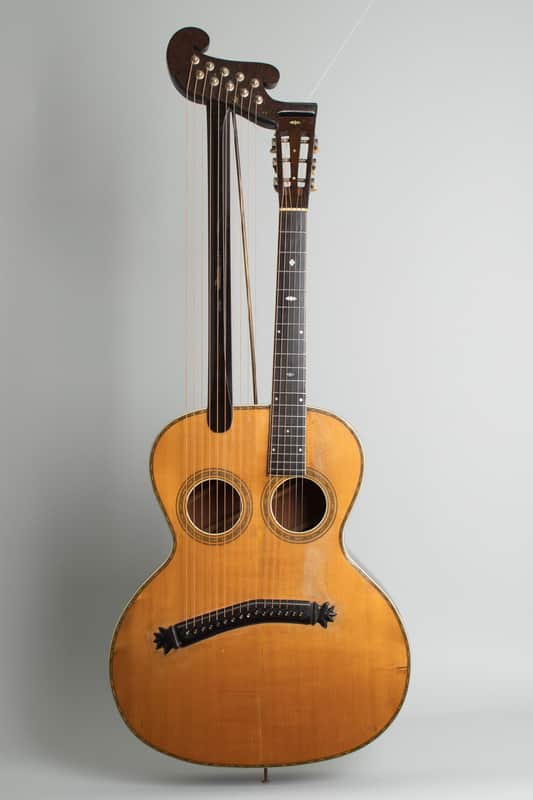
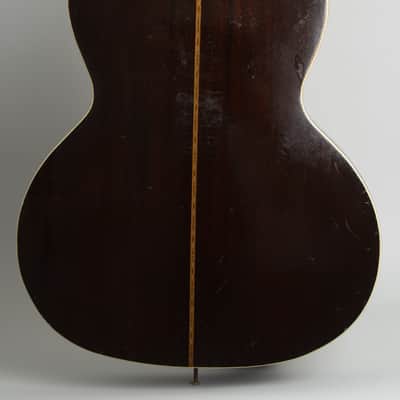
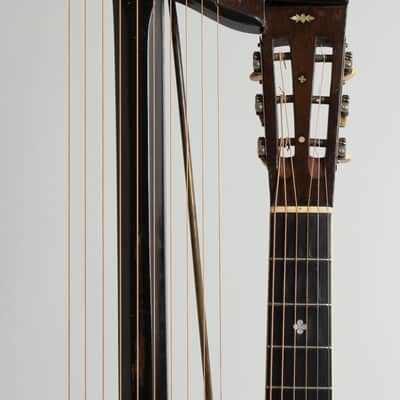
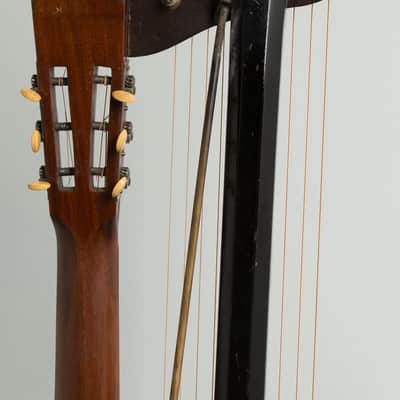
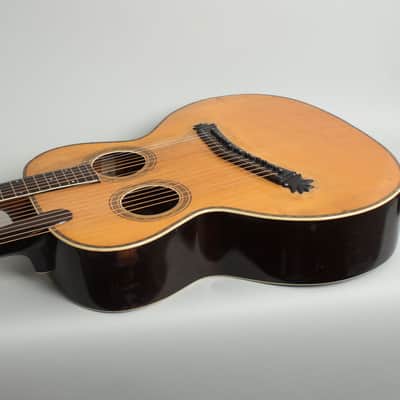
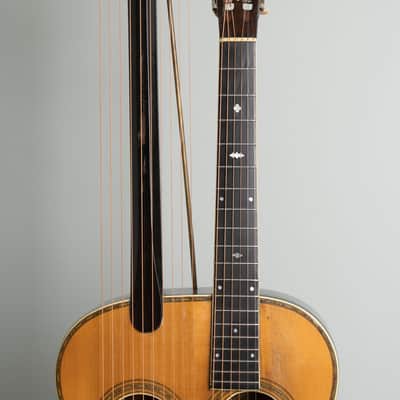
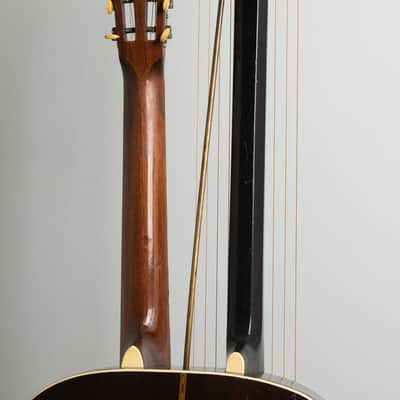
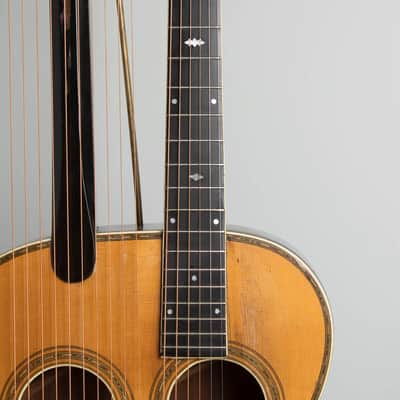
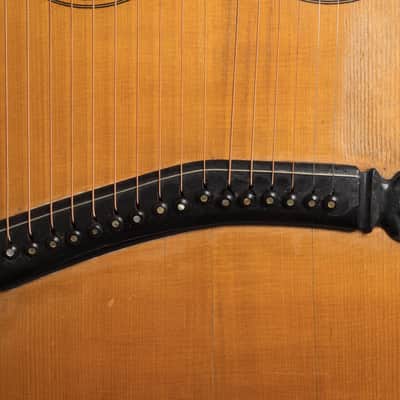
Stahl 10 Sub-Bass Harp Guitar, made by Larson Brothers, c. 1912, NO CASE case.
Price$12,500
+ $300 Shipping
Listed:23 days ago
Views:125
Saves:11
Offers:0

Brooklyn, NY, United States
Our users rate Reverb
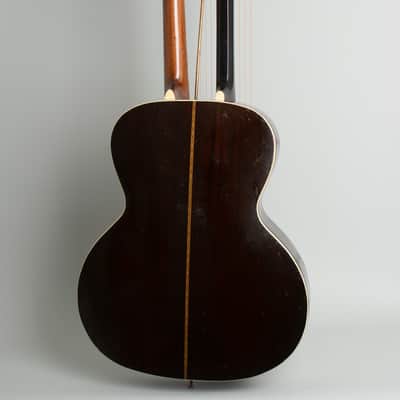
Stahl 10 Sub-Bass Model Harp Guitar, made by Larson Brothers, c. 1912, made in Chicago, natural finish, mahogany back and sides, spruce top; mahogany necks with ebony fingerboard.
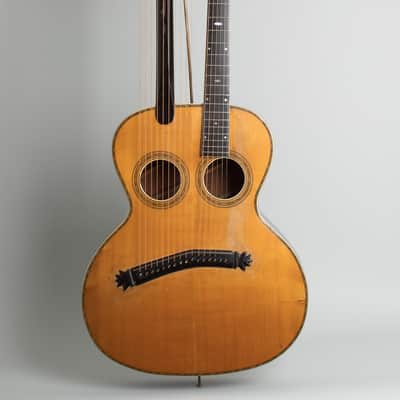
This imposing Stahl-branded 16 string harp guitar is, as far as we know, completely unique. That's not just us; harp guitar Svengali Gregg Miner avers he has never seen another like it, and he has seen more of them than anyone! Nearly 20" wide, with dual round soundholes and 10 sub-bass strings supported on a solid wood stalk rising out of the body this graceful behemoth is sure to stop traffic anywhere it appears!
Although not so branded this guitar is the work of brother luthiers Carl and August Larson. From the beginning of the 20th century up until WWII, the Larsons' small Chicago workshop turned out a dizzying assortment of exceptionally well-crafted fretted instruments, but never with their name on them. Much of their output was sold by others labeled with various brands; they originally used the "Maurer" brand on instrument sold by themselves. When building to order the Larsons made whatever was requested, but always to their own high standards.
One of their largest accounts was William C. Stahl of Milwaukee, a virtuoso mandolin player turned to teaching and publishing. Around 1906 the Larsons began supplying instruments to Stahl who claimed himself as the maker, a deception common in this "patent medicine" era. The Larsons built a steady stream of mandolins and guitars for him up into the 1930s. If Carl and August seemed indifferent to promotion William Stahl was the opposite: garrulous, confident and endlessly chatty.
Stahl's verbose 1910s ads scoff at "machine-made" instruments, insisting his are strictly "handmade ... reasonable in price and perfect as human hands can make them" built under his "personal supervision". This would have been quite a trick, as the Larsons were in Chicago while Stahl's offices were in Milwaukee! While primarily promoted mandolins, Stahl also sold a decent proportion of guitars, including a VERY few harp guitars. In 1912 he advertised an instrument similar to this one but with a single oval soundhole at a price of $100; Stahl particularly disliked Gibsons, and takes several veiled digs at their designs in the ad copy.
Based on Gregg Miner's research this is a fairly early Larson/Stahl instrument dating to around 1912. It appears designed for the "Boehm system" (of harp guitar tuning, not flute!) championed by virtuoso Walter Boehm. This more complex "re-entrant" harp guitar tuning was heavily promoted specifically for Gibson Harp guitars in the late 'aught years; one wonders if Gibson-hater Stahl took this order as a challenge! For those interested an exhaustive treatise on Boehm's history (including an analysis of this actual instrument) by Gregg Miner can be found here:
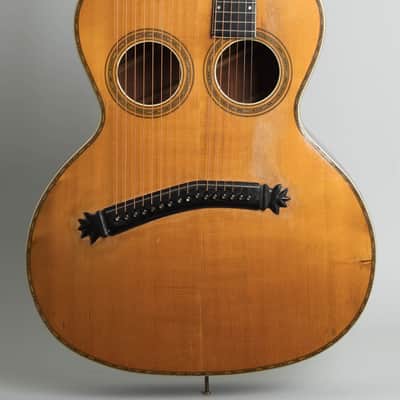
This imposing guitar features some of the Larson's typical characteristics while adding ideas drawn from other sources. They were no strangers to the harp guitar world, building both their own "double bodied" twin-neck designs and the "Symphony Harp" models for Dyer with an extended upper body. This one is different from either, with a conventionally shaped body just under 20" wide. The back and sides are mahogany finished in a very dark semi-faux-rosewood look. The expansive top is red spruce; it must have been quite difficult to find pieces large enough. There is a noticeable grain flaw in the spruce at the apex of the lower treble bout; one wonders if Stahl might have complained about that!
The top has dual round soundholes, an unusual configuration Miner believes was adapted from an earlier Harwood instrument (made by Jenkins of Kansas City) dating to around 1900. The elaborate angled ebony bridge with carved ends is also closely patterned on the Harwood design, although mounted higher on the body. The top and back bracing are quite extensive although not done with the Larson's patented laminate-brace system. The pattern is specific to this guitar using quite heavy pieces of spruce as the twin soundholes do not leave much top wood in the crucial area! The top and back are built with the Larson's trademark subtle arching and have held up well for over a century.
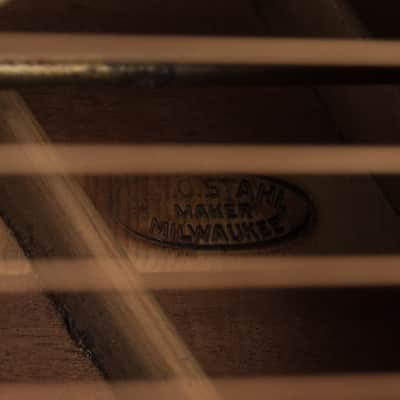
The top is bound in ivoroid and bordered with colored wood marquetry, also inlaid around the circumference of the sound hole rims. The "play" neck is one piece mahogany, slim with the hint of a soft "V" profile the Larsons stopped using by the 1920s. It still has a surprisingly supple modern feel for 110+ years old. The thick ebony fingerboard is bound with grained ivoroid and inlaid with small shaped pearl pieces. The slotted headstock is overlaid with Brazilian rosewood inlaid with small pearl doodads on the face. The tuners are period Handel strips with ivoroid buttons also seen on period Martin and Gibson guitars. The Wm. Stahl brand is hot-stamped into the inner back.
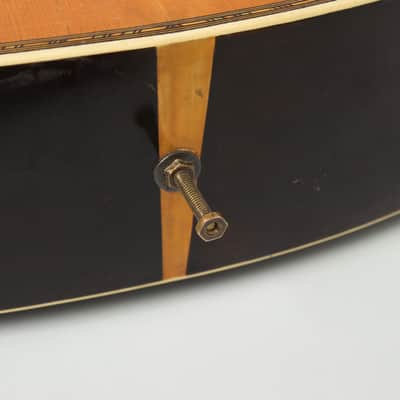
The 10 sub-bass strings are supported by a heavy solid wood arm capped with a sculpted pegholder solidly glued to the headstock. The tuners are Gibson-like zither style pegs that require a key to tune. A long metal shaft is run from the back of this pegbox all the way through the guitar and is adjustable for tension at the bottom end; this actually can adjust the action to a limited degree. This fitting is an improvement on the turnbuckle system Gibson was using and a fascinating precursor to the similar neck adjusting systems August Larson patented and used in the 1920s and '30s on the brothers' own Prairie state branded guitars.
This is a simply huge, physically and sonically imposing guitar, a truly fine representation of the Larson's artistry. The most likely explanation for its existence is someone had an older Harwood harp guitar and ordered a similar instrument from Stahl, but set up in the newer Boehm tuning system then used by Gibson. As far as we can tell, this is the only instrument ever built to this pattern. Well over a century along this is an amazing survivor of the harp guitar's finest era and a quite playable, exceptional sounding instrument.
Overall length is 51 in. (129.5 cm.), 19 7/8 in. (50.5 cm.) wide at lower bout, and 4 13/16 in. (12.2 cm.) in depth at side, taken at the end block. Scale length is 25 1/2 in. (648 mm.). Width of nut is 1 7/8 in. (48 mm.).
This guitar has seen a decent amount of wear and repair over the last 110+ years but is fully playable and remains pretty much all original. The very thin finish remains largely original showing topical touch up around various repairs and worn spots on the top, sides and neck but no wholesale overspray. There is considerable wear including dings, dents and scrapes ov
This imposing Stahl-branded 16 string harp guitar is, as far as we know, completely unique. That's not just us; harp guitar Svengali Gregg Miner avers he has never seen another like it, and he has seen more of them than anyone! Nearly 20" wide, with dual round soundholes and 10 sub-bass strings supported on a solid wood stalk rising out of the body this graceful behemoth is sure to stop traffic anywhere it appears!
Although not so branded this guitar is the work of brother luthiers Carl and August Larson. From the beginning of the 20th century up until WWII, the Larsons' small Chicago workshop turned out a dizzying assortment of exceptionally well-crafted fretted instruments, but never with their name on them. Much of their output was sold by others labeled with various brands; they originally used the "Maurer" brand on instrument sold by themselves. When building to order the Larsons made whatever was requested, but always to their own high standards.
One of their largest accounts was William C. Stahl of Milwaukee, a virtuoso mandolin player turned to teaching and publishing. Around 1906 the Larsons began supplying instruments to Stahl who claimed himself as the maker, a deception common in this "patent medicine" era. The Larsons built a steady stream of mandolins and guitars for him up into the 1930s. If Carl and August seemed indifferent to promotion William Stahl was the opposite: garrulous, confident and endlessly chatty.
Stahl's verbose 1910s ads scoff at "machine-made" instruments, insisting his are strictly "handmade ... reasonable in price and perfect as human hands can make them" built under his "personal supervision". This would have been quite a trick, as the Larsons were in Chicago while Stahl's offices were in Milwaukee! While primarily promoted mandolins, Stahl also sold a decent proportion of guitars, including a VERY few harp guitars. In 1912 he advertised an instrument similar to this one but with a single oval soundhole at a price of $100; Stahl particularly disliked Gibsons, and takes several veiled digs at their designs in the ad copy.
Based on Gregg Miner's research this is a fairly early Larson/Stahl instrument dating to around 1912. It appears designed for the "Boehm system" (of harp guitar tuning, not flute!) championed by virtuoso Walter Boehm. This more complex "re-entrant" harp guitar tuning was heavily promoted specifically for Gibson Harp guitars in the late 'aught years; one wonders if Gibson-hater Stahl took this order as a challenge! For those interested an exhaustive treatise on Boehm's history (including an analysis of this actual instrument) by Gregg Miner can be found here:
This imposing guitar features some of the Larson's typical characteristics while adding ideas drawn from other sources. They were no strangers to the harp guitar world, building both their own "double bodied" twin-neck designs and the "Symphony Harp" models for Dyer with an extended upper body. This one is different from either, with a conventionally shaped body just under 20" wide. The back and sides are mahogany finished in a very dark semi-faux-rosewood look. The expansive top is red spruce; it must have been quite difficult to find pieces large enough. There is a noticeable grain flaw in the spruce at the apex of the lower treble bout; one wonders if Stahl might have complained about that!
The top has dual round soundholes, an unusual configuration Miner believes was adapted from an earlier Harwood instrument (made by Jenkins of Kansas City) dating to around 1900. The elaborate angled ebony bridge with carved ends is also closely patterned on the Harwood design, although mounted higher on the body. The top and back bracing are quite extensive although not done with the Larson's patented laminate-brace system. The pattern is specific to this guitar using quite heavy pieces of spruce as the twin soundholes do not leave much top wood in the crucial area! The top and back are built with the Larson's trademark subtle arching and have held up well for over a century.
The top is bound in ivoroid and bordered with colored wood marquetry, also inlaid around the circumference of the sound hole rims. The "play" neck is one piece mahogany, slim with the hint of a soft "V" profile the Larsons stopped using by the 1920s. It still has a surprisingly supple modern feel for 110+ years old. The thick ebony fingerboard is bound with grained ivoroid and inlaid with small shaped pearl pieces. The slotted headstock is overlaid with Brazilian rosewood inlaid with small pearl doodads on the face. The tuners are period Handel strips with ivoroid buttons also seen on period Martin and Gibson guitars. The Wm. Stahl brand is hot-stamped into the inner back.
The 10 sub-bass strings are supported by a heavy solid wood arm capped with a sculpted pegholder solidly glued to the headstock. The tuners are Gibson-like zither style pegs that require a key to tune. A long metal shaft is run from the back of this pegbox all the way through the guitar and is adjustable for tension at the bottom end; this actually can adjust the action to a limited degree. This fitting is an improvement on the turnbuckle system Gibson was using and a fascinating precursor to the similar neck adjusting systems August Larson patented and used in the 1920s and '30s on the brothers' own Prairie state branded guitars.
This is a simply huge, physically and sonically imposing guitar, a truly fine representation of the Larson's artistry. The most likely explanation for its existence is someone had an older Harwood harp guitar and ordered a similar instrument from Stahl, but set up in the newer Boehm tuning system then used by Gibson. As far as we can tell, this is the only instrument ever built to this pattern. Well over a century along this is an amazing survivor of the harp guitar's finest era and a quite playable, exceptional sounding instrument.
Overall length is 51 in. (129.5 cm.), 19 7/8 in. (50.5 cm.) wide at lower bout, and 4 13/16 in. (12.2 cm.) in depth at side, taken at the end block. Scale length is 25 1/2 in. (648 mm.). Width of nut is 1 7/8 in. (48 mm.).
This guitar has seen a decent amount of wear and repair over the last 110+ years but is fully playable and remains pretty much all original. The very thin finish remains largely original showing topical touch up around various repairs and worn spots on the top, sides and neck but no wholesale overspray. There is considerable wear including dings, dents and scrapes ov
Reverb Buyer Protection
Reverb has your back if your item is lost, damaged, or doesn't match its description. Simply report any issues within 7 days and we'll help you get a full refund.Learn more about Reverb Buyer Protection.
| Listed | 23 days ago |
|---|---|
| Condition | Very Good (Used) Very Good items may show a few slight marks or scratches but are fully functional and in overall great shape.Learn more |
| Brand | |
| Model |
|
| Finish |
|
| Year |
|
Product safety information may be available here.

