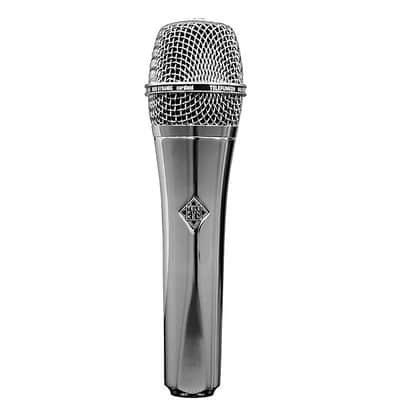
Telefunken M80 Red Dynamic Supercardioid Handheld Vocal Microphone — Red Finish


Telefunken M80 Red Dynamic Supercardioid Handheld Vocal Microphone — Red Finish

Spedizione in 2 giorni gratuita


Politica per i resi entro 30 giorni
Concediti il massimo della tranquillità con il tuo nuovo strumento
I nostri utenti valutano Reverb
The Telefunken M80 is the handheld dynamic vocal microphone the touring world reaches for when an SM-class dynamic isn't capturing enough top end. A 25 mm dynamic moving-coil capsule paired with an ultra-thin low-mass diaphragm gives the M80 transient response closer to a small-diaphragm studio condenser than to a typical stage dynamic — 3 kHz of additional top-end air without an external EQ boost. A supercardioid polar pattern keeps the gain-before-feedback margin that working live engineers demand from a dynamic. A custom American-wound Telefunken T80 output transformer auto-matches impedance to the preamp and contributes the forward midrange that has made this microphone a touring staple. This is the red-finish variant: red powder-coat body paired with a chrome-plated head grille. The red finish is a high-visibility choice — touring vocalists who want a distinct stage-presence mic, worship leads who want a visual focal point for the audience, and band productions assigning specific finishes to specific singers all reach for the red M80 for the same visual reasons. The capsule, electronics, and acoustic performance are identical across every M80 finish — this is the same M80 capsule that ships on the standard chrome-grille version, with the same touring-grade build and the same broadcast-condenser top-end air.
Condenser-Like Clarity From a Stage-Rugged DynamicThe M80's 25 mm moving-coil capsule is engineered with an exceptionally low-mass diaphragm — that's the mechanical key that lets a dynamic capture transient detail typically reserved for studio condensers. On a vocalist with breathy articulation, sibilant consonants, or chest-voice harmonics, the M80 passes through the texture instead of smoothing it. On a guitar cab close-mic position where engineers historically reach for a small-diaphragm dynamic like an SM57, the M80 reads with more brightness and articulation, especially on the top end where pick attack and string transient detail live. On a snare top, the M80's combination of fast transient response and 135 dB max SPL handling gives the engineer a more open snare tone than a typical handheld dynamic. Live engineers have been adopting the M80 across vocal channels, snare top, snare bottom, and guitar cab positions for over a decade — the spec sheet underwrites the choice, but it's the audible difference at the desk that earns the repeat purchase.
Supercardioid Pattern with Touring-Grade Feedback RejectionA supercardioid pattern is tighter than a cardioid — the null position moves from 180 degrees (directly behind the mic) to roughly 110-120 degrees off-axis, while the on-axis lobe narrows. For a vocalist on a loud stage with wedge monitors angled in from the front, the supercardioid null is exactly where the wedge sits. The result is dramatically more gain-before-feedback margin than a typical cardioid handheld, especially in rooms with reflective surfaces. The capsule geometry also tames proximity-effect bass buildup — a vocalist who works the mic close (a common stage technique for intimacy on quieter passages) doesn't pump muddy low-mid into the channel the way cheaper dynamics do. The T80 transformer rolls off below 50 Hz to suppress stage rumble, then opens cleanly through the vocal range to 18 kHz at the top end. 1.54 mV/Pa sensitivity means the M80 arrives at the channel with more level than a typical handheld dynamic — the engineer's gain stage stays clean, and the channel signal-to-noise ratio sits well above the room's noise floor.
red-finish Finish: The M80 Red Variantred powder-coat body paired with a chrome-plated head grille. The red finish is a high-visibility choice — touring vocalists who want a distinct stage-presence mic, worship leads who want a visual focal point for the audience, and band productions assigning specific finishes to specific singers all reach for the red M80 for the same visual reasons. The cosmetic finish is the only difference between this M80 variant and the standard chrome-grille production model — every internal component, the diaphragm geometry, the T80 transformer, the steel body construction, and the acoustic performance are identical across the color lineup. Touring vocalists, worship teams, and venue audio engineers choose specific finishes for visual reasons: stage lighting interaction, branding consistency across the band's mic lineup, in-ear monitor camera-shot aesthetics. The acoustic response is unchanged, so a band running multiple M80 variants across vocal channels gets the same channel-to-channel tonality with visual differentiation between vocalists.
Build and Durability: A Touring-Grade HandheldThe M80's body is powder-coat steel — heavier and more impact-resistant than the typical zinc-alloy construction at this price tier. The head grille is steel mesh with internal pop filtering. The capsule is internally shock-mounted, which keeps handling noise and stand-thump artifacts out of the channel during normal stage use. The 3-pin XLR connector accepts every standard balanced microphone cable. The microphone ships with a hard-shell carrying pouch and the Telefunken M780 microphone clip, which mounts to any 5/8"-27 mic stand thread. There is no on/off switch on the body — a deliberate touring choice that eliminates the most common cause of dead-mic moments on stage. The microphone weighs 15.2 ounces, which is heavier than a typical handheld dynamic — touring vocalists describe the weight as confidence-inspiring rather than fatiguing during normal performance lengths.
Who the Telefunken M80 Is ForFor the touring lead vocalist who has reached the ceiling of a typical broadcast dynamic and wants condenser-level top-end air without giving up feedback rejection, the M80 is the upgrade that lives on the road. For the worship-team vocalist running through wedge monitors or in-ear systems where intelligibility on a full band has to read to the back of the room, the M80's open top end carries consonant articulation forward in the mix without any console EQ boost. For the festival main-stage vocalist whose voice has to compete with stage SPL approaching 110 dB at the lip, the 135 dB max SPL ceiling and supercardioid feedback margin land the signal cleanly. For the live engineer mixing snare top, snare bottom, or guitar cabs and looking for a brighter dynamic alternative, the M80 has been a touring-pro snare standard for over a decade. For the venue or rental house building a touring-grade vocal mic inventory that survives years of rotation, the powder-coat steel body and internal capsule shock-mounting deliver the durability margin that justifies the per-unit investment. Order it once. Bring it to the gig. Let the audience hear the texture.
| Condizione | Nuovo (Nuovo) Gli articoli "Nuovi” sono venduti da un rivenditore autorizzato o dal produttore originale e comprendono l’imballo originale.Scopri di più |
|---|---|
| Marchio | |
| Modello |
|
| Finish |
|
| Categorie | |
| Anno |
|
| Elettronica |
|
| Tipo di microfono |
|
| Figura polare |
|
| Con cavo/senza cavo |
|
Le informazioni sulla sicurezza del prodotto sono disponibili qui.

Protezione di Reverb
Resi semplici, transazioni sicure, assistenza di persone in carne e ossa
Scopri di più