










The Vermona Formation 1 (1981)🌞The sound of a classic
This seller has not set a shipping cost for Continental U.S.. Please contact them to ask about shipping.

The Vermona Formation 1 (1981)🌞The sound of a classic
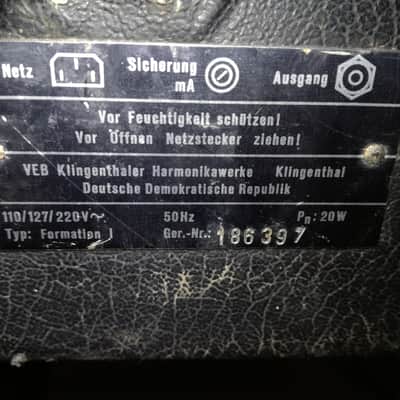
The Vermona Formation 1 (1981) was a classical combo organ produced at the VEB Klingenthaler Harmonikawerke in the “Musikwinkel” region of Saxony. This paper tries to understand the instrument as the result of a specific production culture of state-owned enterprises in the GDR of the 1980s. The design team had to navigate the demands and instructions of several stakeholders, including the state and domestic and foreign trade organizations. At the same time, they had to work with limited resources – especially regarding advanced sound generation – to compete on the international market and satisfy west-oriented rock musicians in the GDR.
▪️Shipping :
Please ask for it before bidding. I can ship worldwide with no worries about transportation effort, with a solid professional shock-protection box-in-box package with a shockproof foam inside.
▪️ About me :
I am a musician and I love my instruments for creating music.I am based in Bucharest, Romania, UE.
I have done a lot of very safety shipping transactions during years, from Jupiter 8 to B3 Hammond organ.
Please see my history of trust.
▪️Shipping (good to know):
1. Please contact me before bidding to get each other a perfect understanding.
2. The shipping includes the insurance cost which is recommended.
3. EUROPEAN UNION the postage is to be specified according to the city location..
4. If you're outside EUROPEAN UNION we need before to agree the shipping final cost.
5. The custom or any other local taxes (if any) will be on your responsibility.
▪️This item is sold As-Described and cannot be returned unless it arrives in a condition different from how it was described or photographed. Items must be returned in original, as-shipped condition with all original packaging
The Formation 1 – Interface, Design, and Sound (Generation)
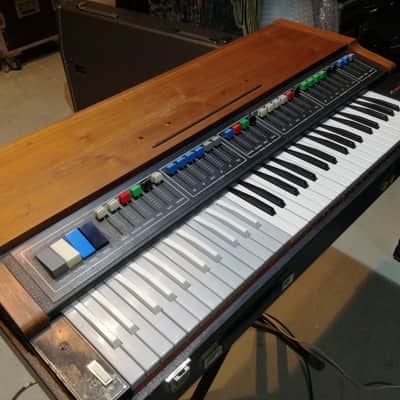
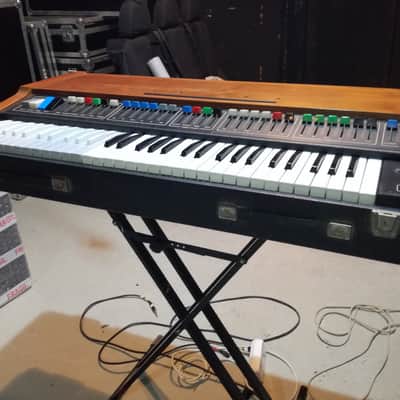
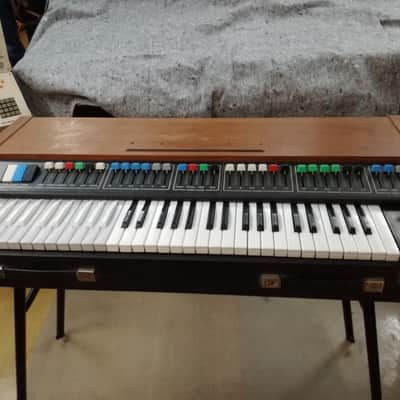
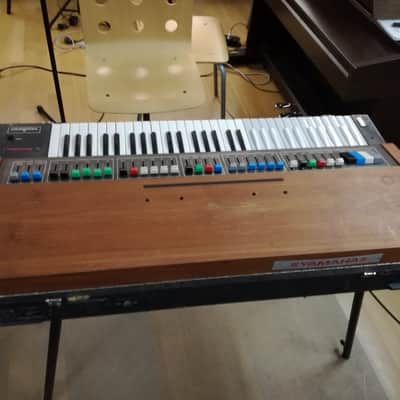
The Vermona Formation 1 belongs to the type of instruments that were called „combo organs“ (Carson 1996,32) from the 1960s on. Its 61 plastic keys manual is encased in a housing of metal topped with a wooden shelf. This main module is sitting in a case of sturdy plastic, which can be closed for transportation. The control panel holds four drawbars and one effect section grouped around a mixing control. The different sections are differentiated through a color scheme; grey for example marks the bass section, which is also mirrored in the grey keys of the left two octaves of the keyboard. The instrument is attached to a robust stand of black metal, which displays the brand’s name Vermona on a stabilizing center brace. Like most electronic instruments of this era, it must be connected to an amplifier and loudspeaker (via jack plug, which hints at the standardization of this format transcending the Iron Curtain) (see Fig. 1) to produce sound. Via a separate black foot pedal in a plastic case the overall loudness can be adjusted.
The Formation 1 main interface, especially the control panel, is designed after the pipe organs disposition, so that the player has the choice between different stops that can be opened or closed to change the resulting sound. Through the switches it is possible to adjust the share of each stop precisely and stepless . Each of these switches is named after standard organ stops virtually referencing the foot length of the pipes of a pipe organ. In electronic organs this simply means that if for example a 16′ stop is activated, a tone will occur that is one octave lower than the actual key depressed (with 8′ being the stop for the actual, notated tone). The principal two section consist of six stops ranging from 16′ (one octave lower) to 1 3/5′ (two octaves and a third higher). If one stop of the bass section (flutes 1) is turned up, the keyboard is split into two sections whose sound can be adjusted independently. When the bass section is turned down all the way, all other sections can be played across the whole keyboard. To deliver a simulation of the attack of key instruments, a third section named percussion is included, adding a more noise like click with a weak pitch. Three additional, single voices named clarinet, oboe, and nasal form a final section labeled „solo“.
The sound generation is modelled after the Hammond organ, a fact that is not just referenced in the manual and advertisement but also discussed throughout the planning process of the new model series.
The sinus tones of the main sections (each with a different pitch according to the respective stops) add up to an organ-like hovering sound .
The basis of its sound generator is a top octave synthesizer (see Fig. 3) as they were used in most of the cheaper combo organ models from the middle of the 1970s. It is a miniaturized version of the older transistor based sound generation design that needed multiple main oscillators. The high frequency (about 2 megahertz) of an oscillator clock goes into the integrated circuit and is split up into the 12 semitones of the chromatic, equal tempered scale. These then can be further divided by so called frequency dividers, also called divide-by-two chips to produce all the needed tones for the many stops of the instrument that sound at the same time.
The Formation 1 exclusively uses US-American products for sound generation, namely the MM5555 and the MM5556 from National Semi Conductor as well as the more advanced MK 50 240 C from Mostek. To produce more harsh timbres of the respective instruments, the “solo section” utilizes additional square and rectangle waves and filter circuits. The picture of the sound generation system showcases the miniaturizing effect of the new design, if it is compared to the inner life of e. g. the famous Vox organ of the 1960s .
The left side of the interface houses the effect section. It consists of a phasing effect, a low pass filter („soft“), a (spring)reverb, and the adjustment of the percussion. The phasing effect can be applied to each section individually. Also, some parameters of the phasing motion can be adjusted stepless, namely the speed of the phase oscillation, the intensity, and the feedback, which makes possible a great range of settings.
Reverb Buyer Protection
Reverb has your back if your item is lost, damaged, or doesn't match its description. Simply report any issues within 7 days and we'll help you get a full refund.Learn more about Reverb Buyer Protection.
| Listed | 2 years ago |
|---|---|
| Condition | Very Good (Used) Very Good items may show a few slight marks or scratches but are fully functional and in overall great shape.Learn more |
| Brand | |
| Model |
|
| Finish |
|
| Categories | |
| Year |
|
| Made In |
|
| Number of Keys |
|
| Built-In Speakers |
|
| Keyboard Action |
|
Product safety information may be available here.

