


Radial JS2 Passive 2-Way Microphone Splitter with Jensen Transformer
Il venditore non ha impostato il costo di spedizione per Malta. Per favore contatta e chiedigli il costo della spedizione.


Politica per i resi entro 30 giorni
Concediti il massimo della tranquillità con il tuo nuovo strumento
I nostri utenti valutano Reverb
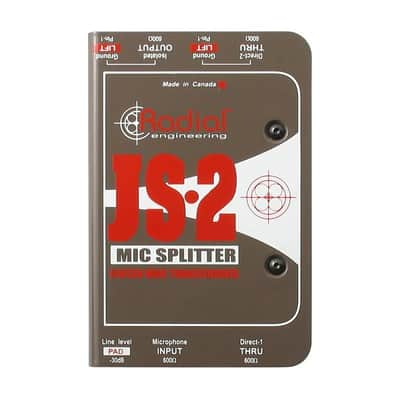
The Radial JS2 is a passive two-way microphone splitter that takes a single microphone and feeds it to two mixing consoles at once, using a direct thru output alongside a Jensen JT-MB-CPC transformer-isolated output. Because the split happens through a transformer instead of a simple Y-cable, the second console is galvanically isolated from the first, so the two systems never fight each other and never trade a ground-loop hum. Whenever one microphone has to reach two rooms, front-of-house and monitors, or the stage and a broadcast truck, without a whisper of hum, the JS2 is the quiet, road-proven fix.
What a Microphone Splitter DoesA microphone splitter lets one microphone feed two independent destinations. On a live show that usually means the front-of-house console and the monitor console; in broadcast or recording it means the house mix plus a record truck or broadcast feed. The catch is that connecting one mic to two grounded consoles with a plain Y-cable ties their grounds together, and any tiny voltage difference between those grounds pushes current through the audio shield, which you hear as 60-cycle hum. A proper splitter has to share the signal while keeping the grounds apart.
Why a Transformer Split Beats a Y-CableThis is the heart of what the JS2 does. Its isolated output passes through a transformer, where the incoming signal crosses from one winding to the other magnetically, through the core, with no direct copper connection between the two sides. That magnetic hand-off, called galvanic isolation, means the two consoles share the audio but not a ground path, so there is no loop for hum current to flow through. A front-panel ground lift goes one step further and opens pin 1 on the isolated output, letting you chase down any last trace of hum in a stubborn system. A Y-cable can do none of this; the transformer is what makes the split truly quiet.
The Jensen JT-MB-CPC TransformerAt the center of the JS2 is a Jensen JT-MB-CPC 1:1 microphone transformer, a component chosen for its faithful, full-bandwidth signal transfer and its rock-solid isolation. A 1:1 ratio means it passes the microphone signal at the same level it receives, adding isolation and rejection of common-mode noise without changing the gain your preamp expects. This is the part responsible for the JS2's dead-quiet performance and its transparent, uncolored handoff to the second console.
Direct Thru and Phantom PowerThe JS2 provides two outputs from its single input. The direct thru is a straight, hard-wired connection to the console you designate as primary, and because it is direct, it passes 48V phantom power from that console straight back to the microphone, so a condenser mic stays powered exactly as if it were plugged in normally. The transformer-isolated output feeds the second console independently, blocking phantom and ground so that console can do whatever it likes without disturbing the first.
Reference-Grade SpecificationsFor a passive box, the JS2 measures like a piece of test gear. Its frequency response runs 20 Hz to 20 kHz within a +0 to -2 dB window, dynamic range reaches an enormous 140 dB, and total harmonic distortion is a vanishingly small 0.0005 percent. It accepts levels up to +25 dBu, and a -30 dB pad lets it take a hot +4 dBu line-level signal in stride, so the JS2 is equally at home splitting a delicate ribbon mic or a line source.
Built for the RoadThe JS2 is a passive device, which means there is no power supply to fail and nothing to go wrong under the pressure of a live show. It is housed in a rugged 14-gauge steel enclosure that shrugs off the abuse of touring and stagehands, and its passive transformer heart will keep splitting cleanly for decades. Reliability like this is exactly why splitters live in the most mission-critical corner of a live rig.
Where the JS2 Shines, and Who It Is ForThe JS2 goes to work anywhere one microphone has to serve two masters: splitting a stage mic to front-of-house and monitors, sending a house feed and a simultaneous broadcast or record-truck feed, or A/B comparing two preamps on the same source in the studio. It is for the front-of-house engineer who needs monitors and house fed from one mic without hum, for the broadcast and recording tech who has to hand off a clean isolated feed, and for the studio engineer who wants a transparent, transformer-isolated way to run one source into two chains.
| Condizione | Nuovo (Nuovo) Gli articoli "Nuovi” sono venduti da un rivenditore autorizzato o dal produttore originale e comprendono l’imballo originale.Scopri di più |
|---|---|
| Marchio | |
| Modello |
|
| Categorie | |
| Anno |
|
Le informazioni sulla sicurezza del prodotto sono disponibili qui.

Protezione di Reverb
Resi semplici, transazioni sicure, assistenza di persone in carne e ossa
Scopri di più