Rode Ai-1 Single-Channel USB-C Audio Interface with 48V Phantom Power and Zero-Latency Monitoring


Rode Ai-1 Single-Channel USB-C Audio Interface with 48V Phantom Power and Zero-Latency Monitoring

Free 2-Day Shipping


30-Day Return Policy
Enjoy peace of mind with your new gear
Our users rate Reverb
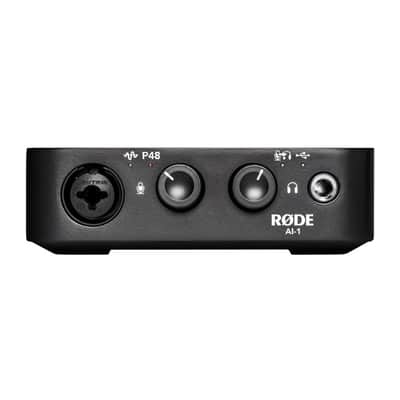
The Rode Ai-1 is Rode's compact single-channel USB-C audio interface — designed from the ground up for a buyer who owns one XLR microphone and wants the cleanest possible signal chain from capsule to DAW. One combo XLR/TRS input accepts a microphone, line, or instrument source with switchable 48V phantom power for condenser mics like the NT1 Signature, NT2-A, or NT5. The discrete studio-quality headphone output drives any standard closed-back monitoring pair with independent level control. Two balanced 1/4-inch TRS monitor outputs send the studio reference signal to powered monitors. Zero-latency direct monitoring routes the preamp signal straight to the headphone output during tracking, so there is no perceptible delay between the source and what the performer hears. Class-compliant on Mac and Windows — plug in and the OS recognizes it instantly, no driver installation required. Solid aluminum body, satin black finish, large rubber feet, and Rode's industrial-design language throughout.
Why the Ai-1 Wins for Single-Mic Studio RecordingThe bigger interfaces in this category bury what most home studio buyers actually need — one clean preamp, one set of clean monitor outputs, one clean headphone path — under multiple channels and routing complexity that gets used twice and ignored after that. The Ai-1 strips the workflow back to its essentials: one input, one headphone output, one monitor pair, all studio-grade, all driven by a USB-C bus connection to a laptop. The preamp is quiet enough to capture the NT1 Signature's industry-leading 4 dBA self-noise without contributing additional noise of its own. The headphone output is loud enough to drive 32-to-80-ohm closed-back monitoring headphones without an external amplifier. The monitor outputs are properly balanced TRS for the long cable runs typical in a treated studio space.
Zero-Latency Direct Monitoring Solves the Tracking Delay ProblemRecording vocals through a software-only monitoring chain introduces audible delay between the singer hitting a note and hearing themselves through the headphones — typically 5 to 15 milliseconds of round-trip latency that pushes a vocalist's timing forward and makes the take feel uncomfortable. The Ai-1 solves this by routing the preamp output directly to the headphone output during tracking, completely bypassing the computer for the monitor path. The take that lands in the DAW is the digitized version; the headphone signal is the analog direct feed. The vocalist hears themselves in real time, sings to the beat, and the take prints clean.
USB-C, Class Compliant, Mac and WindowsThe Ai-1 was one of the early USB-C interfaces in this price tier — the connector is on the interface side; the included cable is USB-C to USB-A so it works on legacy ports as well. The interface is fully class compliant, so it does not require any driver installation on either Mac or Windows. Plug it in, the OS recognizes it as an audio device immediately, and any DAW that supports Core Audio (Mac) or WASAPI/ASIO (Windows) sees it as an input and output. Pro Tools, Logic, Reaper, Cubase, Ableton Live, FL Studio, Studio One — all of them work with the Ai-1 without configuration beyond selecting it in the audio preferences.
Build Quality That Matches the Microphone LineupThe Ai-1 is built in solid aluminum with a satin black finish, large rubber feet that prevent the unit from sliding on a desk, and front-panel controls that match Rode's industrial design language across the microphone lineup. The gain control on the front is generous in throw, the headphone level control is independent of the monitor level, and a peak indicator LED warns when the input is approaching clip. This is the interface built for the buyer who owns Rode microphones and wants the rest of the chain to feel and look like it belongs in the same studio.
Who Buys the Ai-1The Ai-1 is the right interface for a buyer in three distinct situations. First-time studio setup: someone who owns one Rode condenser microphone — NT1, NT1 Signature, NT2-A, or the smaller-diaphragm NT5 — and is putting together a recording chain at a desk for the first time. Single-source recording workflow: a podcaster, voiceover artist, or singer-songwriter who tracks one source at a time and does not need the additional input channels that come with two-channel and four-channel interfaces. Rode-ecosystem upgrader: someone who already records with a Rode USB microphone like the NT-USB or PodMic USB and is moving up to a full XLR signal chain. For all three buyers, the Ai-1 is the interface that disappears into the workflow — never the limit, never the bottleneck.
| Condition | Brand New (New) Brand New items are sold by an authorized dealer or original builder and include all original packaging.Learn more |
|---|---|
| Brand | |
| Model |
|
| Categories | |
| Year |
|
| Computer Connectivity |
|
| Sample Rate |
|
| Electronics |
|
| Compatibility |
|
| Bus-Powered |
|
| Format |
|
| Bit Depth |
|
| Simultaneous I/O |
|
| Number of Mic Preamps |
|
| Number of Headphone Outputs |
|
| Number of MIDI Outputs |
|
| Number of MIDI Inputs |
|
| Number of Digital Outputs |
|
| Number of Digital Inputs |
|
| Number of Analog Outputs |
|
| Number of Analog Inputs |
|
Product safety information may be available here.

