



ART Pro MPA2
Dieser Verkäufer hat keine Versandkosten für Malta hinterlegt. Bitte Kontakt ihn bezüglich Versand.

Unsere Benutzer bewerten Reverb
The Pro MPA2 can be set up for dual‑mono, conventional stereo or M/S (Mid/Side) operation. In this last role, channel one is used for the 'Mid' mic and channel two for the 'Sides'. Further tonal variety is offered by the ability to run the 12AX7 valves at low or high anode voltages.
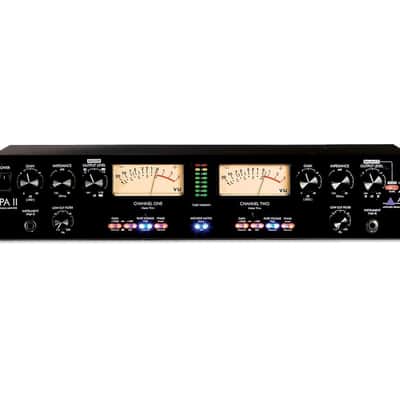
The Pro MPA2 certainly feels solid — it was rather heavier than I expected it to be when I lifted it — and the front panel looks stylish, with its detented, somewhat retro‑styled knobs and large, backlit, moving‑coil VU output meters that have adjustable calibration trims. Further LED bar-graph meters, labelled Tube Warmth and set between the VU meters, show the amount of tube drive being used. While the mic inputs and balanced XLR and TRS jack outputs are on the rear panel, a high‑impedance instrument input is conveniently positioned on the front panel, this taking precedence over the mic input when connected. A rear‑panel button allows the output level to be set to +4dBu or ‑10dBv, and the meter calibration automatically follows this setting.
The mic input is a solid-state design, with a rotary control to set the initial gain. This has only a 40dB range, but an extra 20dB of gain can be applied before the tube stage. Having an extra gain boost selectable in this way helps the preamp to run at lower gains while still maintaining a high signal‑to‑noise ratio, as many affordable mic preamps only deliver their quoted EIN figure when set close to maximum gain. A combination of the input gain and this 20dB 'boost' can be used to drive the tube stage as hard as you feel appropriate. A further 10dB is available via the output gain control, so there's an overall maximum gain of 70dB. (The manual claims 75dB with everything flat out, but I'm not sure where the extra 5dB comes from!)
Next to the input gain control is the one that governs input impedance, which ranges from 150Ω to 2.4kΩ. To keep the lows under control, there's a smooth, 6dB/octave low‑cut filter that can be swept from 10Hz to 200Hz. Four illuminated buttons beneath the VU meter are used to select 'normal' or +20dB of gain, phantom power, high or normal 'plate' voltage, and polarity inversion.
A further button mounted between the channels selects the M/S decoding matrix, so that an M/S mic pair fed through the unit will produce a standard stereo signal at the output. At the extreme right of the unit is a 'stereo' button that allows the rightmost output‑level control to function instead as a stereo balance, while the leftmost output‑level control operates as a master stereo level control.
The technical spec looks suitably impressive on paper, with a frequency response extending from 15Hz to 48kHz (+0, ‑1dB) when the valve anode‑voltage is set to normal. An equivalent input noise for the mic input is quoted as ‑129dBu A‑weighted, translating to a dynamic range of better than 110dB, again A‑weighted. Both mic inputs can accommodate signal levels of up to +10dBu before clipping, whereas the maximum instrument level is +17dBu (800kΩ impedance). The output stage can handle up to +27dB on the XLRs, and has a low 47Ω impedance, which is suitable for driving long cables.
Dieser Artikel wird verkauft "wie beschrieben"
Dieser Artikel wird verkauft "wie beschrieben" und kann nicht retourniert werden, es sei denn er kommt anders als beschrieben oder fotografiert an. Artikel müssen im Originalzustand mit allen gelieferten Teilen und Zubehör in ursprünglicher Verpackung zurückgesendet werden.Mehr erfahren
| Inseriert | vor 10 Tagen |
|---|---|
| Zustand | Gut (Gebraucht) Artikel mit Zustand Gut funktionieren einwandfrei, können aber einiges an Makeln oder Spielspuren aufweisen.Weitere Informationen |
| Marke | |
| Modell |
|
| Kategorien | |
| Elektronik |
|
Möglicherweise sind hier Informationen zur Produktsicherheit verfügbar.

Reverb-Schutz
Einfache Rücksendungen, sichere Transaktionen, Support von Experten
Weitere Informationen