

Zapata, TX, Stati Uniti
Informazioni su questo annuncio
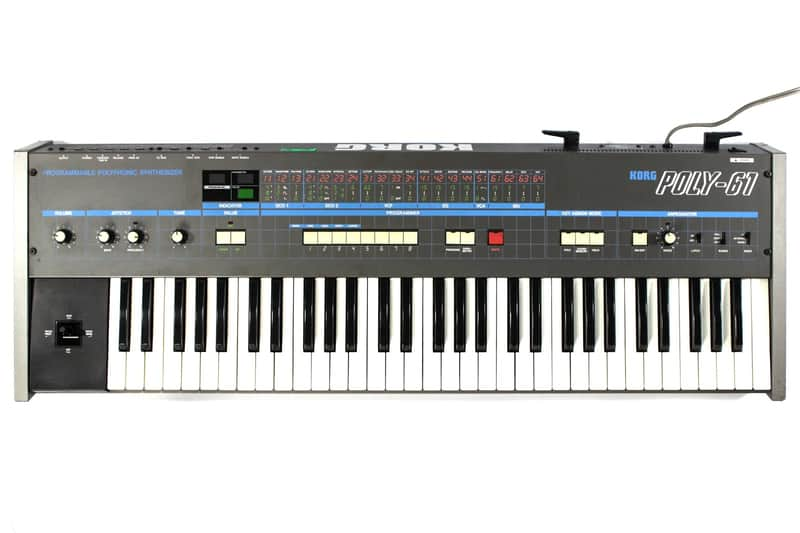
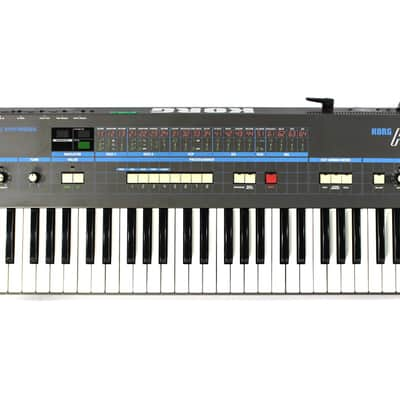
you’ll be in synthwave heaven with this Korg Poly-61.suuuper underrated synth! if you have not heard / seen this one before, look up a youtube demo asap!this is my second one (keeping the first always!)purchased in 2020 off of FB marketplace!great condition, ready to go! i’ve included excellent detailed photos so you can see the condition carefully.message me if you have any questions, you can message me through here or find me @ imperialsoundst on IG!here’s some info i pulled from muzines:The Korg Poly-61 was released in 1982 as the successor to the Polysix. It was somewhat of a step up from the Polysix, as it has 2 DCOs for better reliability. It also retained the arpeggiator of the Polysix. The Poly-61 can provide cool gritty basses or trippy analog sounds and fx.Also added is the familiar Korg joystick, which can be used to modulate the VCO or the VCF. However, its filter only has 7 steps of resonance. It also uses the same method of programming the Poly-800 uses. The first Poly-61s didn't have MIDI, but the Poly-61M released in 1984 corrects this! On the front panel, controls are neatly sectioned from left to right, with the current Korg knobs in grey/off-white two-tone finish and new momentary 'click' pushbutton switches (apart from 3 ordinary 2/3 way slide switches at far right), as follows: Volume, Joystick, Tune, Indicator Value, Programmer, Key Assign Mode, and Arpeggiator.Above these sections are 'Program No.', 'Parameter No.' (both 2 digit ½" red LED displays), and 'Value' i.e. Indicator Value for parameter selected (2 digit ½" green display). To the right of these displays is printed the information for selecting the different parameters available (in red) and the value settings available (in green). The main legending is in soft blue with 'Tron' style square grids around the controls.The instrument measures 110 (H) x 350 (D) x 985 (W) and weighs 12Kg. Supplied accessories are data cassette (64 factory-programmed sounds) and connection cord for tape recorder.It has been used by FM Static and The Faint.Rear PanelFrom the performer's viewpoint, these are from left to right: Mono Output (with high or low switch), Stereo phones (8 ohms), Arpeggio Trigger In (for external control from drum machine, computer or sequencers etc — Korg's negative going pulse-to-ground required, although the E&MM Trigger Interface box or Korg MS-02 interface unit will match up any trigger), Release (gives release parameter only when inserted momentary foot-switch is pressed to add piano-like sustain pedal effect), Program Up (advances program number one step via momentary footswitch). Tape Interface switches are also located here for 'Tape Enable' and 'Write Enable', along with Tape 'To' and 'From' sockets. All sockets are standard jack types.CircuitryThe main panel swings back for quick servicing, although full access to the PCB's requires removal of keyboard section. There are 3 main PCB's on the base, with left board containing dual 8049 micro processors, 8255 x 3 peripheral interface, 8253 x 4 etc. plus battery back-up. The centre voice board features 6 SSM 2056 IC's and the right board contains +/-5V, +15V power supply. Extra boards are provided for joystick and modulation as well as the 3 panel-mounted PCB's holding pots and switches. Rear panel jacks are sealed PCB mounted types.ProgrammingOnce you've connected the Poly-61 output to your mixer/amplifier set-up and powered up, the display reads PS61 (!) followed by Program No. 11, Parameter 11 and an arbitrary Value No. A volume control lets you match output level to your system, and both Write and Tape rear switches are set to 'disable'.The Programmer section allows 64 different sounds to be stored in the instrument's memory and at any time these can be saved as a complete set on standard mono cassette recorder. Programs are dialled up using 8 switches numbered 1-8. Since the instrument controls are either for changes to programs or parameters, two switches to the right of these select either Program or Parameter, followed by a red Write switch which enters new programs you've created.So to get Program 21 you press 2, then 1 and this will be displayed in the Program No. display. If you get it wrong, you can easily change the number around. Programs are grouped in 8's, so you'll only get 11-18, 21-28, through to 81-88 for the total 64 programs. The Poly-61 comes with factory-loaded sounds that are fully listed in the large instruction manual. These contain a good selection of sounds and you'll hear samples on E&MM Demo Cassette 9. In performance the instrument offers quick switching from one program to the next and, since you can arrange sounds in the required order for each piece easily (without losing any existing programs), a touch of a button (or footswitch in Program Up socket) will call these up instantly. Changeover is very smooth and can be done whilst playing.EditingTo create a new sound of your own, you select a program near to the sound you want (or any suitable program number). All editing is 'temporary' until you actually 'Write' it into a program. The actual number you select this to be does not have to be the location you're working at, e.g. Program 21 can be edited and then stored in Program 31, leaving the original Program 21 intact. This is a very useful procedure in practice.Editing is carried out by selecting 'Parameter' mode and choosing one of the 20 parameters available using the 8 numbered buttons (in the same way as locating a Program number). The Indicator Value Display will then show your setting as you use the down or up buttons below it. An interesting feature here is the red 'Edit' LED that glows only when you've changed an existing value, so it's easy to find original settings. Pressing both Up and Down buttons together restores the original parameter value.This 'digital access control' can be carried out for all 20 parameters one at a time and takes only a second or so to make a parameter edit — there lies the big difference between analogue and digital control and may take some time to get used to. You'll also have to wait for the up/down switches to reach the required value. Like Korg's new digital delay, they run slow at first then more quickly when held on.Since all parameters, except one, cover a maximum 15 values, it's quickly done. The exception is Frequency Cutoff, which takes some 5 seconds to go from 0 to 63!Writing a program to memory is probably as quick and easy as you'll get. With rear Write switch enabled, pressing the Write button and selecting a program number is all you have to do.Even though battery back-up (with power off) can hold your 64 programs (provided you use the instrument for a few hours each year), another most useful feature is to be able to store your sounds on cassette. Tape transfer is a very fast 8 seconds with little possibility of error. The displays show TAPE, LOAD, SAVE and VRFY to indicate load, save and verify functions. An error is shown by ERR and correct transfer by GOOD.Performance ControlsThe Poly-61 has plenty of polysynth features to make your performance more enjoyable. The joystick is an established favourite with Korg and offers four way control for pitch +/-7 semitones (horizontally) and vibrato depth or filter depth (vertically). Joystick rotary pots set Bend limit and Frequency rate (independent of MG) with LED indication from 1 cycle every 8 seconds to 10Hz approx. A Tune control sets overall pitch +/- 1 semitone. Three Key Assign modes are available: Poly, Chord Memory/Unison, and Hold. In Poly mode, six independent notes can be played on the keyboard, with last note priority as you play more notes. Chord memory unison lets up to 6 notes be 'memorised' and then played from any one key at the correct transposition — great for parallel tones jazz or drawbar style. Unison makes big fat 'six voices to one note' playing (mono). The Hold switch keeps notes playing after release — particularly useful in Arpeggio mode.The Arpeggiator is now a standard feature on poly machines and this one triggers notes held (either chords or unison) once every 26 seconds to fast 6 notes runs every ¾ second or so. The range of the Arpeggio will be the same as the keyboard span for the current DCO pitch setting, so 'C' has 6 notes to use — others have what's left! Arpeggios run up, up/down or down over full keyboard, 2 octaves or 1 octave. You can add notes to your arpeggio provided you don't make a 'fresh' key press, and use external triggers as mentioned.ConclusionsIf you make comparisons between the Poly-61 and the Polysix (and other polysynths), you'll find it's a winner for its price. Sound making possibilities are plentiful, especially through the use of two oscillators per note, although you'll have to decide whether one EG is enough. it’s light weight, good looks, wide-ranging sounds plus unlimited program storage and low cost should make it a very popular 'new look' instrument.
Prezzo$440
+ $122.11 Spedizione a

Prevede di vendere presto
Solo 1 disponibile e un’altra persona ce l’ha nel carrello