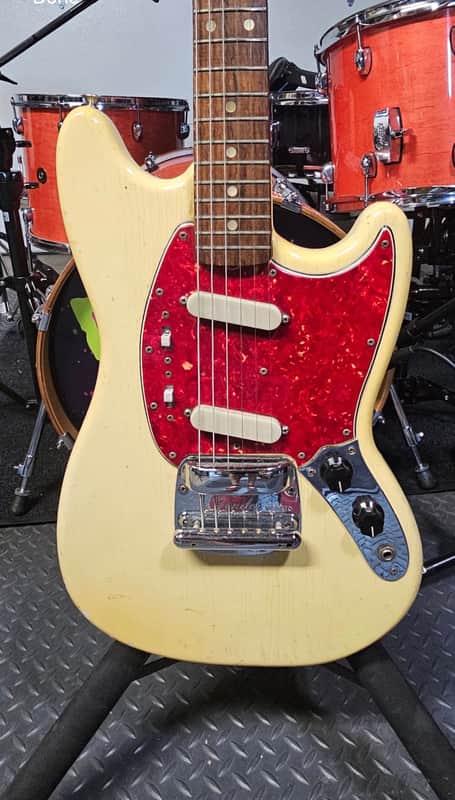
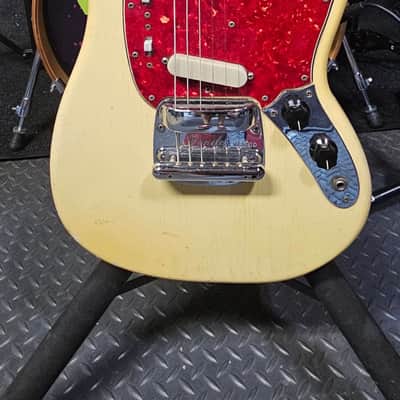

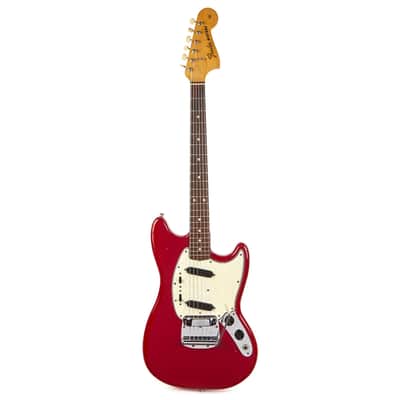
Fender Mustang Guitar with Rosewood Fretboard 1964 - 1969 - Olympic White

Our users rate Reverb
The following is a honest write-up from a local certified luthier on the condition and value of this guitar.
1965 FENDER MUSTANG OLYMPIC WHITE (SN: L 93818)
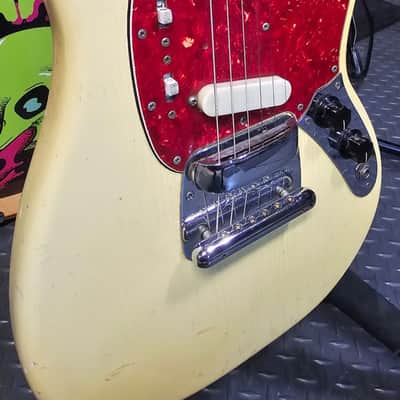
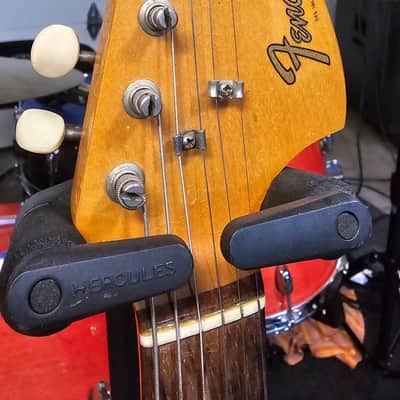
This is a Fender Mustang model featuring a double cutaway alder body, maple neck, veneered rosewood fretboard with white pearloid dot inlays, Olympic White Nitrocellulose Lacquer finish, 4 ply red tortoise pickguard, wraparound Mustang tremolo tailpiece and Mustang style bridge, dual single coil pickups with white plasc covers, white, 3-position sliders to control the phase of the pickups, master volume and master tone control, bone nut, 22 narrow nickel frets, and 24” scale length.
For most of Fender’s U.S. instrument production history, production dates have been applied to various components.
Most notably, production dates have been penciled or stamped on the butt end of the heel of the neck of most guitars and basses, although there were periods when this was not consistently done (1973 to 1981, for example) or simply omitted. Neck-dating can be useful in determining the approximate age of a guitar, but it is certainly not definitive because the neck date simply refers to the date that the individual component was produced, rather than the complete instrument.
Given the modular nature of Fender producon techniques, an individual neck may have been produced in a given year, then stored for a period of me before being paired with a body to create a complete guitar, perhaps, for example, in the following year. Therefore, while helpful in determining a range of production dates, a neck date is obviously not a precisely definitive reference.
Most specifications for a given Fender instrument model change little (if at all) throughout the lifeme of the model. While there have been periods of dramatic change—such as the transition periods between the Leo Fender years and the CBS years or the transition between the CBS years and the current ownership—most models are generally feature-specific and do not change from year to year.
Serial numbers are also helpful in determining an instrument’s production year. For years, serial numbers have been used in various locations on Fender instruments, such as the top of the neck plate, the front or back of the headstock and the back of the neck near the junction with the body.
But once again, due to Fender’s modular production methods and open non-sequential serial numbering (usually overlapping two to four years from the early days of Fender to the mid-1980s), dating by serial number is not always precisely definitive.
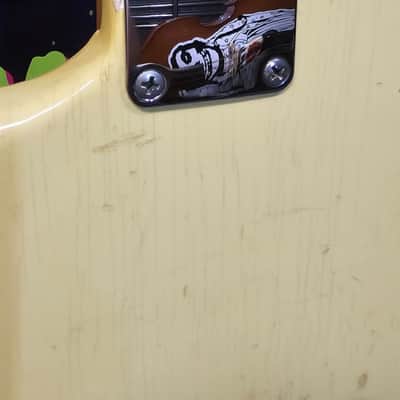
The serial number, located on the neck plate, falls in a well documented me frame known informally as the “L Plate” era, due to the serial numbers beginning with the letter L and their location on the neck plate. This was only done between 1963 through the earlier part of 1965.
This neck plate, in conjunction with date stamps found on the neck heel and potentiometer casings places the manufacture of this instrument in 1965.
The ink-stamped production information on the heel of the neck reads “8DEC64 A” and appears original with period-correct black ink. The “8” at the beginning of this serial code tells us that this neck is for a Mustang model, “DEC64” is the month and year the neck was constructed, and the “A” signifies the profile of the neck Fender used (in this case the most narrow with a 1.5 inch nut width).
The Volume and Tone Pots on this guitar are Stackpole Potentiometers with matching serial codes of “304-6520” which dates to production during the 20th week (Mid-May) of 1965. The first half of this code (304) identifies the pot as produced by Stackpole, the 4th and 5th digits identify the year of production, and the remaining digits signify the week the unit was produced. All wiring and solder appears period appropriate, if not factory original, except of a solder bead on the back of the volume pot.
The pickups appear to be original and match the appearance of other documented examples used during this era. The bottom flat work is light grey and has the construcon date written in black wax pencil. The neck pickup clearly has date code of 8-20-65 written on it, but the bridge pickup has the date slightly obscured. We can decipher what we believe to be 8-16-6_. This last
digit falls right near the eyelet for the pickup lead wire, which has evidence of being re-heated and melting the surrounding wax. This indicates that a repair has occurred at some point in time, either the pickup was rewound, or just the leads were replaced. We cannot say for certain what the extent of the repair was, but the quality of the repair is excellent and the original flat work was used to maintain as much originality as possible. This circles back to the retouched solder joint on the master volume pot. Assuming that a repair was performed, this retouched joint falls perfectly in line with what we would expect to see.
The fretwork on this guitar appears to be original and we do not believe it has been re-fretted.
The frets have certainly been leveled at various points throughout the instruments’ lifetime.
There is not much fret life left; and what frets life is left; currently shows some minimal wear.
While performing a refret can affect the “unmodified collectors” value of the instrument, given the current condition of the guitar cosmetically, a well-done professional refret wouldn’t hurt the “real world” appraisal value too significantly. It is of the opinion of the luthiers of Indy String Theory LLC that improving the playability of the guitar holds more appeal to prospective buyers.
The truss rod functions and adjusts smoothly.The bone nut also appears to be original. We do not see any signs of it having been removed, as the “lacquer lip” on the back side of the nut appears to still be intact. The nut slots do show significant signs of modificaron, with evidence of the slots having been filled, recut, and filed on practically all of the strings. Much like the situation with the fretwork, a well-made replacement nut would improve the playability and appeal of the guitar to prospective buyers.
The tuning machines are the original Kluson Deluxe split post tuning machines with white plastic buttons. They are in phenomenal working and cosmetic condion. During our investigation, we believe we were the first ones to have removed any of the mounting screws based on the lack of evidence of tool marks on the screw heads and how securely the screws were in the maple. We only removed the low E string tuner to inspect for previous screw mounting holes or other signs of the tuners having been changed or repaired. By all indications, these tuners have not been modified or replaced.
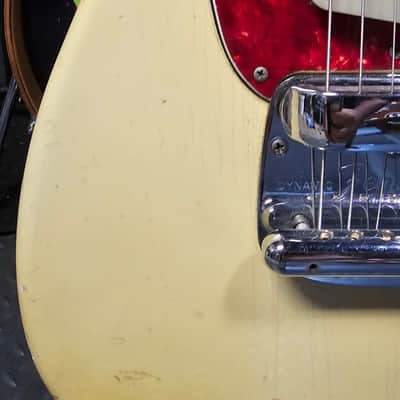
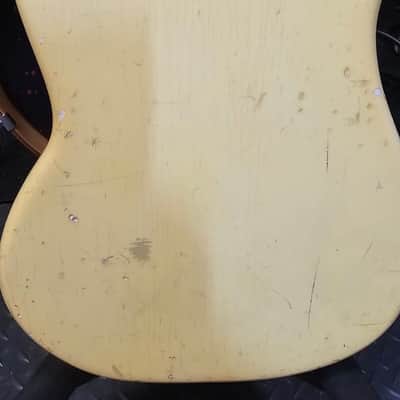
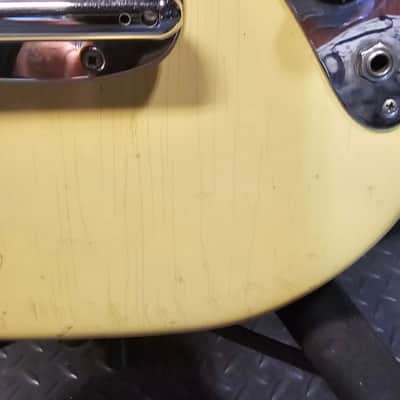
The guitar is in great condion for its age. The finish has consistent checking in a manner we’d expect to see on most any guitar of this age. There are a significant number of chips, dings and other marks present in the finish, but these fall in a category of “used but not necessarily abused.” We would place the guitar above a player-grade condition, but not necessarily a collector grade piece.
The Vintage Guitar magazine’s 2025 edion of their Price Guide sites: “Fender Mustang – 1964-1965” and notes “1964-1965 Red, white, or blue” models with an esmated value between $3,250 and $5,000 based on condition. This estimate shows low to high values for items in all-original excellent condition. Our assessment of this guitar is that it falls within that descripon.
To determine the current market valuation, we perform our research using Reverb.com to find previously sold examples of the pieces in question, as well as consult the Price Guides for the items. These guides are compiled from sales record data from the previous two years and provide a graphical representation of the changes in actual sales over this me, as well as provide a reasonable valuation of what the items are selling for at the current moment.
As of September 2025, Reverb lists the value of Fender Mustang Guitar with Rosewood Fretboard 1964-1969 Olympic White in “Good to Mint” condition between $1,908 and $3,727, with the most recent sale being for $2,100.
It should be noted that this includes a broader descripon of the instrument’s valuation than the Price Guide descripon but falls below/on the lower end of what the Price Guide estimates. This suggests volality in market values currently, but not anything significant.
There are a few active listings for 1960’s Fender Mustang models in comparable condition at the me of appraisal. These have an average listing price of approximately $3,900 demonstrating that other sellers of this model instrument are asking for closer to the lower end of book value than what current sales figures are suggesting.
The cost of replacement for insurance purposes, we determine to be $4,000 to secure a comparable model in similar condition.
Reverb Buyer Protection
Reverb has your back if your item is lost, damaged, or doesn't match its description. Simply report any issues within 7 days and we'll help you get a full refund.Learn more about Reverb Buyer Protection.
| Listed | 9 days ago |
|---|---|
| Condition | Good (Used) Good condition items function properly but may exhibit some wear and tear.Learn more |
| Brand | |
| Model |
|
| Finish |
|
| Categories | |
| Year |
|
| Made In |
|
| Series | |
| Fretboard Material |
|
| Pickup Configuration |
|
| Color Family |
|
| Scale Length |
|
| Body Shape |
|
| Right / Left Handed |
|
| Number of Strings |
|
| Neck Material |
|
| Model Family | |
| Finish Style |
|
| Body Type |
|
| Body Material |
|
| Offset Body |
|
| Wood Top Style |
|
| Bridge/Tailpiece Type |
|
| Fretboard Radius |
|
| Neck Construction |
|
| Number of Frets |
|
Product safety information may be available here.