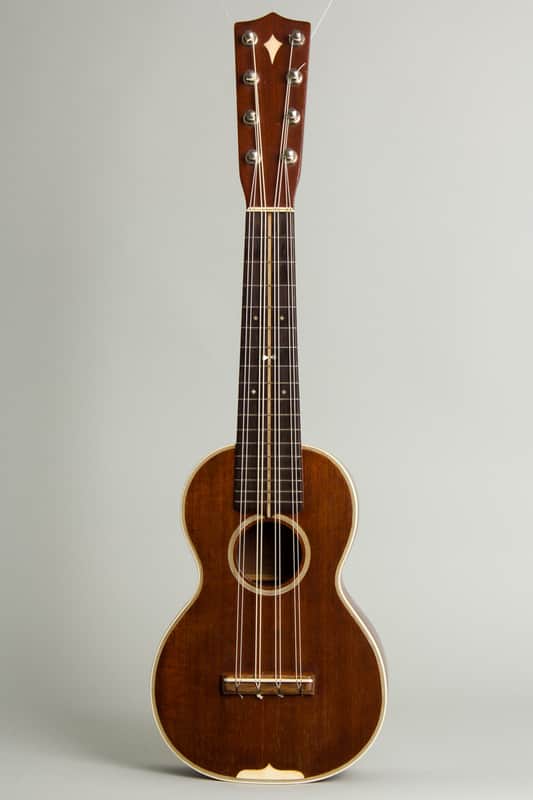
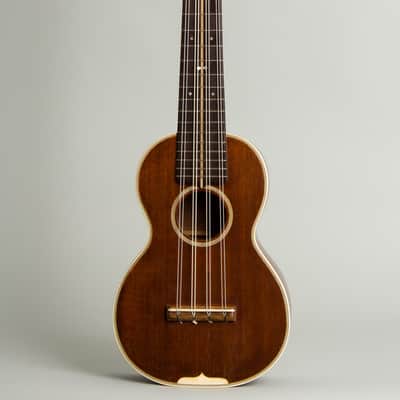
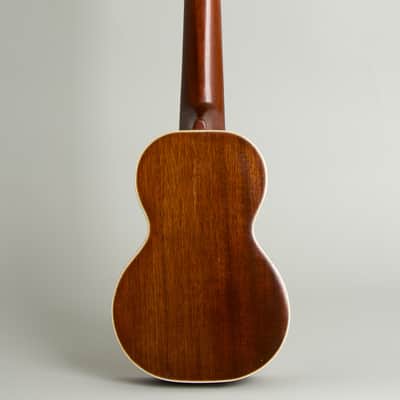
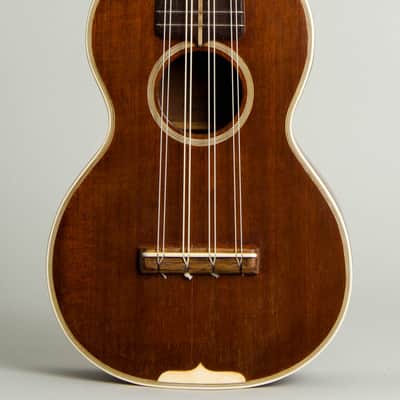
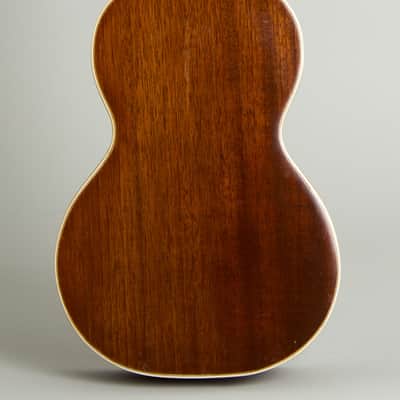
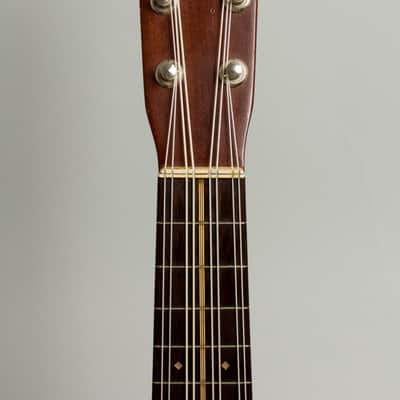
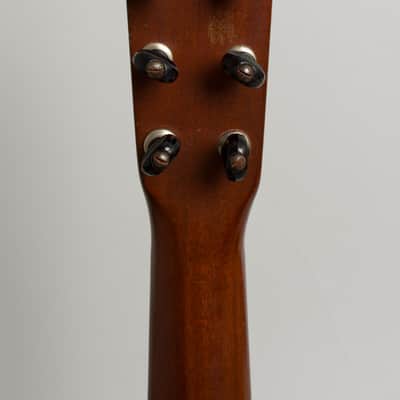
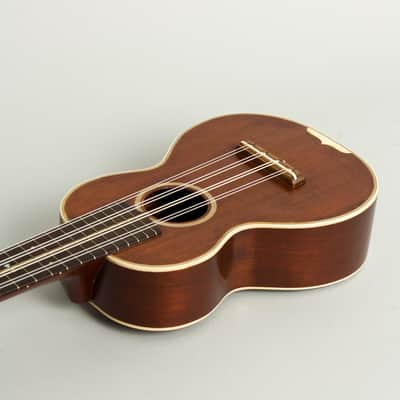
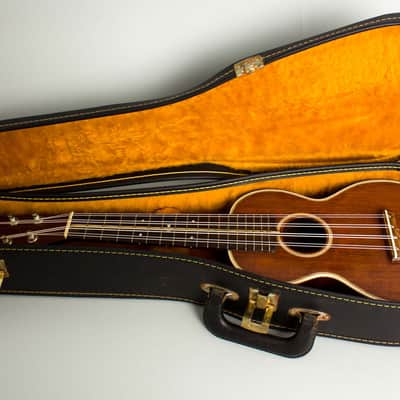
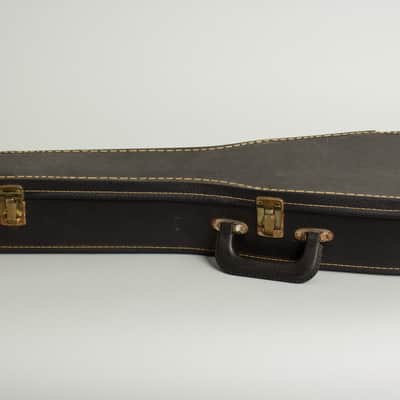
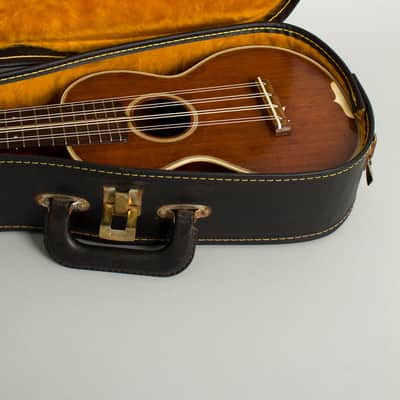
C. F. Martin Style 3M Taropatch (1920), black chipboard case.
Prezzo$3,000
+ $300 Spedizione
Pubblicato:4 mesi fa
Visualizzazioni:290
Salvataggi:16
Offerte:1

Brooklyn, NY, Stati Uniti
I nostri utenti valutano Reverb
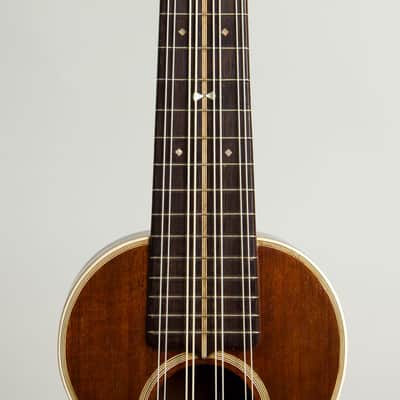
C. F. Martin Style 3M Model Taropatch (1920), made in Nazareth, PA, dark mahogany finish, mahogany body and neck, rosewood fingerboard, black chipboard case.
This early Martin style # Taropatch is a very rare instrument, showing some old repair work but still an excellent player. The eight-string Taropatch (originally called the "Taro Patch fiddle") was one of the early Hawaiian forms of the ukulele, persisting in the islands even after the familiar 4-string uke was popularized. Comparatively few versions were ever made on the mainland, but the instrument was offered as part of C. F. Martin's early uke line from 1916 through 1931. With eight gut strings on a longer scale neck the taropatch was considered harder to play (and tune!) than the simple uke, and thus ordered in vastly smaller numbers. Eventually Martin adapted this larger body form into the 4-string concert uke, which pretty much replaced it in the company's line.
The Martin Taropatch was offered stock in Styles 1,2 and 3; this early Style 3 was the top of the original line. It was made no later than 1920, the last year the Style 3 featured the "kite" inlay on the headstock as well as the small diamond inlay at the 9th fret, moved to the 10th fret before 1921. This would be one of only 24 Style 3 examples shipped between 1918 (when position marks were added to the fingerboard) and 1920 when the celluloid "kite" disappeared from the headstock. The Style 3 Taropatch was last produced in 1927, although not officially discontinued until 1929
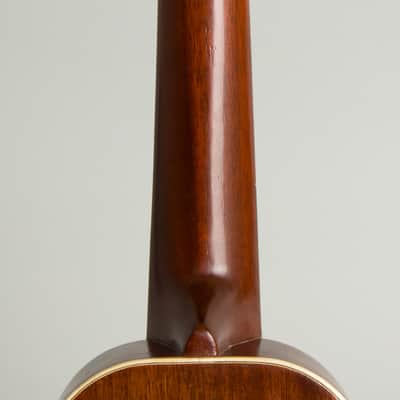
Style 3 was Martin's original top of the line level for uke family instruments until the pearl-bordered style 5K arrived in the 1920s. That style was not offered in 8-string format in any case. These were absolutely pro-quality instruments, usually considered the best of their type ever made. The Style 3 is nicely decorated if not as out-and-out flashy as the Style 5. The thin dark natural mahogany finish is offset with 6-ply W/B/W celluloid binding around the top and triple ply on the back. The sound hole has a multiply ring ornament, there is a multiply celluloid strip running up the fingerboard and even the nut is W/B/W. Small pearl diamond position marks were added to the fingerboard in 1918. The headstock and the base of the body have small celluloid ornaments vaguely inspired by period Hawaiian designs.
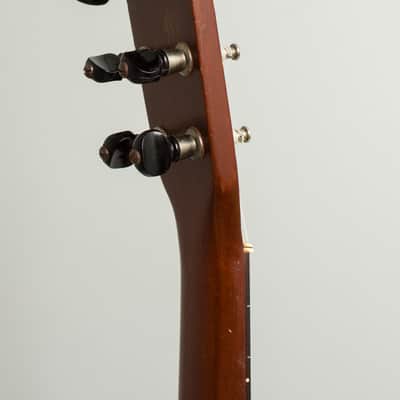
The tuners are vintage black-button Grover Champion style; these are quite functional but not original as this Taropatch would have originally had wooden violin-style pegs. This is a lovely extremely rare find and a fine playing instrument; while more awkward to tune than a 4-string uke it rewards the player with a distinctive chorused double-strung sound that has a real archaic island character.
Overall length is 25 1/8 in. (63.8 cm.), 7 5/8 in. (19.4 cm.) wide at lower bout, and 2 3/4 in. (7 cm.) in depth at side, taken at the end block. Scale length is 14 3/4 in. (375 mm.). Width of nut is 1 1/2 in. (38 mm.).
This century+ old Taropatch survives in very good playing condition with some older restoration. The very thin varnish finish is original on the neck, headstock and sides of the body; it has been lightly overfinished on the top and back as part of some structural work. The bridge is a later replacement, it was carved in the exact correct style if not made of particularly well-matched wood. It is also mounted slightly to the rear of where the original was to correct the intonation; this is now the most in-tune Taropatch we have ever heard!
The top has a single sealed grain split running back from the bridge to the back edge behind the third string course, this is under the overfinish. The back has a sealed and cleated grain split running down just off the center from just under the heelblock, and another of the lower bout off the treble side back edge. Both are solidly closed up.
The finish overall has some light wear with dings, dents and scuffs but no really notable loss. As noted the tuners are not original, although in The Grover Champion style Martin used in subsequent decades. The instrument plays very nicely and holds tune better than most of these do, a really nice very early example of an extremely rare and beautiful early Martin ukulele family instrument that seldom turns up today. It resides in a later (1950-60s) chipboard case. Very Good + Condition.
This early Martin style # Taropatch is a very rare instrument, showing some old repair work but still an excellent player. The eight-string Taropatch (originally called the "Taro Patch fiddle") was one of the early Hawaiian forms of the ukulele, persisting in the islands even after the familiar 4-string uke was popularized. Comparatively few versions were ever made on the mainland, but the instrument was offered as part of C. F. Martin's early uke line from 1916 through 1931. With eight gut strings on a longer scale neck the taropatch was considered harder to play (and tune!) than the simple uke, and thus ordered in vastly smaller numbers. Eventually Martin adapted this larger body form into the 4-string concert uke, which pretty much replaced it in the company's line.
The Martin Taropatch was offered stock in Styles 1,2 and 3; this early Style 3 was the top of the original line. It was made no later than 1920, the last year the Style 3 featured the "kite" inlay on the headstock as well as the small diamond inlay at the 9th fret, moved to the 10th fret before 1921. This would be one of only 24 Style 3 examples shipped between 1918 (when position marks were added to the fingerboard) and 1920 when the celluloid "kite" disappeared from the headstock. The Style 3 Taropatch was last produced in 1927, although not officially discontinued until 1929
Style 3 was Martin's original top of the line level for uke family instruments until the pearl-bordered style 5K arrived in the 1920s. That style was not offered in 8-string format in any case. These were absolutely pro-quality instruments, usually considered the best of their type ever made. The Style 3 is nicely decorated if not as out-and-out flashy as the Style 5. The thin dark natural mahogany finish is offset with 6-ply W/B/W celluloid binding around the top and triple ply on the back. The sound hole has a multiply ring ornament, there is a multiply celluloid strip running up the fingerboard and even the nut is W/B/W. Small pearl diamond position marks were added to the fingerboard in 1918. The headstock and the base of the body have small celluloid ornaments vaguely inspired by period Hawaiian designs.
The tuners are vintage black-button Grover Champion style; these are quite functional but not original as this Taropatch would have originally had wooden violin-style pegs. This is a lovely extremely rare find and a fine playing instrument; while more awkward to tune than a 4-string uke it rewards the player with a distinctive chorused double-strung sound that has a real archaic island character.
Overall length is 25 1/8 in. (63.8 cm.), 7 5/8 in. (19.4 cm.) wide at lower bout, and 2 3/4 in. (7 cm.) in depth at side, taken at the end block. Scale length is 14 3/4 in. (375 mm.). Width of nut is 1 1/2 in. (38 mm.).
This century+ old Taropatch survives in very good playing condition with some older restoration. The very thin varnish finish is original on the neck, headstock and sides of the body; it has been lightly overfinished on the top and back as part of some structural work. The bridge is a later replacement, it was carved in the exact correct style if not made of particularly well-matched wood. It is also mounted slightly to the rear of where the original was to correct the intonation; this is now the most in-tune Taropatch we have ever heard!
The top has a single sealed grain split running back from the bridge to the back edge behind the third string course, this is under the overfinish. The back has a sealed and cleated grain split running down just off the center from just under the heelblock, and another of the lower bout off the treble side back edge. Both are solidly closed up.
The finish overall has some light wear with dings, dents and scuffs but no really notable loss. As noted the tuners are not original, although in The Grover Champion style Martin used in subsequent decades. The instrument plays very nicely and holds tune better than most of these do, a really nice very early example of an extremely rare and beautiful early Martin ukulele family instrument that seldom turns up today. It resides in a later (1950-60s) chipboard case. Very Good + Condition.
Protezione di Reverb per gli acquirenti
Reverb ti protegge nel caso in cui il tuo articolo venga perso, danneggiato o non corrisponda alla descrizione. Basta segnalare eventuali problemi entro 7 giorni e ti aiuteremo a ottenere il rimborso completo.Scopri di più sulla Protezione di Reverb per gli acquirenti.
| Pubblicato | 4 mesi fa |
|---|---|
| Condizione | Molto buono (Usato) Gli articoli "Molto buoni" possono mostrare qualche piccolo segno o graffio ma sono pienamente funzionali e in buone condizioni generali.Scopri di più |
| Marchio | |
| Modello |
|
| Finish |
|
| Categorie | |
| Anno |
|
Le informazioni sulla sicurezza del prodotto sono disponibili qui.

Protezione di Reverb
Resi semplici, transazioni sicure, assistenza di persone in carne e ossa
Scopri di più