National Tricone Exploding Palm Tree Resophonic Guitar (1937), ser. #A-2909
National Tricone Exploding Palm Tree Resophonic Guitar (1937), ser. #A-2909
Il venditore non ha impostato il costo di spedizione per Canada. Per favore contatta e chiedigli il costo della spedizione.
PrezzoC$11,164.77
+ spedizione
Pubblicato:2 mesi fa
Visualizzazioni:1.648
Salvataggi:35
Offerte:0

Brooklyn, NY, Stati Uniti
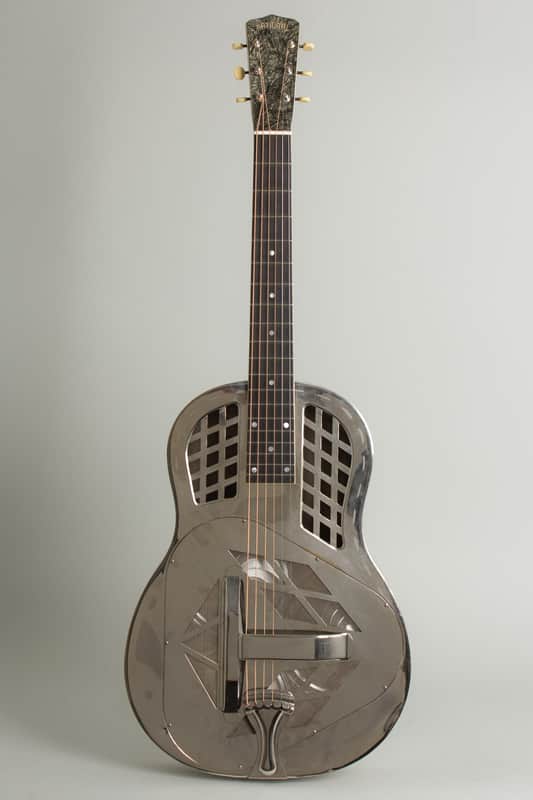
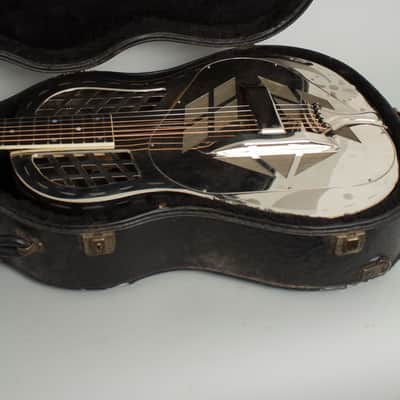
National Tricone Exploding Palm Tree Model Resophonic Guitar (1937), Chicago, serial # A-2909.
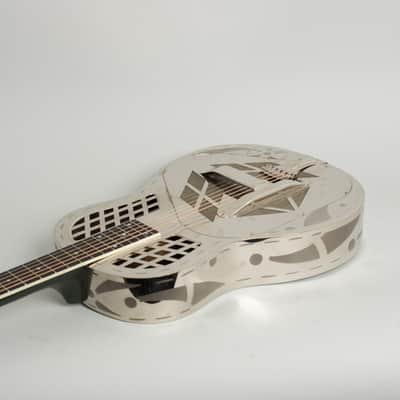
This distinctive 1937 Tricone is one of the most obscure of all National products, so rare whatever name the company may have had for it is lost to history. It is generally referred to as the "Exploding Palm Tree" Tricone, a nickname made up by collectors trying to describe the abstract decorative patterns on the body. This was codified in National reference books and has since become part of the general resophonic lingo, no official name having ever been unearthed.
This VERY rare variation the pre-war National Tricone has a brass body, not the German silver used on earlier Styles 1-4. The neck is wood, not the integral metal neck used on those which makes conversion of a Hawaiian model to the standard Spanish style fairly easy, as indeed has been done here. Tricones in general are often considered the best-sounding of all acoustic resonator guitars, and this is a nice if very unusual example. The brass body Tricone offers perhaps a slightly "tighter" response than the familiar German silver models, with a bit less of the overtones and more fundamental-rich tone.
As its name implies the Tricone uses 3 small spun aluminum cones to amplify the strings, set inside a hollow metal body. This mellows the attack and adds sustain, creating a uniquely ethereal sound. The original Tricone was a collaboration between inventor John Dopyera and Hawaiian guitarist George Beauchamp, who wanted a louder instrument for the vaudeville stage than existing wooden guitars. The project came out so well that in 1927 they attracted investors and went into production, with four styles of Tricones ranging from a plain deco Style 1 at $125 through the elaborately engraved $195 Style 4.
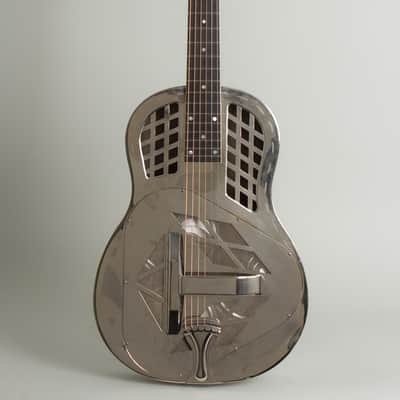
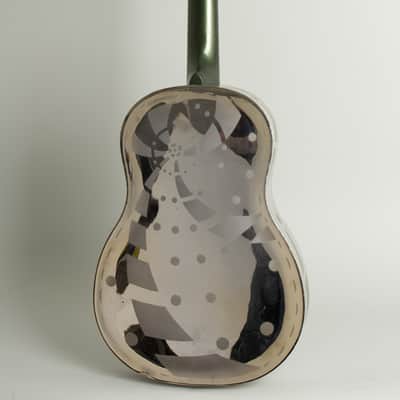
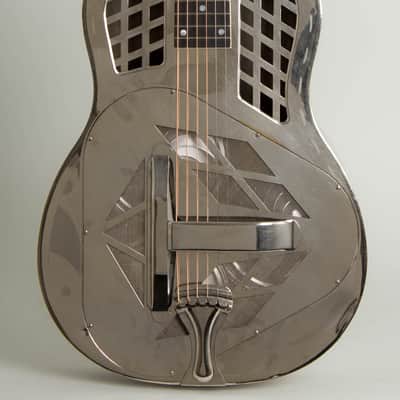
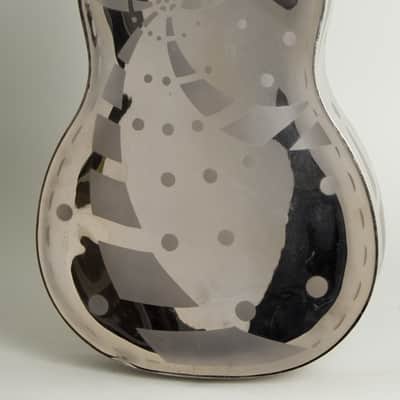
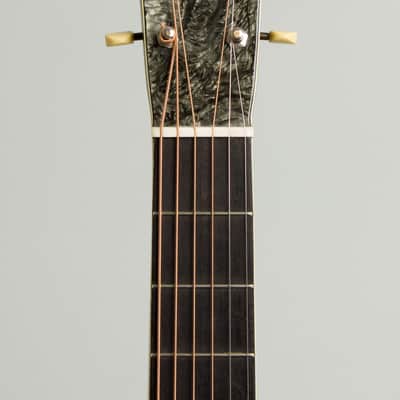
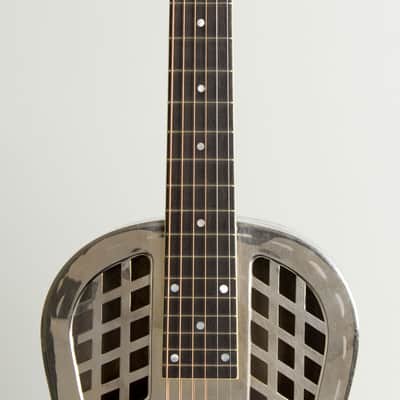
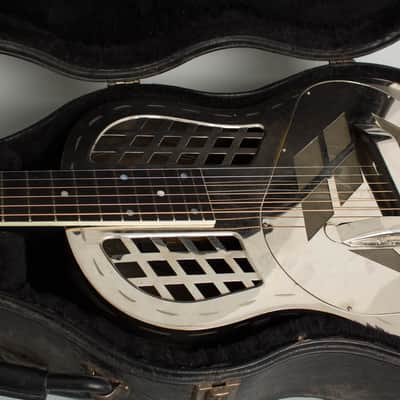
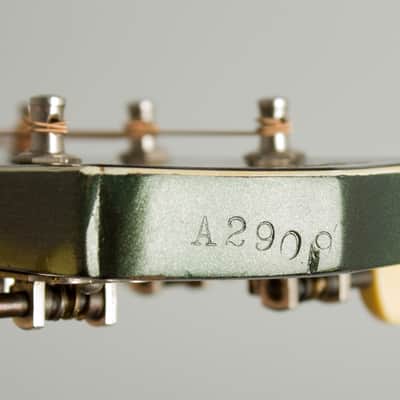
After the 1920s Jazz Age party came crashing down and the depression kicked in the expensive Tricones were increasingly unaffordable, National surviving mostly on cheaper single cone guitars. This model represents an effort to create a more affordable Tricone, as were the sandblasted and painted Styles 97 and 35. The body is nickel plated and has abstract sandblasted designs that on the back at least could be interpreted as a palm tree from outer space raining coconuts. The wood neck has a bound ebony fingerboard and the solid headstock is faced in mottled grey pearloid with an etched National logo. The serial number stamped on the top of the headstock puts this example as the earliest known of the second documented batch, in the A-2900 series.
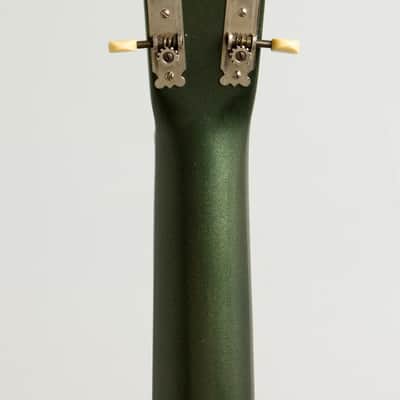
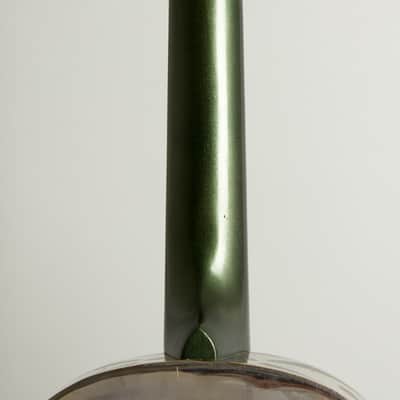
We believe this was originally a square neck Hawaiian instrument very cleanly converted to a round neck, and is sold as such. The neck was refinished in a decent approximation of the green/grey lacquer many were originally finished in, if a bit "greener" than the original. The profile is chunky and fairly flat but comfortable, and then heel is carved in a decent approximation of the typical National pattern. The fingerboard appears original, neatly refretted with appropriate wire. The cones have been replaced but the tuners and the rest of the hardware remain original.
The Tricones were mostly forgotten after WWII until the blues revival of the 1960s brought a new interest to the old resonator designs. This striking silver guitar looks modern even today, plays perfectly and has the smooth deep and punchy sound, fabulous for both slide blues or other 6-string fingerstyles.
Overall length is 38 1/8 in. (96.8 cm.), 14 1/4 in. (36.2 cm.) wide at lower bout, and 3 3/16 in. (8.1 cm.) in depth, measured at side of rim. Scale length is 25 in. (635 mm.). Width of nut is 1 27/32 in. (47 mm.).
This is a generally well preserved Tricone, as noted a very well-done conversion from a Hawaiian square neck to the more generally playable round neck style. The body shows some general wear -- mostly scuffing and scratching to the plating -- and some mostly small dents largely around the rim. The three spun aluminum cones are later replacements while the 3-point saddle unit, fluted tailpiece and Waverly strip tuners remain original.
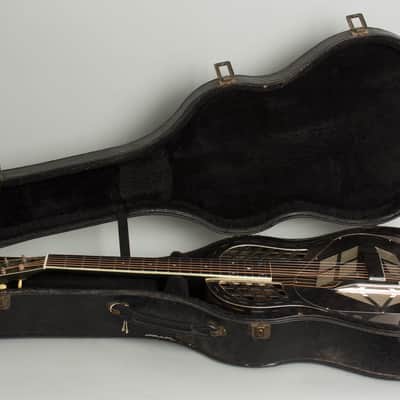
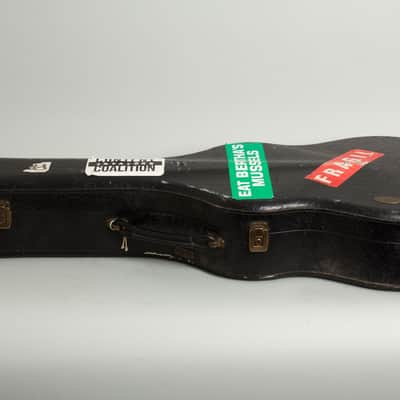
The original square wooden neck was at some point re-carved and refinished, but still preserves a nice period look and the serial number on the top of the headstock is still intact. The correct-style frets show hardly any wear, the fingerboard is clean as well. The neck is chunky but comfortable, playability is excellent and this extremely rare National instrument is both great-looking and fabulous-sounding. It lives in a well-worn touring case festooned with stickers. Overall Very Good + Condition.
This distinctive 1937 Tricone is one of the most obscure of all National products, so rare whatever name the company may have had for it is lost to history. It is generally referred to as the "Exploding Palm Tree" Tricone, a nickname made up by collectors trying to describe the abstract decorative patterns on the body. This was codified in National reference books and has since become part of the general resophonic lingo, no official name having ever been unearthed.
This VERY rare variation the pre-war National Tricone has a brass body, not the German silver used on earlier Styles 1-4. The neck is wood, not the integral metal neck used on those which makes conversion of a Hawaiian model to the standard Spanish style fairly easy, as indeed has been done here. Tricones in general are often considered the best-sounding of all acoustic resonator guitars, and this is a nice if very unusual example. The brass body Tricone offers perhaps a slightly "tighter" response than the familiar German silver models, with a bit less of the overtones and more fundamental-rich tone.
As its name implies the Tricone uses 3 small spun aluminum cones to amplify the strings, set inside a hollow metal body. This mellows the attack and adds sustain, creating a uniquely ethereal sound. The original Tricone was a collaboration between inventor John Dopyera and Hawaiian guitarist George Beauchamp, who wanted a louder instrument for the vaudeville stage than existing wooden guitars. The project came out so well that in 1927 they attracted investors and went into production, with four styles of Tricones ranging from a plain deco Style 1 at $125 through the elaborately engraved $195 Style 4.
After the 1920s Jazz Age party came crashing down and the depression kicked in the expensive Tricones were increasingly unaffordable, National surviving mostly on cheaper single cone guitars. This model represents an effort to create a more affordable Tricone, as were the sandblasted and painted Styles 97 and 35. The body is nickel plated and has abstract sandblasted designs that on the back at least could be interpreted as a palm tree from outer space raining coconuts. The wood neck has a bound ebony fingerboard and the solid headstock is faced in mottled grey pearloid with an etched National logo. The serial number stamped on the top of the headstock puts this example as the earliest known of the second documented batch, in the A-2900 series.
We believe this was originally a square neck Hawaiian instrument very cleanly converted to a round neck, and is sold as such. The neck was refinished in a decent approximation of the green/grey lacquer many were originally finished in, if a bit "greener" than the original. The profile is chunky and fairly flat but comfortable, and then heel is carved in a decent approximation of the typical National pattern. The fingerboard appears original, neatly refretted with appropriate wire. The cones have been replaced but the tuners and the rest of the hardware remain original.
The Tricones were mostly forgotten after WWII until the blues revival of the 1960s brought a new interest to the old resonator designs. This striking silver guitar looks modern even today, plays perfectly and has the smooth deep and punchy sound, fabulous for both slide blues or other 6-string fingerstyles.
Overall length is 38 1/8 in. (96.8 cm.), 14 1/4 in. (36.2 cm.) wide at lower bout, and 3 3/16 in. (8.1 cm.) in depth, measured at side of rim. Scale length is 25 in. (635 mm.). Width of nut is 1 27/32 in. (47 mm.).
This is a generally well preserved Tricone, as noted a very well-done conversion from a Hawaiian square neck to the more generally playable round neck style. The body shows some general wear -- mostly scuffing and scratching to the plating -- and some mostly small dents largely around the rim. The three spun aluminum cones are later replacements while the 3-point saddle unit, fluted tailpiece and Waverly strip tuners remain original.
The original square wooden neck was at some point re-carved and refinished, but still preserves a nice period look and the serial number on the top of the headstock is still intact. The correct-style frets show hardly any wear, the fingerboard is clean as well. The neck is chunky but comfortable, playability is excellent and this extremely rare National instrument is both great-looking and fabulous-sounding. It lives in a well-worn touring case festooned with stickers. Overall Very Good + Condition.
| Pubblicato | 2 mesi fa |
|---|---|
| Condizione | Molto buono (Usato) Gli articoli "Molto buoni" possono mostrare qualche piccolo segno o graffio ma sono pienamente funzionali e in buone condizioni generali.Scopri di più |
| Marchio | |
| Modello |
|
| Finish |
|
| Categorie | |
| Anno |
|
Le informazioni sulla sicurezza del prodotto sono disponibili qui.

Protezione di Reverb
Resi semplici, transazioni sicure, assistenza di persone in carne e ossa
Scopri di più