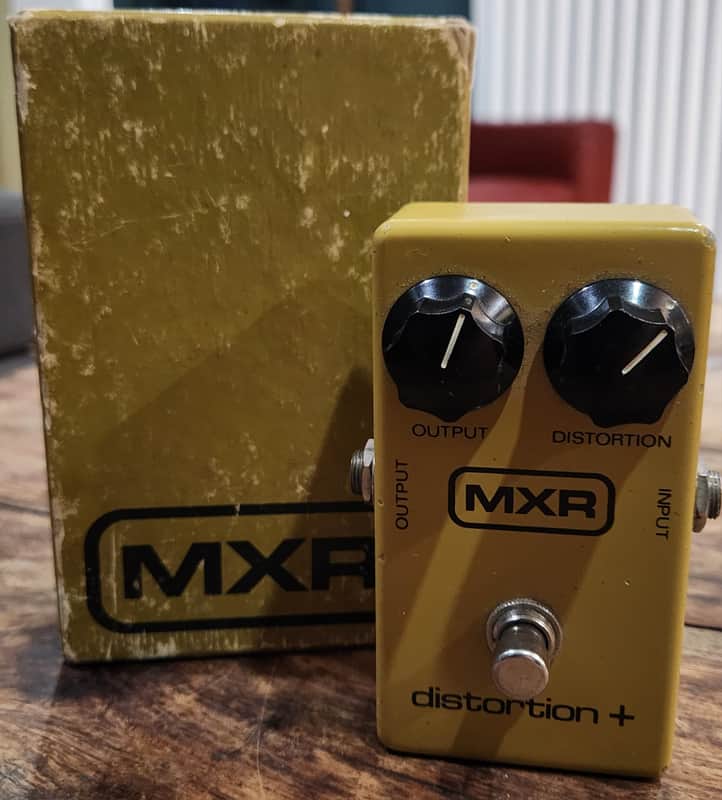
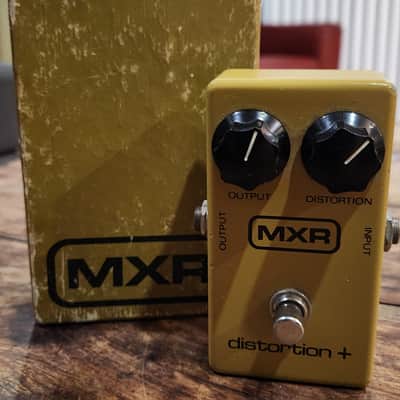
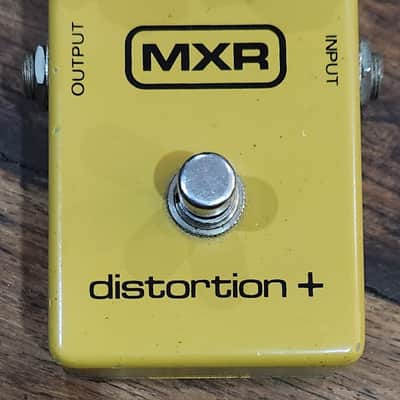
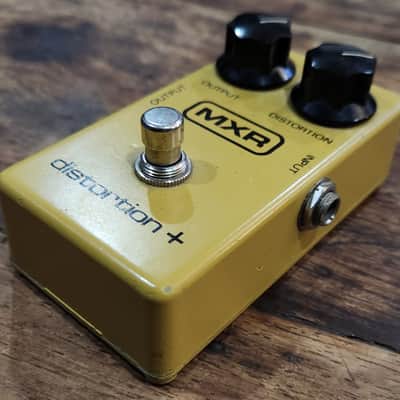
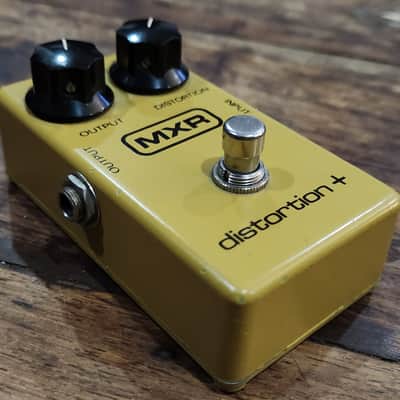
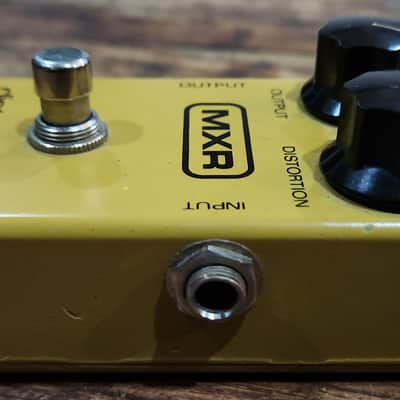
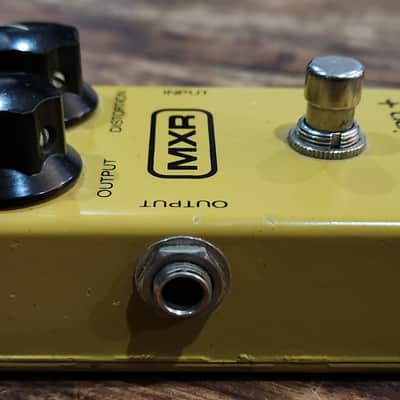
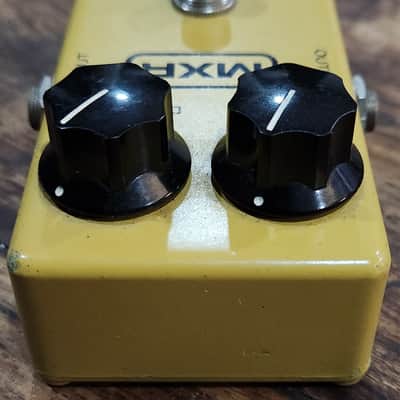
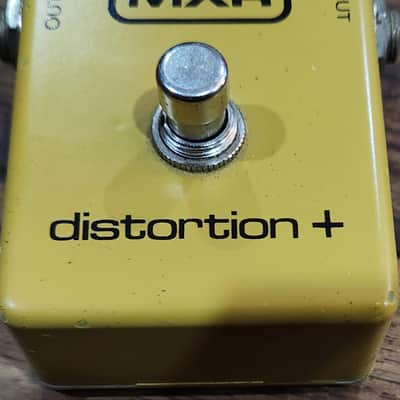
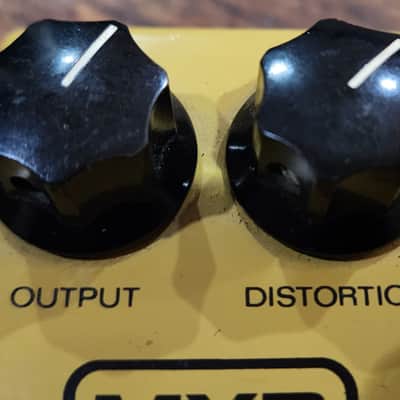
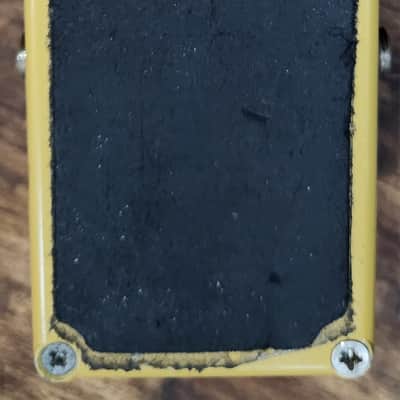
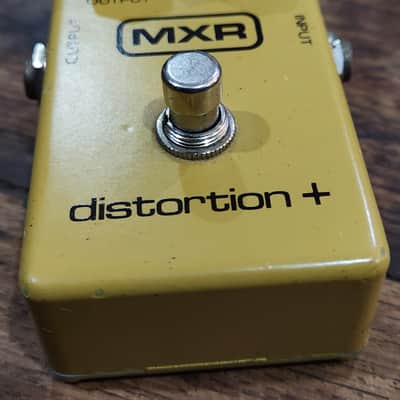
VINTAGE! M104 MXR Distortion + Brown Block Logo Germanium Soft Clipping 1970s USA

Our users rate Reverb
Read through for shipping info. We ship internationally via courier at heavily reduced rates.
See store for more cool finds.
Scroll down for video.
The sound of Randy Rhodes and Bob Mould....
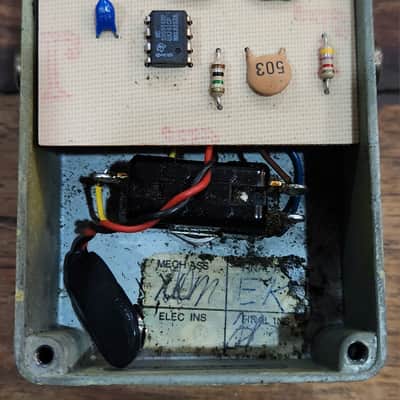
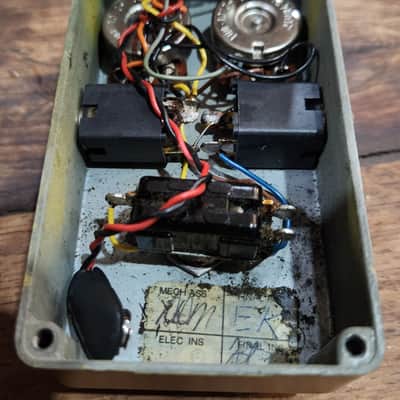
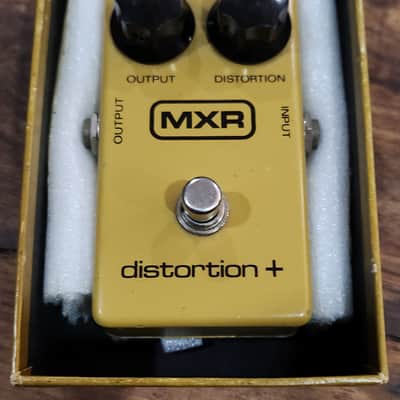
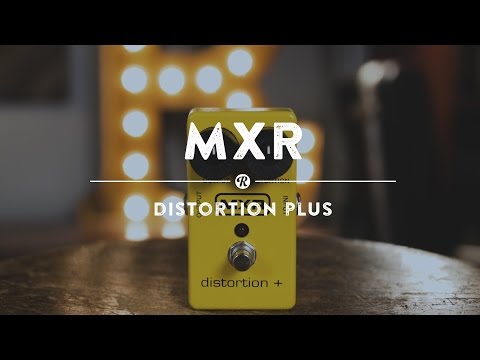
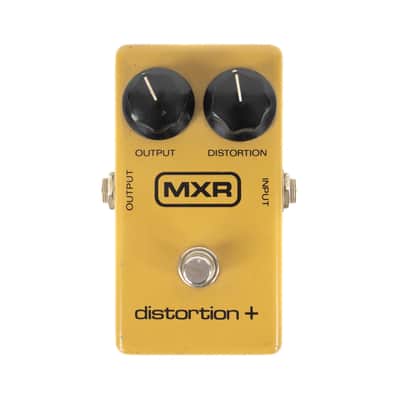
Here is a vintage 1982 MXR block logo Distortion +. These pedals are brown for a reason. MXR were the first pedal makers to coin the term 'distortion' in a pedal and that pushed Marshall 'brown sound' is exactly what they created...but better. Many will think of Randy Rhodes and early Ozzy solo era but for us at Music Man, it's Husker Du. If you love that distinctive, adrasive, treble all the way up, bridge humbucker sound that Bob Mould pioneered, this is the pedal that he used. The new yellow ones do not sound the same. Tested and sounding fantastic. Comes with original box.
FROM PREMIERE GUITAR:
Celebrating a Nasty Little Dirt Box
The MXR Distortion + isn’t the sexiest OD pedal on modern ’boards, but it’s durable, moddable, and gets the job done with dispatch. All hail the D +!
This is an homage to a nasty little pedal with a long history, so basic and overshadowed by the endless fiesta of overdrive and fuzz boxes that have come in its wake that, today, despite being in production for nearly 50 years, it is often snubbed. At least until the hunt is on for gritty, vintage ’60s through ’80s tone. Because that’s where the MXR Distortion + does its dirty deeds.
For many of us, our first pedal was the Distortion +. I have fond memories of stomping on mine—which I bought used at Cambridge Music in Cambridge, Massachusetts, for about $20—in my early stage days at Boston-area clubs like the Rat and the Middle East. When I tapped the switch, my Twin Reverb grew hair. (I was looking for a Big Brother and the Holding Company vibe.) And when I gamed up to the Twin and a Marshall plexi with a 4x12, running parallel, the extra gain pushing the Super Lead was fil-thee. What I loved, I later came to realize when I had more distortion device experience under my belt, is how—regardless of the settings—the essential sonic qualities of both of those amps remained intact … mostly.
My Distortion + is from 1979. But the device first emerged from the MXR shop in 1974. It is very simple—which appealed to me in my beginner days and, honestly, still does—inside and out. It has an output and distortion control, and, under the hood, a single op-amp and a pair of germanium diodes. That setup is key to its old-school sound, which also delivers some juicy compression. Crank up the distortion and the D + also boosts treble a bit, to preserve some punch. Gain ain’t shabby, either. At minimum, the distortion dial lays out about 3.5 dB of gain, and maxed there’s roughly 46.5 dB, according to the folks at Catalinbread, who extol the Distortion +’s virtues on their website.
There are filthier pedals, and boxes with a lot more headroom—since this is a hard clipping device—but this humble stomp gets the job done on a budget. And because of its low price and simple innards, it appeals to pedal modders, who have an easy menu of options to alter the compression, add more bass, provide better control gain, put the diodes in parallel, add a tone control, and other tricks. Brian Wampler’s PG article “MXR Distortion Plus Mods,” from 2008, provides details.
Perhaps the best-known Distortion + user is Randy Rhoads, who set the output dial to 10 and the distortion level at 4, reportedly, during the Blizzard of Ozz era, minting the riffs for “Crazy Train” and “Mr. Crowley.” Other prominent devotees include Jerry Garcia (who fanboyed the device in the late ’70s), Bob Mould of Hüsker Dü, Dave Murray of Iron Maiden, the Dream Syndicate’s Steve Wynn, and Thom Yorke of Radiohead. Even Slash was known to use this proletarian pedal in the early days of GNR. So, take that, boutique pedal snobs! The MXR Distortion + is good stuff, indeed.
Have you ever thought about the origin of effects names? I definitely have. As long as I’ve been contemplating things like what the word “jazz” actually means and other such things, I also wonder how folks listened to the FZ-1 or the broken console through which Marty Robbins and his band recorded “Don’t Worry” and thought, “hmm, fuzz is definitely the word for this sound.”
Of course, malfunctioning equipment is the greatest invention for electric guitar. Just like the aforementioned bogus console tube, or the Kinks slicing their amps’ speakers to produce more ragged tones, the concept of distortion in general arose from something once seen as an unwanted byproduct of amplification.
Low-watt tube amps, as we know, can “break up” when the volume is turned up. This wasn’t always ideal, especially as the audiences for electric guitar music became larger and the stage size outpaced the size of amps in general. You want to get loud? It’s going to distort. You want it to stay clean? Buy a bigger amp. Distortion was persona non grata in those days, and amp manuals distinctly warned players not to turn up too loud, lest your guitar sound broken, or just downright unpleasant.
Over time though, this became a desirable trait, and there is perhaps no bigger piece of evidence than effects produced specifically to distort a signal and then feed that distortion through a loud clean amp. What a difference a few years makes to completely flip the very function of gear 180 degrees. This pedal is the MXR Distortion+.
Many fuzz pedals danced around the idea that a signal should be distorted when it hits an amp, but not like a pedal like the D+ that put this sound in amp terms. While fuzz units provided a tone that was quite literally modeled after electrically malfunctioning equipment, the D+ made your amp sound like a naturally distorting amp, more or less. Did it sound like “your amp”? Not exactly. But it did sound like “an” amp, that’s for certain.
Now that we live in an era where overdrive pedals have 12 knobs, the idea that someone can skirt by without so much as a tone knob is rather droll. But when you’re first at bat, you can either hit or strike out, and MXR hit. Much like the company’s other products, the simplicity and actual tones were a revelation in the mid ‘70s. Manufacturers both domestic and foreign descended on MXR’s designs and used them as a foundation to launch their own lines. Ross Electronics of Chanute, Kansas was one such company, as was Japan’s Coron among many—almost innumerable—others. But it was MXR that coined the term “distortion pedal” and made monstrous cranked amp tones accessible to apartment dwellers and beginners.
By today’s standards (and even compared to the other pedals in MXR’s 1970s catalog) the parts count and overall topology is rather demure. Popping the lid of the D+ reveals a sparsely populated board with just a handful of components, including three simple semiconductors. By contrast, the Blue Box or Phase 100 were lousy with parts, filling their boards to the brim.
The distortion engine of the D+ is a simple op-amp with a large 1M pot setting the voltage gain. At minimum, the Distortion knob delivers just 3.5dB of gain, but at maximum there’s 46.5dB of gain, a full 11.5dB more than the next benchmark in purposeful distortion, the Boss DS-1. Yes, that is loud. But right before reaching the output jack, the signal is clipped by a pair of anti-parallel germanium diodes that clip the waveform heavily, leading to distortion. If you were to take a pair of wire cutters and remove these diodes from the D+ board, you would dramatically increase the volume at the expense of saturation.
This acts sort of like an amp, in a roundabout way. The forward voltage of the diodes ensures that the signal is clipped once it passes a certain threshold. And until the player crosses that threshold, the diodes won’t turn on and the signal remains unaltered by them. Turning the distortion control up amplifies the signal to intentionally clip and compress, which sounds an awful lot like tube amp distortion if you squint your proverbial eyes.
Despite its no-frills facade, the D+ is quite an important piece of gear history and has served as a crude blueprint for what distortion effects would become in the future. I love it and if you haven’t played one, you’re cheating yourself.
Overseas buyers contact us with your address for an accurate shipping quote.
Items are packed properly and shipped within twenty four hours.
Reverb Buyer Protection
Reverb has your back if your item is lost, damaged, or doesn't match its description. Simply report any issues within 7 days and we'll help you get a full refund.Learn more about Reverb Buyer Protection.
| Listed | a month ago |
|---|---|
| Condition | Very Good (Used) Very Good items may show a few slight marks or scratches but are fully functional and in overall great shape.Learn more |
| Brand | |
| Model |
|
| Finish |
|
| Categories | |
| Year |
|
| Made In |
|
| Pedal Format |
|
Product safety information may be available here.

