Korg Trident
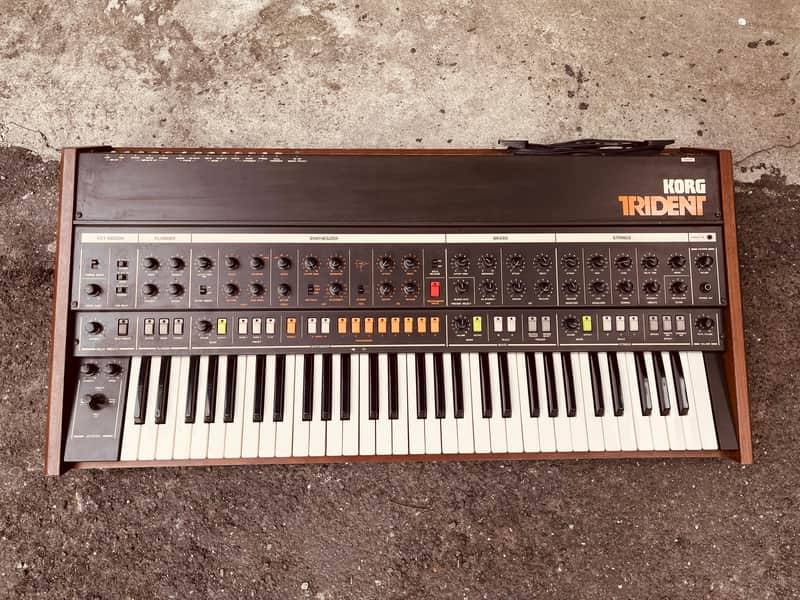
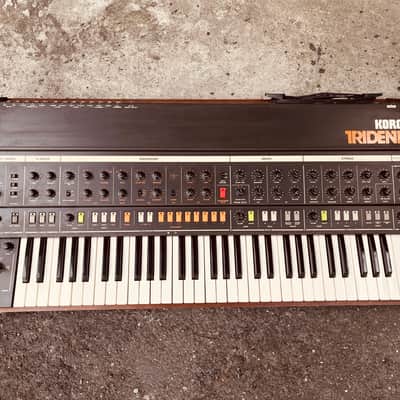


Korg Trident

I nostri utenti valutano Reverb
The Korg Trident (released in 1980, is a legendary but somewhat underrated 8-voice analog polyphonic multi-section synthesizer. It combines three completely independent synthesis engines in one massive instrument — a true “triple-threat” hybrid that was Korg’s ambitious flagship before the Polysix / Poly-61 era.
Here are its most important features and characteristics:
Core Architecture
• 8-voice polyphony across the whole instrument
• Three separate sections that can be layered or split across the keyboard:
1. Polysynth Section — the most powerful part (dual VCO per voice)
2. Brass Section — bright, punchy ensemble brass / synth hybrid
3. String Section — classic warm string machine style
• 61-note keyboard with split and layer capability (upper/lower/both assignment for each section)
Polysynth Section (the real “synth” heart)
• 2 VCOs per voice:
• VCO-1: Sawtooth, Square, Pulse, PWM
• VCO-2: Sawtooth only + detune
• 24dB/oct Low-pass filter (SSM2044 based, very warm & musical, capable of self-oscillation)
• ADSR envelope(s) → single shared ADSR
• PWM, cross-modulation feel, very characteristic early-80s Korg tone
Brass Section
• Single VCO (saw-based)
• Very similar filter + envelope architecture to the Polysynth section
• Fast attack, bright & aggressive — great for synth brass, horns, or extra aggressive leads
• Often used as a second synth layer because of the similarity
String Section
• Single oscillator with paraphonic ensemble/chorus character
• Simple Attack/Release envelope
• Dedicated EQ (low/high)
• Bowing effect (initial volume accent on new notes — very characteristic!)
• Classic rich, washy analog string sound (think Solina / ARP String Ensemble vibe but darker)
Signature Effects
• Global analog flanger — one of the Trident’s most loved features!
• Can self-oscillate dramatically
• Controls: Speed, Feedback, Intensity, Manual
• Can be routed to any combination of the three sections
• Joystick controller: left/right = pitch bend, up/down = vibrato / trill intensity
Memory & Practicality
• 16 user programs + 3 presets (Piano 1/2, Clavi)
I/O & Connectivity
• Separate outputs for Synth / Brass / Strings + mix out + headphone
• CV/Gate inputs per section (filter, trigger, expression) — very patchable
• No native MIDI (needs retrofit)
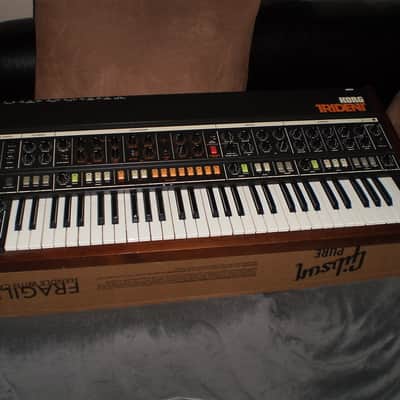
Here are some photos of the beautiful (and huge!) Korg Trident panels:
• Extremely versatile “one-box orchestra” for 1980–82 standards
• That self-oscillating flanger is pure magic on pads/strings/brass
• Very warm, organic Korg SSM-chip sound (many prefer for dreamier 70s vibe,
• Underrated classic — never became as famous as Prophet-5 or Jupiter-8, but has a very devoted following today
If you’re hunting for the classic analog layered string/brass/synth sound of early 80s prog / new wave / film scores — the Trident is a very special (and still relatively affordable compared to other flagships) vintage beast! 😎
100v Version
We accommodate different regions by supplying the correct power transformer according to your local voltage (e.g., 110-120V or 220-240V).
Protezione di Reverb per gli acquirenti
Reverb ti protegge nel caso in cui il tuo articolo venga perso, danneggiato o non corrisponda alla descrizione. Basta segnalare eventuali problemi entro 7 giorni e ti aiuteremo a ottenere il rimborso completo.Scopri di più sulla Protezione di Reverb per gli acquirenti.
| Pubblicato | 9 mesi fa |
|---|---|
| Condizione | Molto buono (Usato) Gli articoli "Molto buoni" possono mostrare qualche piccolo segno o graffio ma sono pienamente funzionali e in buone condizioni generali.Scopri di più |
| Marchio | |
| Modello |
|
| Finish |
|
| Categorie | |
| Anno |
|
| Numero di tasti |
|
| Azione della tastiera |
|
| Analogico / digitale |
|
| Polifonia |
|
| Dimensione del tasto |
|
Le informazioni sulla sicurezza del prodotto sono disponibili qui.

Protezione di Reverb
Resi semplici, transazioni sicure, assistenza di persone in carne e ossa
Scopri di più