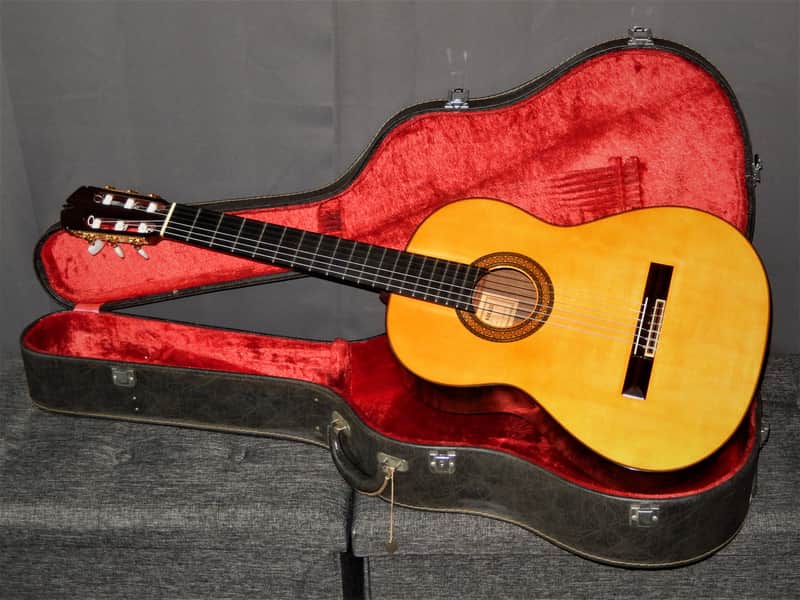
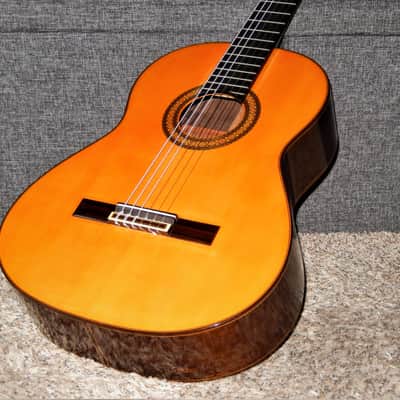
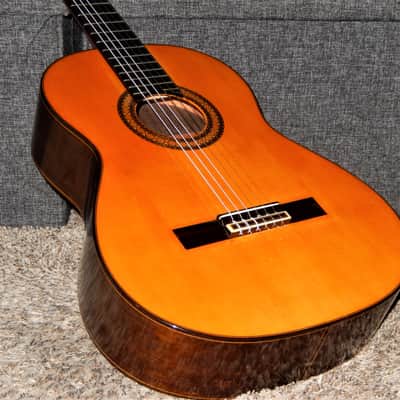
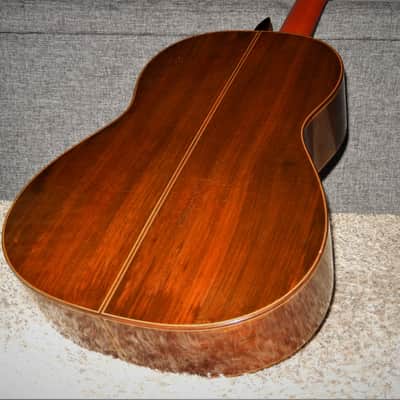
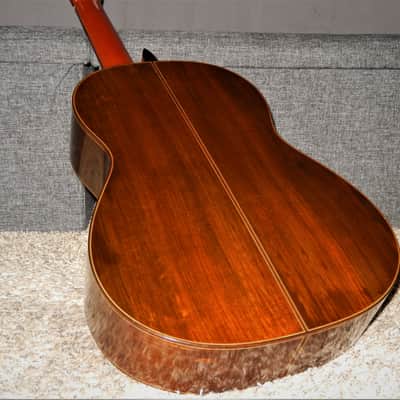

BARGAIN - TERUAKI NAKADE C100 1972 - HERNANDEZ y AGUADO CLASS CLASSICAL CONCERT GUITAR - SPRUCE/BRAZILIAN ROSEWOOD


Our users rate Reverb
YOU ARE LOOKING AT A WORLD CLASS INSTRUMENT PRICED AT THE BARGAIN LEVEL. CURRENTLY MADE IN JAPAN BRAND NEW GUITARS OF THIS CLASS MADE WITH OLD GROWTH BRAZILIAN ROSEWOOD ARE PRICED MINIMUM $15000USD.
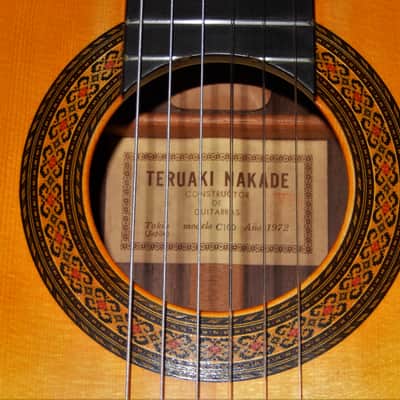
Guitar you are looking at was made in 1972 by Teruaki Nakade, an eldest son of Sakazo Nakade (by many experts considered The Father of Modern Japanese Lutherie).
Born in 1931 Teruaki started working for his father in 1946 (at the age of 15). Besides being trained by his father, Teruaki went to Spain in 1964 and spent 2 years working for famous Hernandez Y Aguado shop in Madrid, and after his return to Japan he opened his own independent workshop in 1966. His guitars are made based on Hernandez Y Aguado blueprints yet have his own personal touch. He kept making them until his retirement in 2011.
Although never as famous as his father, Teruaki was a very accomplished luthier himself and could price his guitars at the same level as his younger brother Toshihiko, although not at Masaru Kohno level. Briefly saying, he had to deliver “more for less”.
There is a video on Youtube entitled "Masakazu Okano plays premium guitars, Herman Hauser, Paulino Bernabe, Paul Fischer, Teruaki Nakade" in which the Japanese professional classical guitarist Masakaru Okano compares a T. Nakade with a Hauser, Paulino Bernabe, and Paul Fisher.
The guitar you are looking at was priced 100 00 yen in 1972. Yet it easily challenges (priced 50% higher) Masaru Kohno No15.
As of today, there is no way to get in Japan a brand new French Polished classical guitar made with solid BR b/s for less than $15000.
This guitar absolutely deserves to be called a “Grand Concert Guitar”. It offers great volume, super response combined with sweet and somewhat dark tonality, high level of note clarity and separation, all greatly enhanced by great deal of overtones and great sustain. Even though it is made with Spruce top, this guitar offers some warmth and is not as bright as most other guitars from that group. It truly is a beautiful instrument.
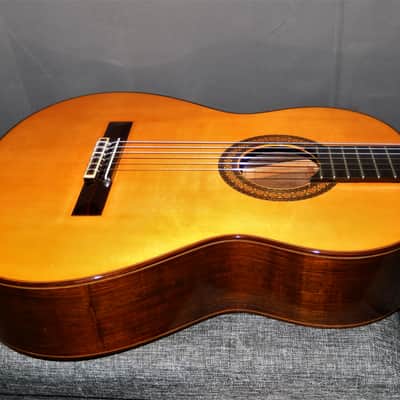
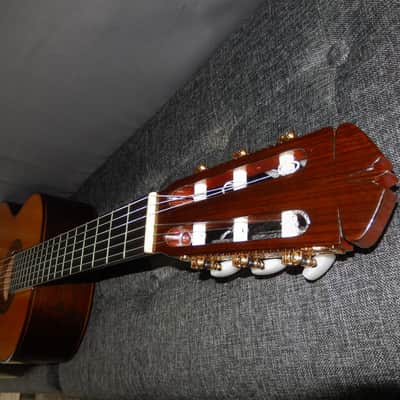
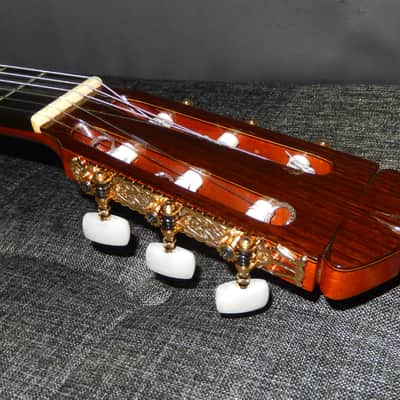
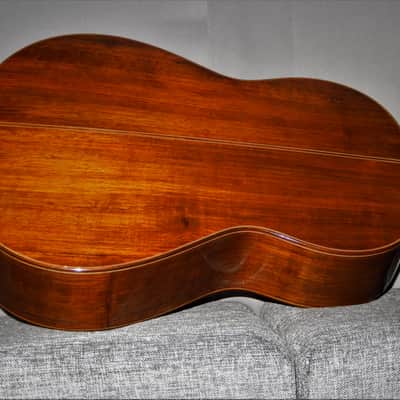
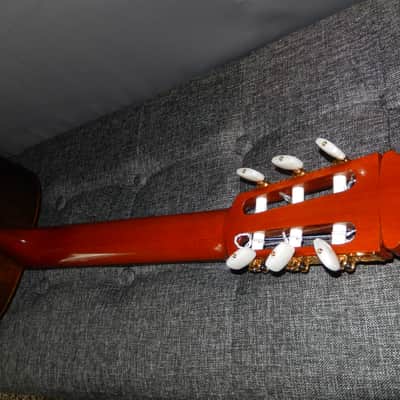
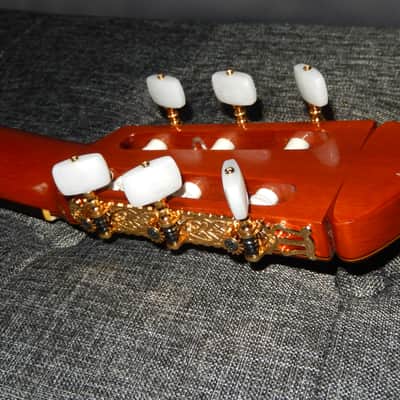
Despite its age this guitar remains in “excellent for its age” condition. While its body bears several light scratches and tine dents (most of which are located on the soundboard) it is structurally sound, its neck is straight, fingerboard and leveled frets remain in excellent condition. The damaged original tuners were replaced with new Gotoh set.
Specification:
Top: Solid Spruce/Shellac
Back& Sides: Solid Brazilian Rosewood/ Shellac
Neck: Mahogany
Fingerboard: Ebony
Nut width: 52mm
Scale: 658 mm
The action is set to 3.70 mm under E6 and 3.2 mm under E1, with practically no extra room on the saddle. This action however is already lower than standard for classical guitars, especially for vintage ones.
This guitar will be shipped in the original used hard shell case in still good condition (although some deterioration on outside).
THE ONLY PURPOSE OF THIS CASE IS TO PROTECT THE GUITAR DURING SHIPMENT. I WILL NOT PROVIDE ITS DETAILED DESCRIPTION OR MAKE ADDITIONAL PICTURES, NOR I WILL ACCEPT ANY COMPLAINTS. IF YOU DON’T LIKE THIS CASE YOU WILL NEED TO BUY A DIFFERENT ONE.
WHEN YOU BUY ANY GUITAR, YOU MUST ANTICIPATE TAKING IT TO YOUR LOCAL GUITAR SHOP FOR FINAL ADJUSTMENTS CALLED “SETUP”. DEPENIDNG ON YOUR PLAYING TECHNIQUE, THIS SETUP ON USED GUITARS MAY INCLUDE NEW CUSTOM-MADE NUT AND SADDLE. IF YOU HEAR STRING BUZZ IT DOESN’T MEAN THAT GUITAR IS DEFECTIVE. IF YOU PLAY HARD ENOUGH ALL BASS STRINGS WILL BUZZ OVER THE FRETS, UNLESS THEY ARE SUSPENDED VERY FAR FROM THE FINGERBOARD. UNLESS YOU PLAY QUITE GENTLY, YOU CAN’T HAVE LOW ACTION AND NO BUZZES. KEEP IN MIND THAT CELLO-LIKE BASSES ON HIGH GRADE CLASSICAL GUITARS HAVE THEIR NATURAL “BUZZ”.
Real Value of Japanese Vintage Guitars
The key to understand value of vintage Japanese guitars is to acknowledge galloping price inflation throughout the late 1960s and 1970s with its peak of 25% in 1974.
During 1960s and most of 1970s model numbers of Japanese guitars were strictly connected with their prices in Japanese yen.
The same class guitar sold in 1970 for 100 000 yen (labelled as model 10), would be sold for 150 000 yen in 1972 (labelled as model 15), 200 000 yen in 1974 (labelled as model 20) and 300 000 yen in 1978 (labelled as model 30). Therefore, you shouldn’t be surprised that two Yamaha GC10 guitars made 10 years apart are two instruments of totally different class. The same rule applies to all guitar models made by all other Japanese makers.
Japanese inflation slowed down in the 1980s. By the early 1980s and during following decades model numbers were no longer strictly associated with their prices. Some Japanese guitar makers introduced model names instead of model numbers. For several economic reasons, since 1980s Japanese made guitars were becoming more and more expensive, while their exports slowing down. Today (2025) Japanese high end classical guitar models are priced at $20000USD level.
Reverb Buyer Protection
Reverb has your back if your item is lost, damaged, or doesn't match its description. Simply report any issues within 7 days and we'll help you get a full refund.Learn more about Reverb Buyer Protection.
| Listed | 6 months ago |
|---|---|
| Condition | Excellent (Used) Excellent items are almost entirely free from blemishes and other visual defects and have been played or used with the utmost care.Learn more |
| Brand | |
| Model |
|
| Finish |
|
| Categories | |
| Year |
|
| Made In |
|
| Body Shape |
|
Product safety information may be available here.

