


Strymon SuperKar+
Dieser Verkäufer hat keine Versandkosten für Deutschland hinterlegt. Bitte Kontakt ihn bezüglich Versand.


30 Tage Rückgaberecht
Genieße Sorgenfreiheit mit deinem neuen Equipment
Unsere Benutzer bewerten Reverb
A New Type of Synth Module
SuperKar+ is a Eurorack voice module that uses Karplus-Strong synthesis to recreate the sound of plucked or bowed strings, struck or blown pipes or tubes, or a suite of other sounds from percussive textures to legato melodies and chords with smart harmonies. This is Karplus-Strong synthesis at its most intuitive and captivating.
Karplus-Strong is a form of delay feedback synthesis, where every tone and texture is constantly in a state of varying tension. SuperKar+ is an engagingly responsive instrument, as tiny changes in attack/decay time and damping create an infinite variety of subtle or dramatic timbral shifts, and variable random per-note detuning can create lifelike realism.
Two Instruments In One: Independent Melodies and Chords
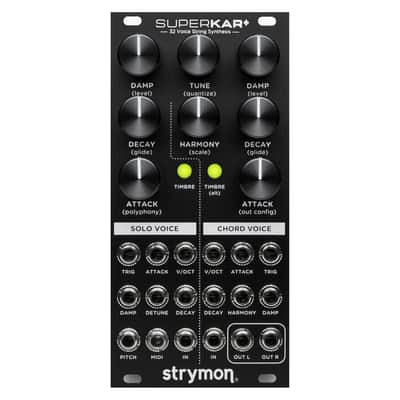
SuperKar+ is divided into two halves or voices: a Solo Voice and a Chord Voice, both of which can be played simultaneously and independently of each other if desired. Both voices can be triggered and pitched independently via control voltage, while the Solo Voice can also be controlled polyphonically via MIDI.
Independent timbre selections are available for both voices, and each voice has its own independent level control and can be routed through a separate audio output if desired.
32-Voice Polyphony
Set the polyphony on the Solo Voice to maximum and SuperKar+ can play up to 16 unique voices simultaneously. If you connect it to MIDI, the Solo Voice behaves as a 16-voice velocity sensitive polyphonic sound module with stable tuning over eight octaves. Via CV the stable tuning range is six octaves.
The Chord Voice can also play up to 16 internally-generated voices simultaneously with a tuning range of five octaves. It creates harmonies based on the root note received at its pitch CV input, and can even
create smart harmonies based on the root note plus a scale selection. The Chord Voice can also be used for creating compelling basslines with doubling and octave options.
Deceptively Powerful, Invitingly Simple And Intuitive.
With an interface that can be understood at a glance, the sheer amount of music you can create with a single SuperKar+ module borders on mind-blowing. It draws you in, allowing you to generate full-sounding arrangements with as much musical and timbral variation as you can imagine via CV connections. Powerful enough to be the center of endless sonic exploration, SuperKar+ delivers all of this in a compact 12HP form factor.
Self-Contained Voice Module
The nature of Karplus-Strong synthesis means that you won’t need to dedicate VCAs or amplifier envelopes to SuperKar+. Independent attack, decay and damping are included for both the Solo and Chord voices, and the module also includes an internal mixer with independent output levels for both voices, as well as multiple stereo and mono audio output modes.
SuperKar+ Values Your Input
The Solo Voice and the Chord Voice each have their own audio inputs, which can be used to not only excite the string or tube, but to transform either channel of SuperKar+ into a sympathetic resonator array for advanced or creative scenarios.
Sound Design
Inspiration Karplus-Strong Synthesis
When senior DSP engineer and Strymon co-founder Pete Celi finished tuning the monophonic Karplus-Strong voice in our StarLab
Experimental Reverb module a few years ago, he immediately started thinking about how to build a standalone polyphonic instrument.
But what exactly is Karplus-Strong synthesis? In this scenario, a very short delay line with high feedback is excited by a sharp transient or burst of noise to produce a pitched sound, which is very similar to the principle of plucking a string. Longer excitations can create bowed string sounds, and when the polarity of the feedback structure is reversed a pipe or tube-like timbre can be produced instead. In SuperKar+ this method of synthesis almost seems to be alive, responding dramatically to slight changes in attack and decay times as well as damping (high frequency filtering that can dampen the string or pipe’s vibration almost like a palm mute). Even clay drum textures can be found with certain settings.
Damp
From Brightly Ringing To Palm Muted
The Damp control is more than just a filter—it’s part of the delay feedback structure, affecting how freely the string or tube can vibrate. In combination with the Decay control it can produce anything from bright ringing textures to darker sounds with deep, resonant bass, extending even to palm-muted effects. CV control of the Damp parameter can create very lifelike and nearly human-performed sounds.
Decay
Play The Feedback
Coupled with a short Attack time, the Decay control allows you to create super short and tight percussive sounds near its minimum setting. Sounds ring out freely at higher settings, and tuned self-oscillation is possible near the maximum setting. The interaction between Damp, Decay and Attack can create an infinite variety of intriguing results, and all three are controllable via both knob and CV.
Attack
Attack of the Tones
Unlike traditional ADSR amplitude envelopes where a longer attack time means that a note takes significantly longer to fade in, with SuperKar+, longer attack times can produce bowed or blown sounds, ranging from
short strokes to more sustained bowing/blowing. Very short attack times create plucked or struck sounds. Like the Damp and Decay parameters, you can control the Attack time via knob or control voltage, with the knob acting as an offset for the CV input.
Detune
Solo Voice Detune
Available via CV input, the Detune feature on the Solo Voice allows for random detuning for every note that is played. This can take string-like timbres to a whole new level of realism, or add additional movement or even a haunting aspect to a patch.
Timbre
A Tale of Two Timbres
At the push of a button, SuperKar+ allows you to choose an independent timbre for each voice. The green LED denotes positive feedback for string-based sounds, and the red LED denotes negative feedback for hollow- tube-based sounds.
Glide
Portamento To The People
You can use the variable Glide setting to slow down the transition between pitch changes, with the effect being more noticeable and pronounced the further away the notes are from one another in pitch.
Harmony
Doubling, Octaves, Smart Harmonies And More
With the Harmony control you can create fat doubled notes, lower and higher octave and fifth harmonies, or choose from a selection of smart harmonies that can create advanced and expansive chords in conjunction with the Scale selection.
Even though the Voices are labeled “Solo” and “Chord”, you can easily play chords with the Solo Voice via MIDI while using the Chord Voice to create basslines with doubling or lower octave harmonies. You’re only limited by your imagination.
You can even create a unique tremolo-like effect by applying an LFO to
the Harmony CV input, where instead of varying the amplitude, the number of harmony extensions is increased or decreased.
Scale
Super Scale+
When a smart harmony is selected via the Harmony parameter, the Scale setting influences the flavor of the chords that will be produced. Choose from: Harmonic Minor, Aeolian, Major, Expanded Voicing Major Scale (for harmonies spaced further away from the root), Dorian, Lydian, Phrygian, or All Major Chords.
Pitch
Solo Voice Pitch
Connect an LFO to the Solo Voice Pitch CV input to create vibrato or trills, or connect an envelope for envelope-based pitch effects. You can also use this input for offsetting the pitch by a fixed amount. The range of the Pitch CV input is +/- 1 octave.
Output Configuration Modes
Wide Stereo, Independent Processing, and More
SuperKar+ is capable of creating a strikingly expansive stereo image. For both of its two stereo output modes, the Chord Voice creates the same type of satisfying stereo image based on the number of harmonies being used. The Solo Voice behaves differently, however.
For both stereo modes, if the Solo Voice has the polyphony set to 1, Solo Voice notes will be heard in the center of the stereo image. Once Solo Voice polyphony is raised to two or more voices, alternating voices will be panned left and right in the stereo image. In Wide Stereo mode, they are panned hard left and right, and in Narrow Stereo mode they are panned near 10 o’clock and 2 o’clock.
But that’s not all: SuperKar+ has two additional output modes for increased flexibility. Split Outputs mode sends the Solo Voice to OUT L and the Chord Voice to OUT R, so that you can process each signal separately. Mono Sum mode sends the same mono mixed output of
both voices through both outputs, allowing you to send the same mix to multiple destinations.
Audio Examples
One of the attractions of modular synthesis is its ability to inspire musical creation during experimentation. Many of the audio samples below were recorded by our DSP guru Pete Celi at different points throughout SuperKar+ development, inspired by various features he was working on at the time.
Videos
SuperKar+ Video Tour
Control & Routing
Press (+) for more info.
Specs
Sound Design
Ins, Outs, and Switches
Audio Quality
• Stable tuning over six octaves
• 520 MHz ARM Superscalar processor • 32-bit floating point processing • Designed and built in the USA
Dimensions & Power
| Zustand | Brandneu (Neu) Brandneue Artikel werden von autorisierten Händlern oder Herstellern verkauft und kommen in originaler Verpackung.Weitere Informationen |
|---|---|
| Marke | |
| Modell |
|
| Kategorien | |
| Hergestellt in |
|
| Synth-Modul-Funktion |
|
| Analog/digital |
|
| Modulares Synthesizer-Format |
|
| Horizontal Pitch |
|
| Polyphonie |
|
| MIDI-Ein- und Ausgang |
|
Möglicherweise sind hier Informationen zur Produktsicherheit verfügbar.

Reverb-Schutz
Einfache Rücksendungen, sichere Transaktionen, Support von Experten
Weitere Informationen