
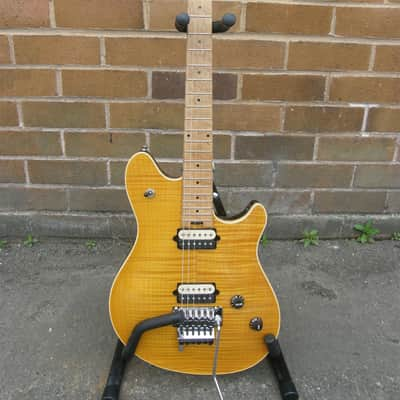



Peavey EVH Wolfgang 2001 - Trans Amber

Our users rate Reverb
Peavey EVH Wolfgang 2001 - USA made, not to be confused with the inferior Special or the Korean made guitars, this has a beautiful carved flame maple top and an utterly gorgeous maple neck with birdseye markings consistent all the way up the neck.
Amazing guitar, designed and used by the great Eddie Van Halen himself.
The guitar weighs 7lb 13oz, 3.61kgs, the nut width is only 41.0mm, quite narrow for you fat fingered folk, but it's a lovely neck, D-shaped and really an absolute joy and a really lovely piece of wood.
My investigations suggest this is 2001 model
Now that Eddie is sadly no longer with us, surely the guitars he not only played but helped design will only increase in value, and this is a great example in the best colour and spec.
Collection in person is preferred, but I can package the guitar in a gig bag inside a padded cardboard guitar box, for collection by courrier at your own risk.
Posted from Reverb
Eddie Van Halen switched allegiance in the mid-'90s, starting afresh with Peavey as his deal with Music Man ended. (Music Man continued to make the Axis, very similar to the Van Halen signature model.) Ed had already teamed up with Peavey to produce his 5150 amp and cabs in 1992 and a combo version in '95.
Jim DeCola was supervisor of guitar design engineering at Peavey, where he'd been since 1988. He'd worked on Peavey's Steve Cropper signature model, introduced in '95, along with a number of regular instruments for the product line. Jim first met Ed back when Peavey was courting the Van Halen guitarist for the amp deal, at which time Jim made a guitar—a one-humbucker Strat-style with a Floyd—to show what they could do in that department.
In fact, when Ed visited the plant in 1990 to talk amps, the guitar he seemed more taken with was the firm's new Peavey Odyssey, a sort of hybrid Tele–Les Paul model. Anyway, the idea went no further because, as we've seen, Ed decided to go with Music Man for his first signature guitar.
Come 1995, however, with the Music Man deal at an end, Jim made a copy of the Music Man to show they were capable of producing an instrument at the quality level Ed would expect. In March 1995, he showed Ed this guitar during rehearsals in Florida for Van Halen's Balance tour. Ed agreed to go ahead with Peavey on a new signature guitar.
Jim went back to the Peavey plant and mulled over the various ideas he wanted to incorporate in his design and present to Ed for approval. They began to-ing and fro-ing on the details, a process that lasted most of '95 as Ed took protos out on the road to test proposed features.
Peavey EVH Wolfgang manual cover, 1998
An early decision was to continue with a basswood body but to make the maple top contoured, in contrast to the flat, thin Music Man top (and perhaps harking back to that carved maple–mahogany Odyssey that Ed had liked). "Basswood does sound great," Jim tells me, "but sometimes it can be a little lackluster, and I think the hybrid basswood–maple really shined."
Jim made the body shape somewhat more asymmetrical, which meant the neck could be pushed a little deeper into the body, in turn improving balance. "It didn't neck-dive as much as the Music Man, because the tip of the horn was closer to the 12th fret," he says. "And because the neck was deeper into the body, when you're reaching for an open E or an F chord, it didn't feel as far out. It almost felt like a shorter-scale guitar, but it was still a full twenty-five-and-a-half."
Peavey continued with a maple neck, too, adding carbon fiber reinforcement rods, which Jim had tried already on a couple of Peavey basses. "I thought it had a lot of virtue," Jim says, "benefitting the feel and tone of the wood with the added harmonic potential and sustain of the carbon fiber, as well as extra stability. I put the rods in the first prototype I sent to Eddie, and he liked it, so we ended up keeping that feature."
Ed wanted a small version of a Flying V head, but Jim told him that was impossible, because it still counted as a copy of the Gibson original. Jim remembered a three-and-three staggered headstock on a guitar he'd built for himself, so he shrunk that a little, added a Peavey-like tip, and showed a rough to Ed.
"Hmm," said Ed. "I see where you're going—but I still like the V." Jim repeated his Gibson warning. Ed then made a drawing of a sort of V-notch idea, which Jim said was too close to a Washburn '70s style. Another drawing. Any good? Nope, too Dean-like.
Then Jim told Ed to give him a few minutes while he went off to the workbench. "I took my headstock I'd done, which had a black-painted face, went out to a spindle sander, and sanded a scoop into the tip of the headstock. I took it back to him, said why don't we do that? It had the V shape he was thinking about, and the scoop thing, and it still had the Peavey profile on the outside. And he's like, 'Oh yeah, I kinda like that.' We tried to honor Eddie's vision while keeping the Peavey identity."
1999 Peavey EVH Wolfgang. Photos by Thunder Road Guitars.
The Music Man guitar had featured a wheel adjuster for the truss rod, a feature that Ed was keen to continue with, but Jim felt it protruded too far and potentially weakened the neck pocket. So he recessed it into the end of the neck, improving stability.
For the pickups, Jim started with one from a Frankenstein that Ed liked, and duplicated it accurately, right down to the shorted-out coils. Ed said he liked it but wanted it without the shorting. Prototypes were made, then rejected in favor of something a little warmer. And so followed several months of back and forth. A frustrated Jim felt he was close to exhausting the possibilities. "So finally I sent back the original set of pickups I'd given him—and then he said, 'Yeah, this is it!' So it went full circle."
The Peavey pickups had a high-ish output, though not, Jim says, to Super Distortion level. "Some people were confused, because there was a higher DC resistance on the neck pickup, lower on the bridge. But they were two different wire gauges, so that's why they had two different voices, and they balanced out in terms of output."
Controls were a single volume and tone—a prototype with two volumes didn't last—where the Music Man had just volume, and the two knobs and switch were placed in a line, providing what Jim felt was a pleasing look within the body outline. The vibrato was a licensed Floyd Rose, made by Ping. "Ed just felt it sounded a bit better," Jim says, "because Floyds tend to get a bit bright and thin sounding. So we settled on a brass block, and that helped the tone."
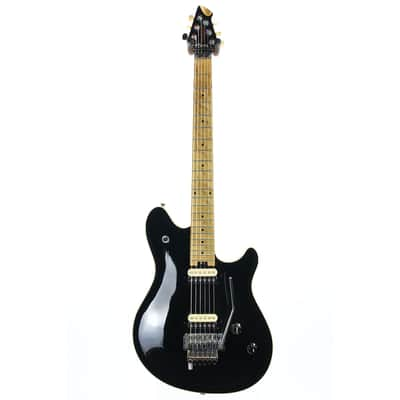
Peavey EVH Wolfgang Special with Floyd Rose10 available from £1,087.08
The bridge had a D-Tuner that Adam Reiver introduced to Ed. It was a barrel-shaped switch on the low E-string's clamping screw for instant drop-D tuning: left pushed in for regular E (or whatever your preferred low-string tuning); pulled out when you wanted D. Jim made some refinements to its fine-tuning capabilities and Ed gave the go-ahead for its inclusion on the guitar.
The Peavey Wolfgang was introduced at NAMM in January 1996, with Ed there to show it off.
"Our collective efforts in designing the Wolfgang guitar have resulted in a versatile, quality-crafted guitar that feels great, sounds great, and is truly inspiring to play," he was quoted in the official blurb. "I've already put mine to the test in the studio and on tour, and now it's your turn."
A basswood-only option was added, and a flat-topped, single-knob Wolfgang Special appeared in 1998.
"The toughest thing about working on Ed's guitar was going up against the Music Man," Jim says, "because they were just fabulously crafted guitars. We really had to step up our quality at Peavey to make sure we didn't look foolish going up against them. And the way I look at it, the Wolfgang was my life's work. I had so much involvement in it, and even though it was Ed's model officially, it was really my model. I like to say: I designed it; he approved it."
Reverb Buyer Protection
Reverb has your back if your item is lost, damaged, or doesn't match its description. Simply report any issues within 7 days and we'll help you get a full refund.Learn more about Reverb Buyer Protection.
| Listed | 4 months ago |
|---|---|
| Condition | Excellent (Used) Excellent items are almost entirely free from blemishes and other visual defects and have been played or used with the utmost care.Learn more |
| Brand | |
| Model |
|
| Finish |
|
| Categories | |
| Year |
|
| Made In |
|
| Body Shape |
|
| Right / Left Handed |
|
| Fretboard Material |
|
| Body Material |
|
| Number of Strings |
|
| Neck Material |
|
| Finish Style |
|
| Bridge/Tailpiece Type |
|
| Body Type |
|
| Offset Body |
|
| Pickup Configuration |
|
| Color Family |
|
| Scale Length |
|
| Neck Construction |
|
| Number of Frets |
|
Product safety information may be available here.


