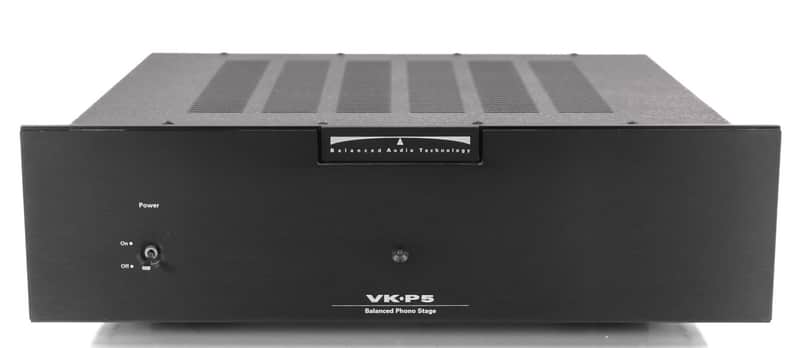
BAT VK-P5 Phono Pre-Amp VK-P5 2004 - Black Steel
This gear has sold
See similar gear from other Reverb sellers

Our users rate Reverb
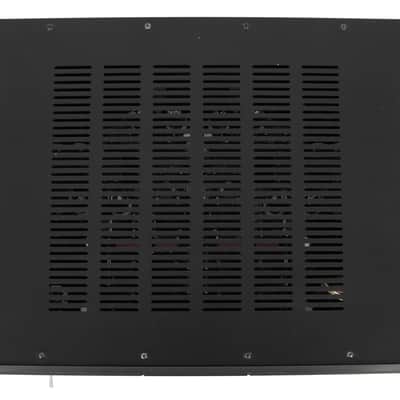
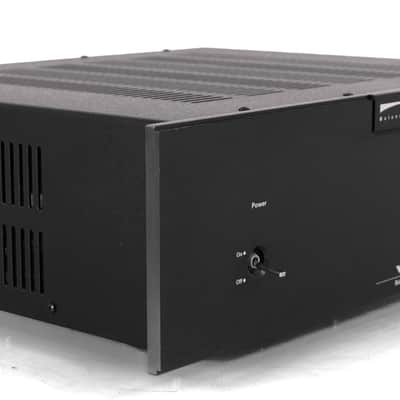
Balanced Audio Technology VK-P5 Phono Preamp. Dual mono, balanced zero feedback topology.
Very Rare!!
Sold On E-Bay For $1,200 Last Year
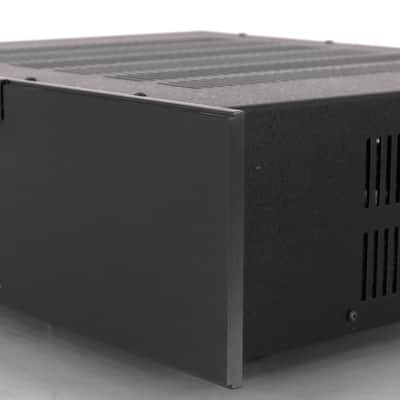
An Audiophile component with greatly extended dynamic range and the ability to resolve harmonic and reverberant detail in the quietest passages. Very clean in excellent cosmetic condition and fully functional.
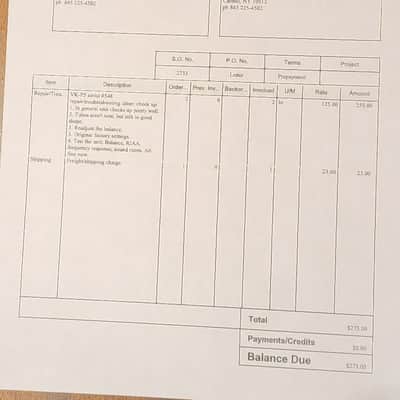
This unit was recently completely serviced.
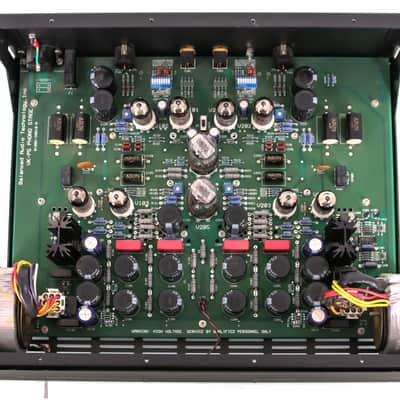
Tubes are:
2 x 6SN7WGTB Sylvania Made in USA
4 x 6s45p E Made in Russia
4 x E88C C Tesla
NO POWER CORED
Original Box
Specification BAT
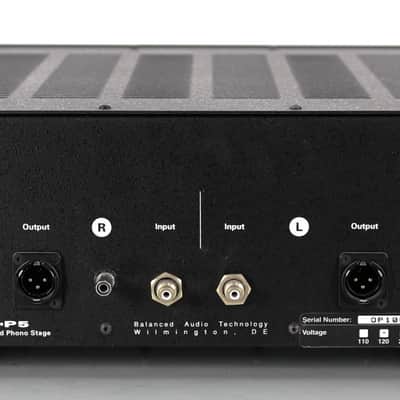
Inputs: XLR No
RCA Yes
Outputs: XLR
Gain @ 1kHz:
Direct-low position: 50 dB
Direct-high position: 55 dB
Step-up low: NA
Step-up high: NA
Signal-to-noise ratio (A-weighted referenced to 1mV):
Direct-low position 71 dB
Direct-high position 73 dB
Step-up high: NA
Cartridge loading:
Resistance: 100 O to 47 kO
Capacitance: 100 pF to 1000 µF
Polarity selectable inverting/non-inverting: No
Power supply energy storage: 140 joules
Power consumption-maximum: 150 VA
This built like a Tank
Weighs as much as some amplifiers.
The Doctor Whines just a bit …
Power and polarity switches are external, but everything else requires taking off the top cover and this constitutes one of only two somewhat minor issues I take with the P10SE.
First, BAT covers are NOT easy to remove, (special tool, little tiny screws, and lots of them) and secondly, the internal adjustment switches are not obvious and are quite small. I hate the little DIP switches, hate ‘em, hate ‘em, hate ‘em! I feel like a bear trying to crochet!
Finding the optimum settings for a given cartridge is likely to require several trips inside the P10SE. Each trip will require removing and replacing the cover and re-attaching the unit to power and interconnects, unless it occupies the top shelf, which is quite unlikely in most installations.
I am sure there are engineering reasons for both the size and the location of these switches, but I would be remiss if I did not point out what a complete and utter annoyance they are. Plus, just on general principles I don't like sticking my hands into the inner workings of expensive audio equipment unless there simply is no other way.
Absent the ability to electronically switch via the remote, external hard switches would be deeply appreciated (a la Bel Canto, Dynavector, Manley Labs, E.A.R., etc).
However, for most users, they will make these adjustments only when they switch cartridges and it will probably take an hour or less to dial in a specific cartridge. For reviewers, we do it all the time.
I might as well get the other remaining quibble out of the way, while I am at it. Toggle switches. I don't think switches that stick out from the front face of a component are a good idea, especially when those switches are somewhat on the delicate side. Murphy's Law clearly states, "That which protrudes gets snapped off." The BAT line stages have not used toggles since the transition from the 5i series. I much prefer those used on their current line stages, silky-action recessed buttons.
Ok, only two quibbles, neither of them sonic, not bad, and pretty typical for my experience with BAT.
The BAT House Sound
I think I know BAT equipment probably about as well as anyone not specifically involved in its design, manufacture or repair. For ten years, and thousands of hours I have lived with it, and in that time I have reached some conclusions.
It's all about power and musicality
I had the Lamm M1.2 hybrid monoblocks right next to the BAT VK-600SE for some time, switching back and forth, sometimes several times in the course of a few days. There are an enormous number of things to respect about the Lamm amps, but I was not charmed away from my BAT 600.
I don't think the 600SE is ultimately as detailed as the M1.2s, but …and this is the "but" that brought me home …the BAT is simply more harmonically rich and musical. I return to it like a favorite chair where I can simply relax, slip off my formal duds, crack a beer and do MUSIC.
This holds true for every BAT piece I have ever heard. There will always be a couple of boutique pieces that better them in some specific, single element, but overall …when certain set-up requirements are maintained, BAT remains at the head of the line for the most reliably musical audio equipment out there; the kind of musical where you forget about the equipment, take another sip and just lose yourself in the moment.
And unlike these boutique pieces that come and go in favor, you don't have to flinch when you turn the BAT equipment on, or wait with anxiety to see if the company is going to survive another year.
And that house sound! It's all about power, baby. Even this phonostage has over 200 joules of energy storage and a beefy chunky-monkey power supply …the flagship 600SE power amp has two toroidal power supplies, each almost as big as your head and a double row of "depth-charge" Jensen capacitors that make the insides of the amp look like the warp drive controller on the Enterprise!
All of this managed through balanced topology. Balanced is good. Balanced is quiet. Balanced solves a whole bunch of problems that are especially troublesome at the teensy tiny signal levels of anemic moving coil cartridges. Take a second and count up the transitions from millivolts to watts and you begin to get an idea of how many opportunities there are to completely frell the audio signal in analog before it ever gets to your speakers.
I have said it before, and it is still true, the BAT sound is meaty, big and bouncy! It is emotional, wet and declarative. There is nothing demure, nothing tentative, nothing fragile here. You hook this stuff up to a full range speaker and you get it all.
Speaking of bandwidth, I remember talking to Victor about the Sony SCD-1 SACD player, 50k cut switch soon after I transitioned to SACD, some years ago. There were horror stories running round about hypersonic oscillation from unfiltered DSD playback destroying power amplifiers.
He snorted …really, he actually snorted, and dismissed my concerns by telling me that BAT designs its amplifiers for full bandwidth and the amplifier (then the VK-500) would remain stable out past 100K. Leave the filter in, switch it out, no matter, whichever I preferred.
Ok, now try to imagine that self assurance and stability taken to the infinitesimal level of phono signals. This massive phono stage, wrapped completely around those tiny, flickering voltages …keeping them alive and unharmed through the journey to watt land.
If you read me with any regularity, you know I have a deplorable love for movie metaphors …so …think of Arnold the Reformed Terminator protecting the young John Connor. This is the BAT VK-P10.
But how does it sound?
Startling dynamics, absolute extension and iron-fisted control; transparent without being wispy, harmonically rich without a touch of sugary euphony, extremely fast and agile; capable of heartbreaking delicacy, but with the simple brutal strength to take on any program material you care to choose …and surprisingly neutral for a tubed amplification device; there simply are no sonic shortcomings here.
Another phonostage might gather short-term attention for performance in a single area, but I cannot think of one that does a better job overall, across the board, than does the VK-P10SE.
If you are seeking the treacle lushness of more traditional tubed phono stages, look else
Sold on E-Bay for $1,200
Having problems getting in invoice clearer, and darker
Reverb Buyer Protection
Reverb has your back if your item is lost, damaged, or doesn't match its description. Simply report any issues within 7 days and we'll help you get a full refund.Learn more about Reverb Buyer Protection.
| Listed | 2 years ago |
|---|---|
| Condition | Excellent (Used) Excellent items are almost entirely free from blemishes and other visual defects and have been played or used with the utmost care.Learn more |
| Brand |
|
| Model |
|
| Finish |
|
| Categories | |
| Year |
|
| Made In |
|
Product safety information may be available here.