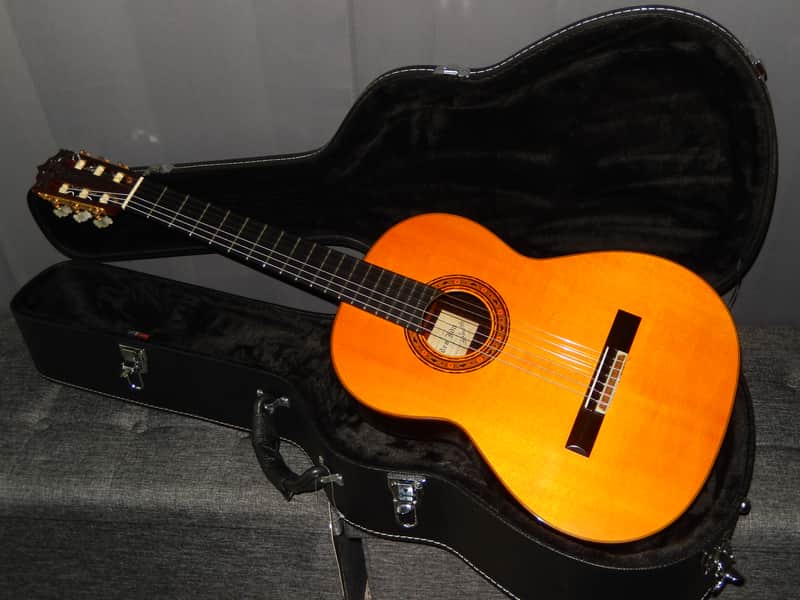
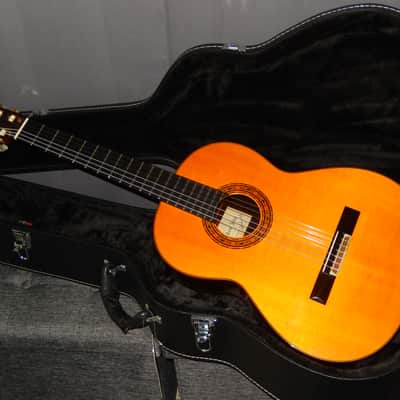
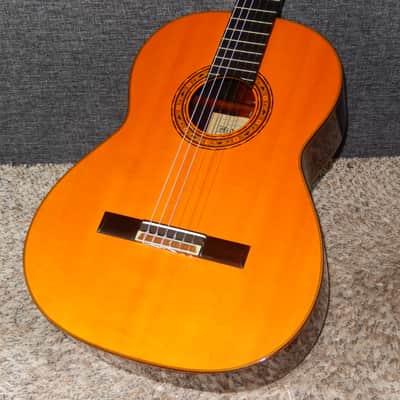
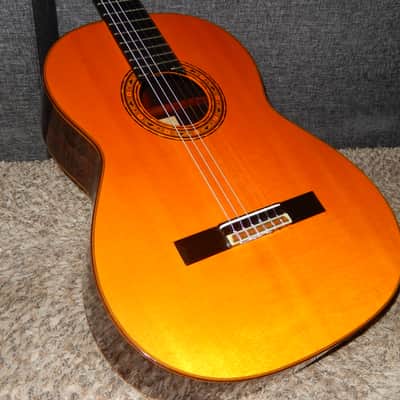
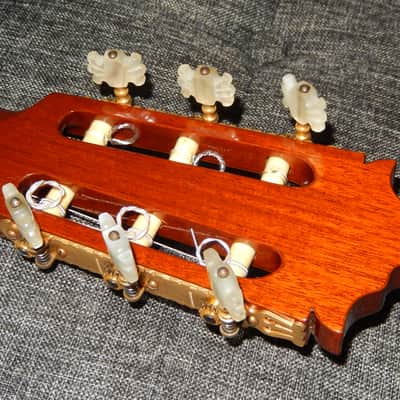
HIDEO IDA C15 1974 - YAMAHA GC70 CLASS CLASSICAL CONCERT GUITAR - SPRUCE/BRAZILIAN ROSEWOOD


Our users rate Reverb
YOU ARE LOOKING AT A WORLD CLASS INSTRUMENT PRICED AT THE BARGAIN LEVEL. CURRENTLY MADE IN JAPAN BRAND NEW GUITARS OF THIS CLASS MADE WITH FIGURED OLD GROWTH BRAZILIAN ROSEWOOD ARE PRICED MINIMUM $18000USD. DISCONTINUED IN 2025 YAMAHA GC70 WAS PRICED AT THAT LEVEL.
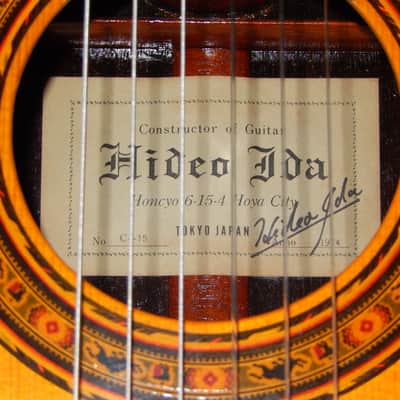
This guitar was made and signed by Master Luthier Hideo Ida in 1974. It was his second from the top model of that era.
Born in 1942, Hideo Ida started to study guitar making in 1957 under Sakazo Nakade and started to study classical guitar in 1960. Hideo established his own workshop in early 1971 and very quickly earned very high reputation among Japanese players. His guitars were highly praised by Andres Segovia, who had a chance to play them in 1982.
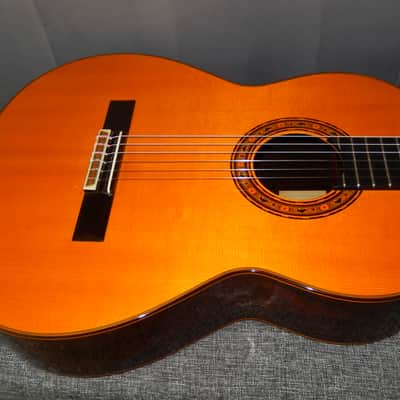
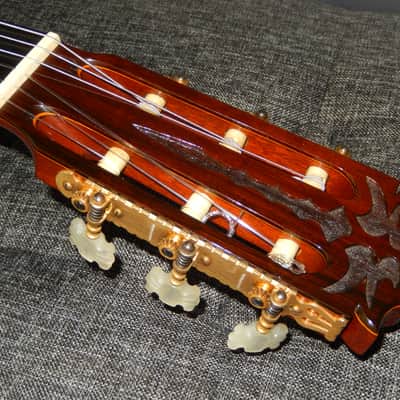
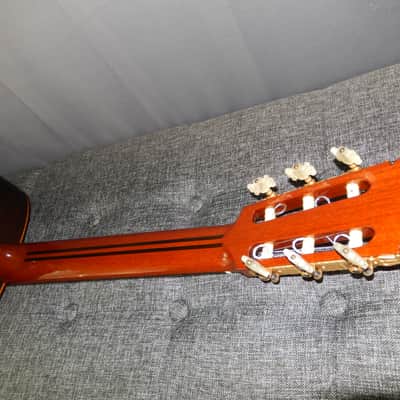
Hideo was making very limited number of guitars each year, all with uniquely carved headstocks and his design rosettes. His favorite motifs present on majority of his guitars, are a “raging bull” or “bull’s head”. They are incorporated into rosette design or sometimes into headstock carvings. His guitars very rarely appear on Japanese secondhand market, as they are highly sought by collectors and players alike.
In addition to their “super attractive” looks his guitars offer exceptional musical feasts for the players. This one is no different. It is a beauty in every regard. It is a very loud concert guitar, “full of honey and butter”, with deep and long resonating basses, with clean and sweet trebles that ring like bells. All notes well balanced and with great sustain. Guitar is responsive to a lightest touch. Sound wise it will satisfy the most demanding player.
Although I don’t know how many he still makes all by himself, Hideo’s guitars are made until today and they are very pricy. If ordered today the same looks and class (made from 50+ years old woods, with solid figured Brazilian Rosewood b/s and shellac finish) guitar would cost you minimum $18000USD. Yamaha was charging $18000USD for their top-of-the-line GC70 model (discontinued it in early 2025). Leading Spanish luthiers charge at least 50% more for similiar level instruments.
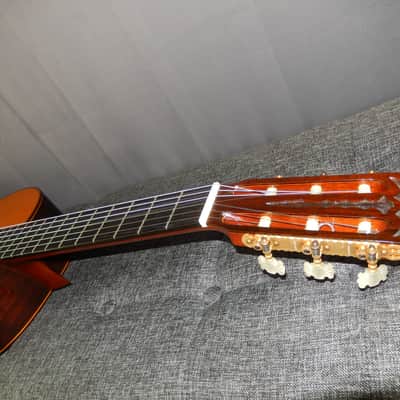
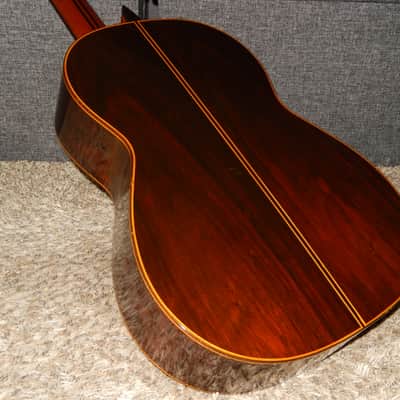
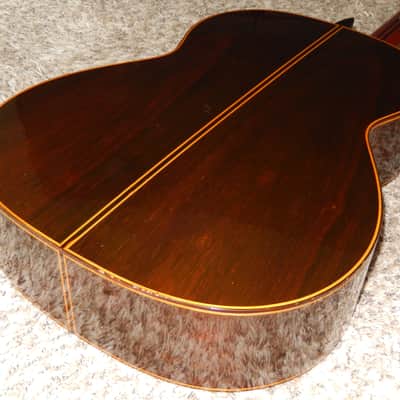
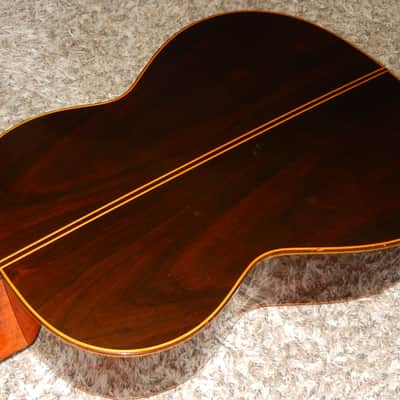
Overall condition of this gorgeous instrument can be described as “excellent for its age”. The only cosmetic flaws are few tiny dents and scratches on its top. There are also several tiny dents on the binding (most located along the bottom edge of the right back plate). Despite these imperfections guitar “looks and feels as if it was made yesterday”.
Specifications:
Top: High Grade Solid Spruce /shellac
Back & Sides: Solid Brazilian Rosewood /shellac
Neck: Mahogany with Ebony reinforcement
Fingerboard: Ebony
Scale: 655 mm
Nut width: 51.5 mm
Strings: Savarez Cantiga Premium Alliance Tension Forte
The action is set to 3.5 mm under E6 and 3.00 mm under E1 with very little extra room on the saddle.
It will be shipped in brand new hard shell case.
WHEN YOU BUY ANY GUITAR, YOU MUST ANTICIPATE TAKING IT TO YOUR LOCAL GUITAR SHOP FOR FINAL ADJUSTMENTS CALLED “SETUP”. DEPENIDNG ON YOUR PLAYING TECHNIQUE, THIS SETUP ON USED GUITARS MAY INCLUDE NEW CUSTOM MADE NUT AND SADLLE. IF YOU HEAR STRING BUZZ IT DOESN’T MEAN THAT GUITAR IS DEFECTIVE. IF YOU PLAY HARD ENOUGH ALL BASS STRINGS WILL BUZZ OVER THE FRETS, UNLESS THEY ARE SUSPENDED VERY FAR FROM THE FINGERBOARD. UNLESS YOU PLAY QUITE GENTLY, YOU CAN’T HAVE LOW ACTION AND NO BUZZES. KEEP IN MIND THAT CELLO-LIKE BASSES ON HIGH GRADE CLASSICAL GUITARS HAVE THEIR NATURAL “BUZZ”.
Real Value of Japanese Vintage Guitars
The key to understand value of vintage Japanese guitars is to acknowledge galloping price inflation throughout the late 1960s and 1970s with its peak of 25% in 1974.
During 1960s and most of 1970s model numbers of Japanese guitars were strictly connected with their prices in Japanese yen.
The same class guitar sold in 1970 for 100 000 yen (labelled as model 10), would be sold for 150 000 yen in 1972 (labelled as model 15), 200 000 yen in 1974 (labelled as model 20) and 300 000 yen in 1978 (labelled as model 30). Therefore, you shouldn’t be surprised that two Yamaha GC10 guitars made 10 years apart are two instruments of totally different class. The same rule applies to all guitar models made by all other Japanese makers.
Japanese inflation slowed down in the 1980s. By the early 1980s and during following decades model numbers were no longer strictly associated with their prices. Some Japanese guitar makers introduced model names instead of model numbers. For several economic reasons, since 1980s Japanese made guitars were becoming more and more expensive, while their exports slowing down. Today (2025) Japanese high end classical guitar models are priced at $20000USD level.
Reverb Buyer Protection
Reverb has your back if your item is lost, damaged, or doesn't match its description. Simply report any issues within 7 days and we'll help you get a full refund.Learn more about Reverb Buyer Protection.
| Listed | 4 years ago |
|---|---|
| Condition | Excellent (Used) Excellent items are almost entirely free from blemishes and other visual defects and have been played or used with the utmost care.Learn more |
| Brand |
|
| Model |
|
| Finish |
|
| Categories | |
| Year |
|
| Made In |
|
| Body Shape |
|
Product safety information may be available here.

