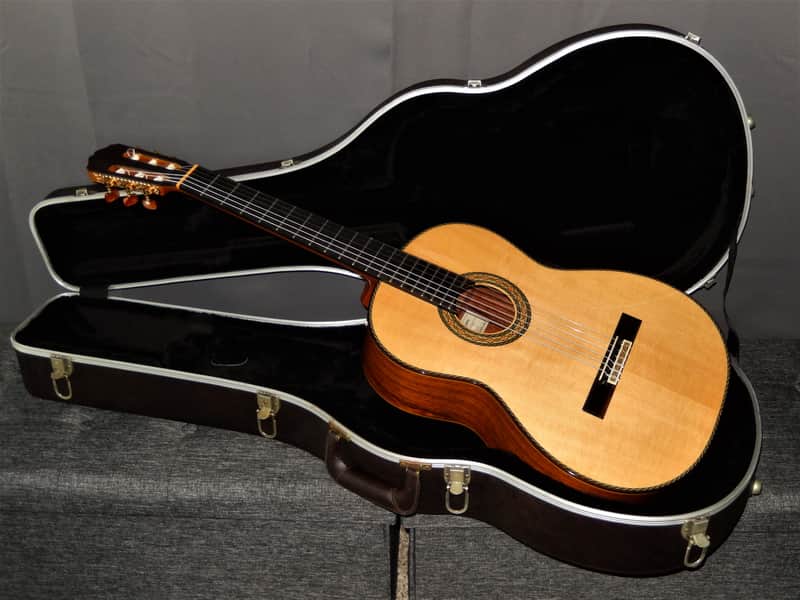
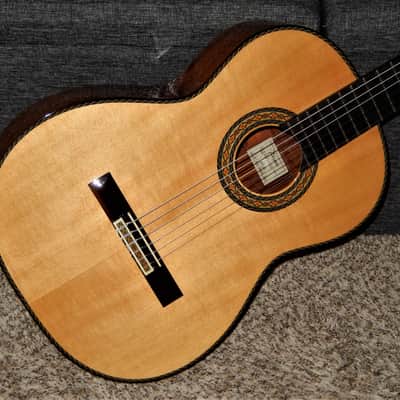
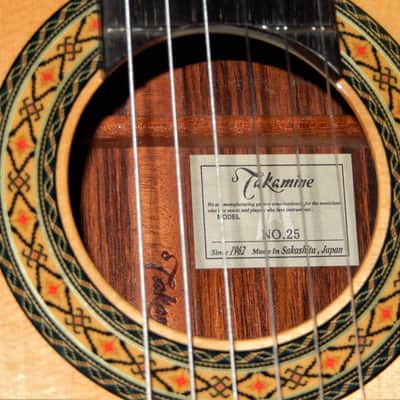
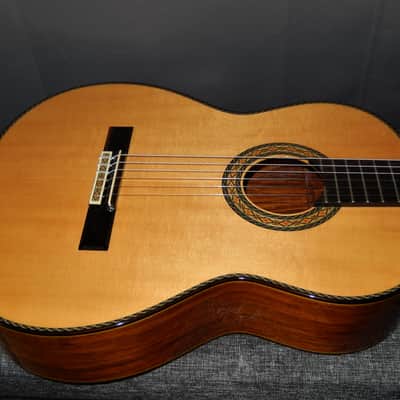
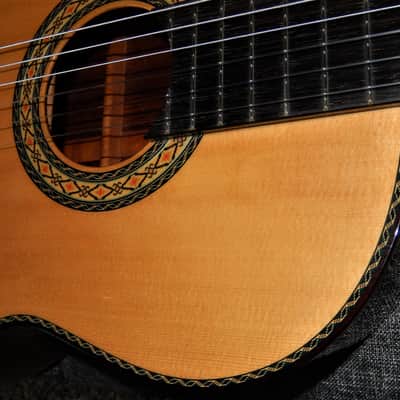
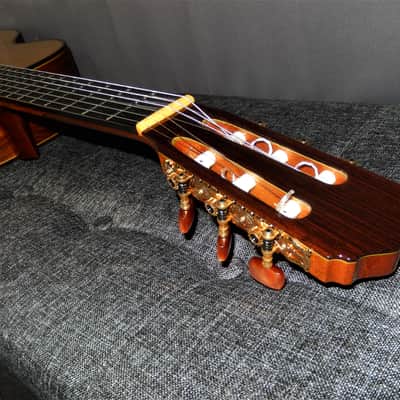
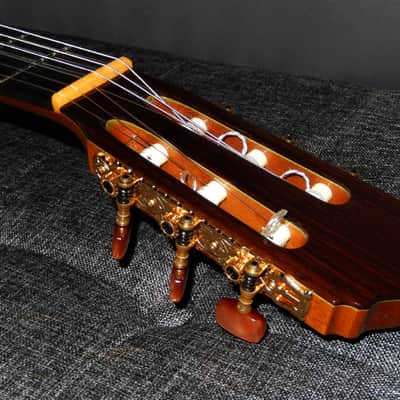
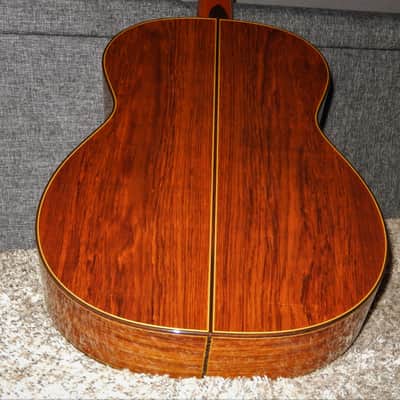
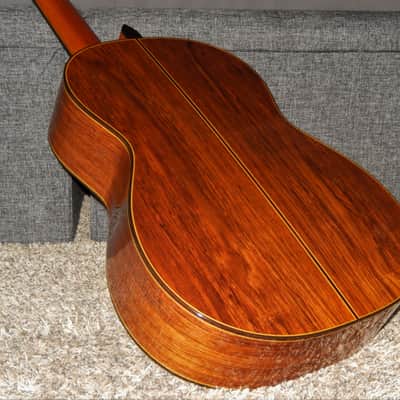
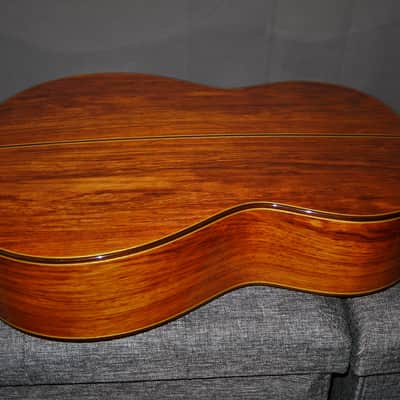
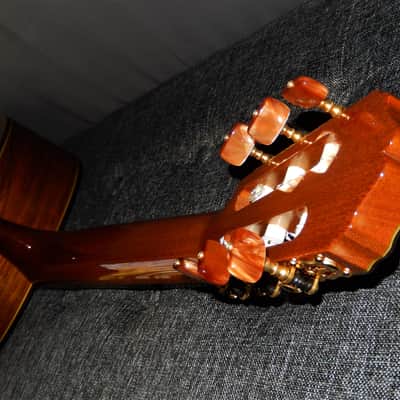
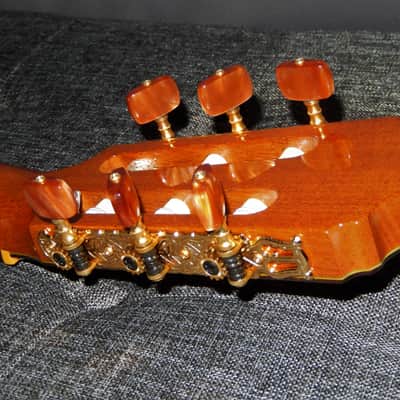
MADE IN 2006 - TOP OF THE LINE - TAKAMINE #25 - CLASSICAL GRAND CONCERT GUITAR - MADAGASCAR ROSEWOOD
This gear has sold
See similar gear from other Reverb sellers

Takamine No25
The guitar was made in 2006 being the very top model in Takamine regular line. During the same years Takamine also had a TGL line of classical guitars ornamented with beautiful “full of roses” rosettes hand-made from recycled fine woods. The very top model in TGL line was TGL8.
This terrific instrument is of higher grade than Takamine models distributed in the West. Takamine Hirade models made exclusively for export are no match to guitars made for Japanese domestic market.
This guitar could easily compete with much higher priced models made during the same era by leading Japanese luthiers and Yamaha Custom Shop.
Even though it was originally priced 250000 yen in 2008 this Takamine No25 was relabeled to Takamine No39 and priced 300000yen. As of right now the same model is labelled as Takamine 39E with net price of 330000yen. If distributed in USA it could very well cost you $4500.
Yet, brand new Spruce top guitar will never sound the same as the same construction guitar made 14 years ago.
The sound this guitar produces, is simply amazing. It is quite loud, yet sweet and lyrical, with round clear and colorful trebles and deep resonating full of overtones basses, all magnified by very impressive sustain. With current action it plays super easy.
This instrument can easily compete with "hand made in Spain" guitars sold in USA for $8000+.
Irony is that you will still be longing to that "hand made in Spain" one...until you get one.
This guitar survived
in near mint condition. The only visible (in regular light) “abnormality”
is that its original nut (most likely made from unbleached cow bone) has turned
amber brown over the years. The saddle has only slight discolorations. What is hardly
visible at first glance but becomes visible if looked at from certain angles
and appears as blemish on the soundboard (located near fingerboard on E1 string
side), is most likely a result of non-perfect sanding of this area before the
finish was applied. I have purposely avoided publishing the pictures that would
make it look far worse that it really does.
Specifications:
Top: Solid Spruce/Kohno style bracing/urethane
Back & sides: Solid Madagascar Rosewood/urethane
Fingerboard: Ebony
Neck: Mahogany with truss rod inside
Scale 650 mm
Width at Nut: 51.50 mm
Its action is set to 3.00 mm under E6 and 2.50 mm under E1 with still extra room on the saddle.
This guitar will be shipped in original hard shell case in excellent condition.
Takamine Guitars History
Takamine Gakki was founded in 1962 and during its first few years of operations, it wasn’t considered as leading Japanese guitar manufacture. It all changed in 1968 when Masaru Kohno took this company “under his umbrella” (most likely be became its owner or co-owner) and his pupil Mass Hirade became its director and leading Master Luthier. Until late 1970s Masaru Kohno personally supervised guitar production at Takamine Co. Right after this transition in 1968 Takamine Gakki adopted ne guitar designs launching 3 series of guitars: Elite, TG and the most precious Yamato guitars (by early 1970s renamed to Aranjuez).
Elite series had Ramirez style headstock and Ramirez style bracing. TG series guitars kept old style Takamine headstock but also had Ramirez style bracing. Aranjuez guitars had Takamine’s unique design headstock (used on Takamine guitars until today) and Kohno style bracing (which is nothing but simple lattice bracing). American luthier & guitar importer (also manufacturer of Luthier & Aranjuez strings) Juan Orozco invested and was deeply engaged in creation of Aranjuez guitar brand, even though these guitars were made only for Japanese domestic market. The truth behind Aranjuez guitars is that right from the start they were designed to satisfy less wealthy Japanese guitar enthusiasts, who couldn’t afford guitars made by Masaru Kohno or other Japanese elite luthiers. Aranjuez guitar have always offered exceptional value for the money. The bodies of all models were made by Takamine workshop. Top Aranjuez models were being finished at Kohno workshop and equipped with soundboards made by Masaru Kohno or his associates. Traditionally the very top Aranjuez model was assembled personally by Masaru Kohno. These very top Aranjuez models were nothing but Kohno guitars priced 50% down. Aranjuez 7 made in 1973 was decisively better than Kohno #10 from the same year and could easily compete with Kohno #15. Aranjuez 720 (priced 200 000 yen) made in 2000 could easily compete with Kohno model Professional R (priced 450 000 yen). Until 1976 all Aranjuez guitars had Kohno stamp on their labels. Starting in 1977 Kohno stamp was no longer used on Aranjuez guitars, even though their production was still closely supervised by Masaru Kohno’s workshop.
In the same late 1970s Takamine Gakki launched new series of guitars named simply “Guitarras Takamine”. These “new” Takamine guitars had the same construction and looks as “old” Aranjuez guitars. The lower Takamine models 20,30 and 40 had their own unique rosettes, while higher models 5, 6, 7, 8, 10 had Kohno style rosettes. The very top Takamine models 15 & 20 had Kohno style purflings and Kohno style decorated bridge. This classical guitar lineup remained unchanged until late 1980s.
Since early 1980s bodies of Aranjuez guitar were made by Ryoji Matsuoka, while the very top model still assembled at Kohno’s and later (after Masaru Kohno’s death in 1998) at Masaki Sakurai/Kohno workshop. After Matsuoka’s workshop was closed in September of 2014, bodies of Aranjuez guitars are again made by Takamine co. while the very top Aranjuez 725 is assembled personally by Masaki Sakurai who also makes its soundboard all by himself. Just like in the early days of Aranjuez guitars this model 725 (priced 250 000 yen) is of the same grade as Masaki Sakurai model Concert R (priced 420 000 yen).
| Listed | 6 years ago |
|---|---|
| Condition | Excellent (Used) Excellent items are almost entirely free from blemishes and other visual defects and have been played or used with the utmost care.Learn more |
| Brand | |
| Model |
|
| Finish |
|
| Categories | |
| Year |
|
| Made In |
|
| Body Shape |
|
Product safety information may be available here.