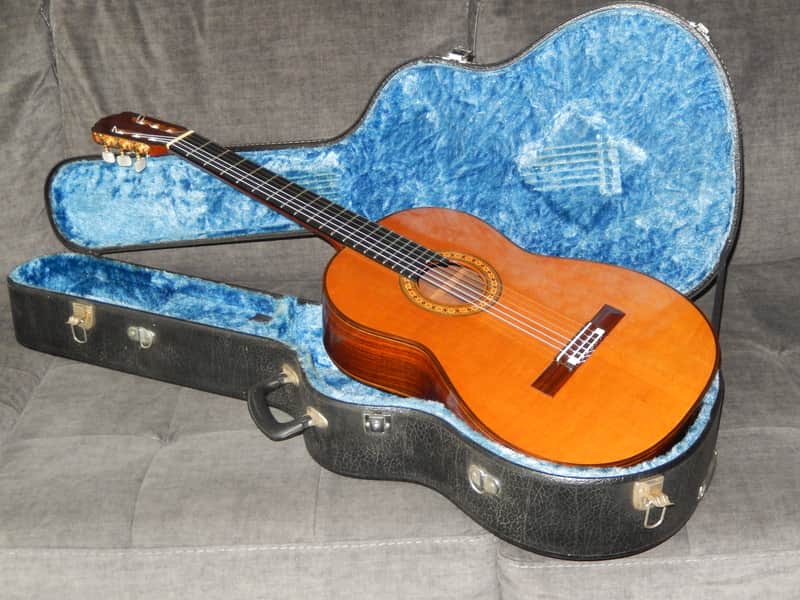
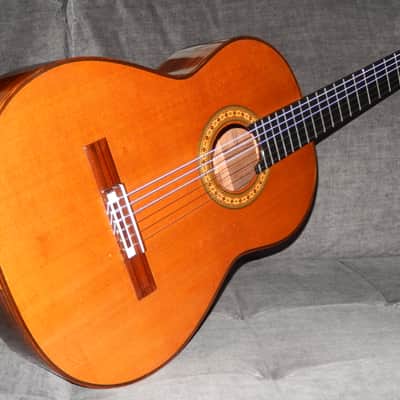
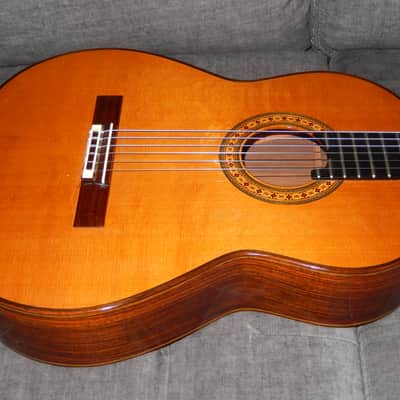
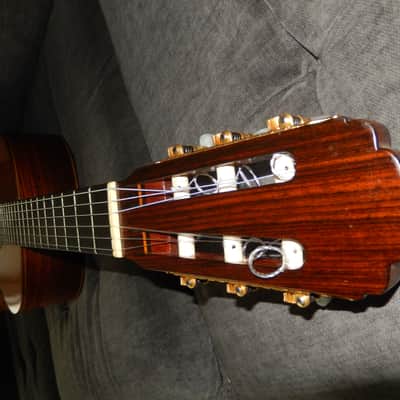
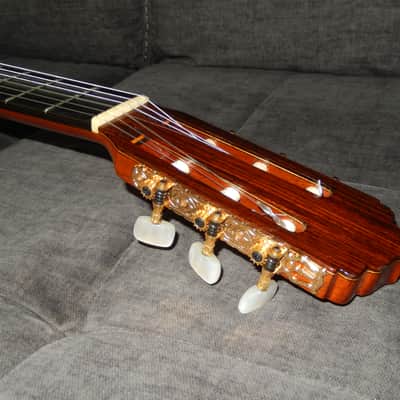
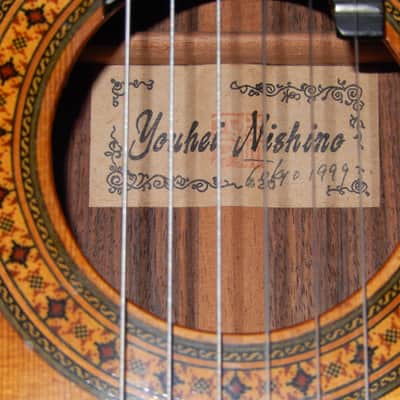
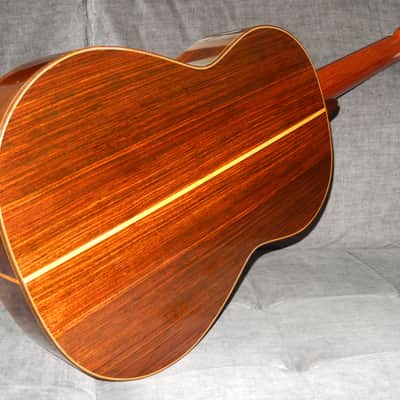
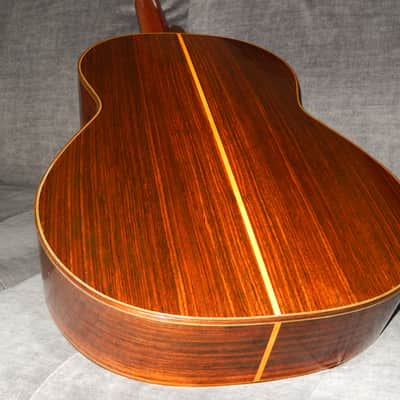
BARGAIN - YOUHEI NISHINO No20 1999 - RAMIREZ CLASS CLASSICAL CONCERT GUITAR - CEDAR/LATIN AMERICA ROSEWOOD
This seller has not set a shipping cost for Austria. Please contact them to ask about shipping.


YOU ARE LOOKING AT A WORLD CLASS INSTRUMENT PRICED AT THE BARGAIN LEVEL. CURRENTLY BRAND NEW GUITARS OF VERY SIMILAR CLASS MADE BY JAPANESE LUTHIERS USING OLD GROWTH LATIN AMERICA ROSEWOOD ARE PRICED MINIMUM $12000USD.
Youhei Nishino No20 1999
Youhei Nishino was a Japanese luthier pioneer, obsessed in his search for the best possible sound of the guitar. He was born in 1937 and after graduating high school he apprenticed at Tsunesaburo Kurosawa’s workshop, working side by side with Sumio Kurosawa, Katsumi Arai and Takashi Yamano. In 1965 he established his own workshop with his brother Shunpei. However soon after both brothers went their separate ways.
While Shunpei’s guitars are not very hard to find on Japanese second-hand market, Youhei’s are very rare. The major reason for that is that Youheii preferred to work just by himself and was making very limited number of guitars, many of them of unique construction and many just “one of their kind”. Construction of his guitars was initially based on Spanish and German blueprints. He however innovated a lot, making all kind of double-structure models and very rare aluminum backed guitars. He had no problem selling his masterpieces at very high prices. Seasoned players who tried Youhei’s guitars guitar had no problem to pay for them. The greatness of Youhei’s guitars might be the reason their owners don’t part with them easy.
Guitar you are looking at was made in 1999, when Youhei already had nearly 40 years of experience as the luthier. I hope you can imagine what such experienced luthier could do with few pieces of high-grade woods.
This guitar sounds simply fantastic. It offers great volume, warmth and sweetness of cedar top guitars, however with richness, superb note clarity and separation resembling fine Spruce top guitars. All notes are magnified by very extended sustain. This combination of tonal traits is surely very hard to achieve, even for very experienced luthier. Experienced players know this truth very well.
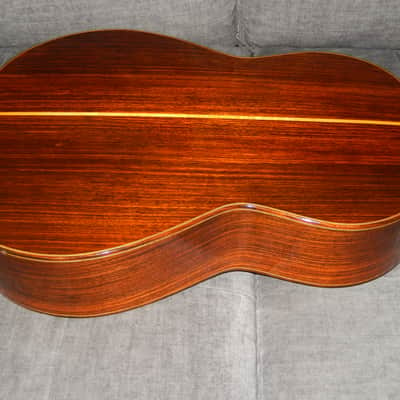
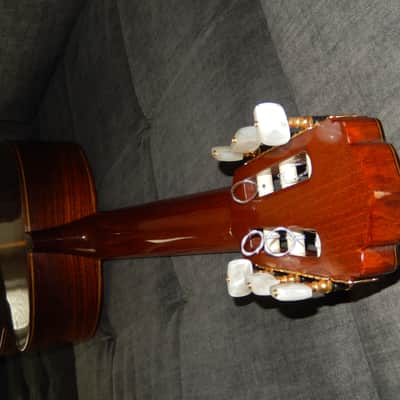
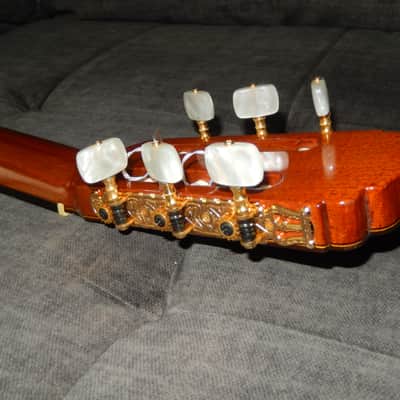
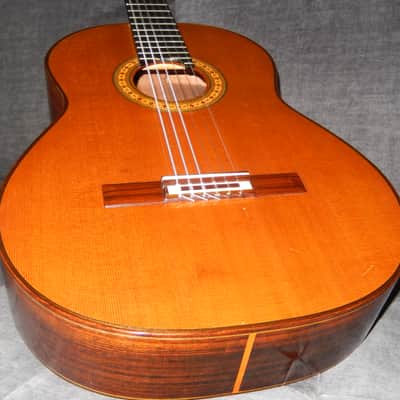
Overall condition of this guitar can be described as "excellent for its age". Besides very few minor dents and scratches the body of this guitar doesn’t bear any conspicuous cosmetic flaws. Guitar doesn’t have any structural problems, it neck is straight, fingerboard and leveled frets are in very good condition. With its current action guitar plays very easy.
Specifications:
Top: High Grade Solid Cedar Top / lacquer
Back and Sides: Solid Latin America Rosewood/ Flamed Maple center strip/ urethane
Neck: Mahogany
Fingerboard: Ebony
Nut and Saddle: Bone
Nut Width: 50 mm
Scale: 650 mm
Action is set to 3.30 mm under E6 and 2.80 mm under E1, with still a bit of extra room on the saddle.
This guitar will be shipped in a used Hard Shell Case in usable condition.
THE ONLY PURPOSE OF THIS CASE IS TO PROTECT THE GUITAR DURING SHIPMENT. I WILL NOT PROVIDE ITS DETAILED DESCRIPTION OR MAKE ADDITIONAL PICTURES, NOR I WILL ACCEPT ANY COMPLAINTS. IF YOU DON’T LIKE THIS CASE YOU WILL NEED TO BUY A DIFFERENT ONE.
WHEN YOU BUY ANY GUITAR, YOU MUST ANTICIPATE TAKING IT TO YOUR LOCAL GUITAR SHOP FOR FINAL ADJUSTMENTS CALLED “SETUP”. DEPENIDNG ON YOUR PLAYING TECHNIQUE, THIS SETUP ON USED GUITARS MAY INCLUDE NEW CUSTOM-MADE NUT AND SADDLE. IF YOU HEAR STRING BUZZ IT DOESN’T MEAN THAT GUITAR IS DEFECTIVE. IF YOU PLAY HARD ENOUGH ALL BASS STRINGS WILL BUZZ OVER THE FRETS, UNLESS THEY ARE SUSPENDED VERY FAR FROM THE FINGERBOARD. UNLESS YOU PLAY QUITE GENTLY, YOU CAN’T HAVE LOW ACTION AND NO BUZZES. KEEP IN MIND THAT CELLO-LIKE BASSES ON HIGH GRADE CLASSICAL GUITARS HAVE THEIR NATURAL “BUZZ”.
Real Value of Japanese Vintage Guitars
The key to understand value of vintage Japanese guitars is to acknowledge galloping price inflation throughout the late 1960s and 1970s with its peak of 25% in 1974.
During 1960s and most of 1970s model numbers of Japanese guitars were strictly connected with their prices in Japanese yen.
The same class guitar sold in 1970 for 100 000 yen (labelled as model 10), would be sold for 150 000 yen in 1972 (labelled as model 15), 200 000 yen in 1974 (labelled as model 20) and 300 000 yen in 1978 (labelled as model 30). Therefore, you shouldn’t be surprised that two Yamaha GC10 guitars made 10 years apart are two instruments of totally different class. The same rule applies to all guitar models made by all other Japanese makers.
Japanese inflation slowed down in the 1980s. By the early 1980s and during following decades model numbers were no longer strictly associated with their prices. Some Japanese guitar makers introduced model names instead of model numbers. For several economic reasons, since 1980s Japanese made guitars were becoming more and more expensive, while their exports slowing down. Today (2025) Japanese high end classical guitar models are priced at $20000USD level.
This item is sold As-Described
This item is sold As-Described and cannot be returned unless it arrives in a condition different from how it was described or photographed. Items must be returned in original, as-shipped condition with all original packaging.Learn More.
| Listed | 7 years ago |
|---|---|
| Condition | Excellent (Used) Excellent items are almost entirely free from blemishes and other visual defects and have been played or used with the utmost care.Learn more |
| Brand |
|
| Model |
|
| Finish |
|
| Categories | |
| Year |
|
| Made In |
|
| Body Shape |
|
Product safety information may be available here.

