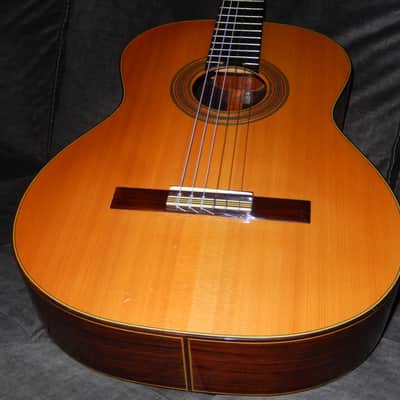
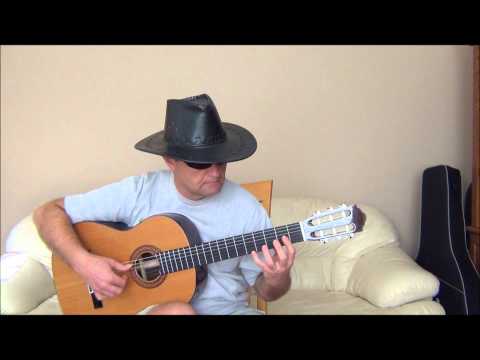
MADE IN 1978 BY M.FURUI - AMAZING TAKAMINE 10 - CLASSICAL GRAND CONCERT GUITAR
This listing has ended
See similar gear from other Reverb sellers
Our users rate Reverb
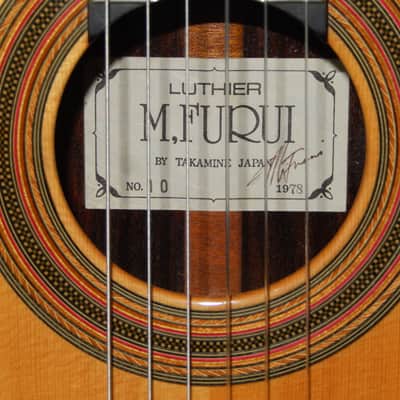
Made in 1978 Takamine 10 by M.Furui
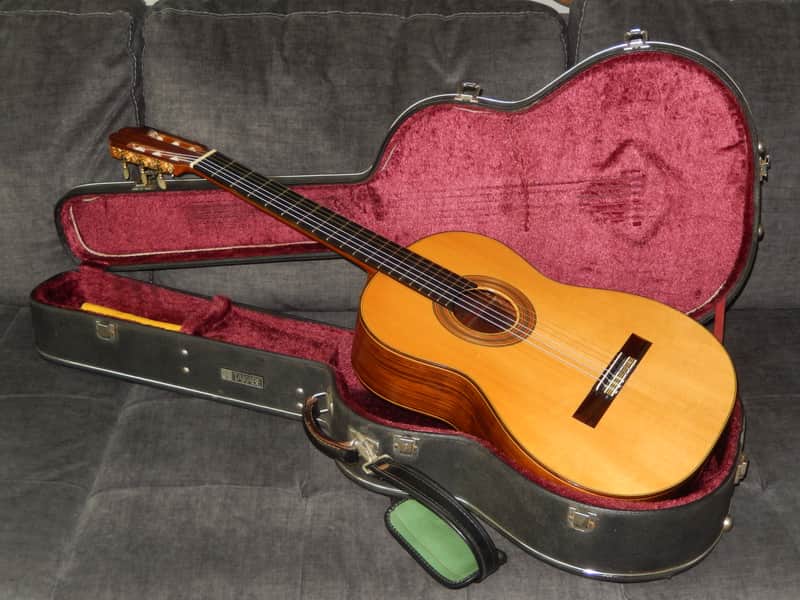
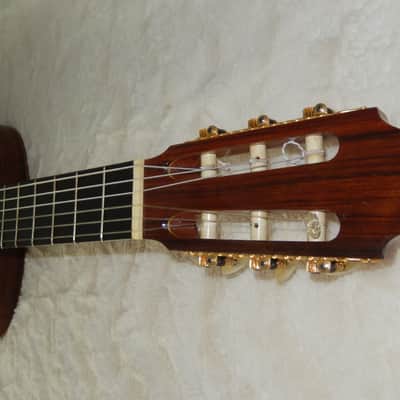
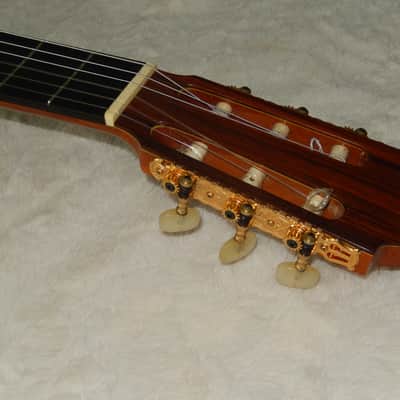
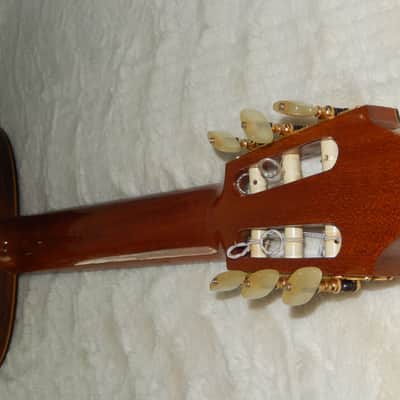
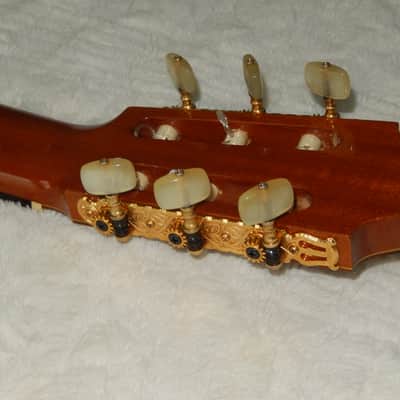
The guitar was made in 1978 by Takamine's Head Master Luthier Masaichi Furui. It was one of the top models in Takamine classical guitar series of that era. The only higher model that I am aware of was 15 and it was also made personally by M.Furuiji. The headstocks, rosettes and bracing on both models was different from all other Takamine models. To my knowledge, years 1978-1979 were the only years these Takamine guitars were made that way, with Mr.Furuiji's name honored on the label.
Takamine Gakki was founded in 1962 and during its first few years of operations, it wasn’t considered as leading Japanese guitar manufacture. It all changed in 1968 when Masaru Kohno took this company “under his umbrella” (most likely be became its owner or co-owner) and his pupil Mass Hirade became its director and leading Master Luthier. Until late 1970s Masaru Kohno personally supervised guitar production at Takamine Co. Right after this transition in 1968 Takamine Gakki adopted new guitar designs launching 3 series of guitars: Elite, TG and the most precious Yamato guitars (by early 1970s renamed to Aranjuez).
Elite series had Ramirez style headstock and Ramirez style bracing. TG series guitars kept old style Takamine headstock but also had Ramirez style bracing. Aranjuez guitars had Takamine’s unique design headstock (used on Takamine guitars until today) and Kohno style bracing (which is nothing but simple lattice bracing). American luthier & guitar importer (also manufacturer of Luthier & Aranjuez strings) Juan Orozco invested and was deeply engaged in creation of Aranjuez guitar brand, even though these guitars were made only for Japanese domestic market. The truth behind Aranjuez guitars is that right from the start they were designed to satisfy less wealthy Japanese guitar enthusiasts, who couldn’t afford guitars made by Masaru Kohno or other Japanese elite luthiers. Aranjuez guitar have always offered exceptional value for the money. The bodies of all models were made by Takamine workshop. Top Aranjuez models were being finished at Kohno workshop and equipped with soundboards made by Masaru Kohno or his associates. Traditionally the very top Aranjuez model was assembled personally by Masaru Kohno. These very top Aranjuez models were nothing but Kohno guitars priced 50% down. Aranjuez 7 made in 1973 was decisively better than Kohno #10 from the same year and could easily compete with Kohno #15. Aranjuez 720 (priced 200 000 yen) made in 2000 could easily compete with Kohno model Professional R (priced 450 000 yen). Until 1976 all Aranjuez guitars had Kohno stamp on their labels. Starting in 1977 Kohno stamp was no longer used on Aranjuez guitars, even though their production was still closely supervised by Masaru Kohno’s workshop.
In the same late 1970s Takamine Gakki launched new series of guitars named simply “Guitarras Takamine”. These “new” Takamine guitars had the same construction and looks as “old” Aranjuez guitars. The lower Takamine models 20,30 and 40 had their own unique rosettes, while higher models 5, 6, 7, 8, 10 had Kohno style rosettes. The very top Takamine models 15 & 20 had Kohno style purflings and Kohno style decorated bridge. This classical guitar lineup remained unchanged until late 1980s.
Since early 1980s bodies of Aranjuez guitar were made by Ryoji Matsuoka, while the very top model still assembled at Kohno’s and later (after Masaru Kohno’s death in 1998) at Masaki Sakurai/Kohno workshop. After Matsuoka’s workshop was closed in September of 2014, bodies of Aranjuez guitars are again made by Takamine co. while the very top Aranjuez 725 is assembled personally by Masaki Sakurai who also makes its soundboard all by himself. Just like in the early days of Aranjuez guitars this model 725 (priced 250 000 yen) is of the same grade as Masaki Sakurai model Concert R (priced 420 000 yen).
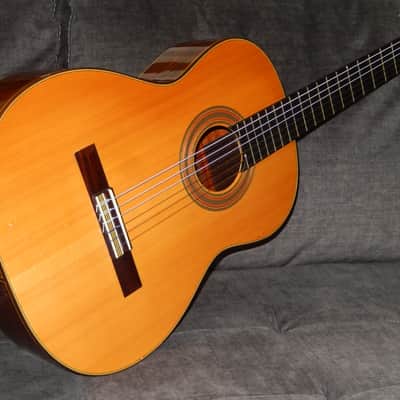
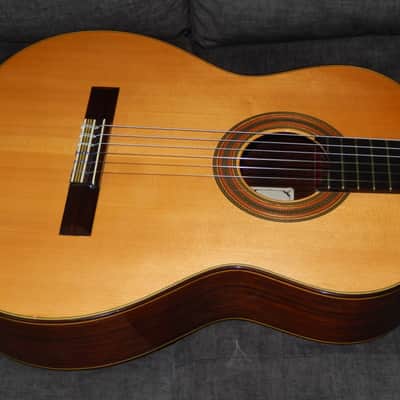
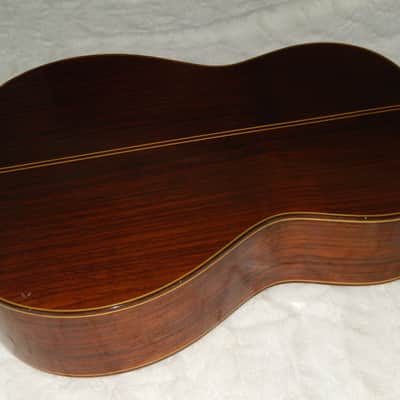
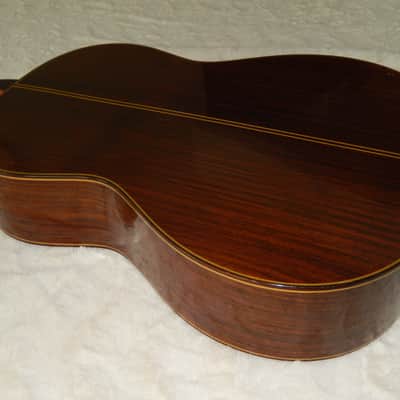
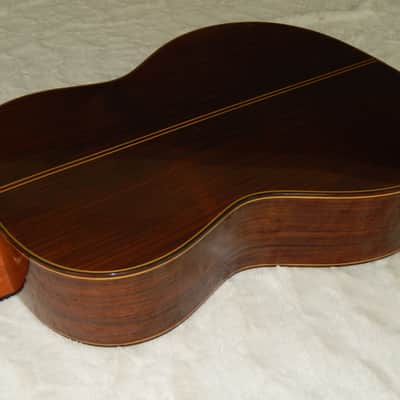
Despite its age this guitar remains in at least very good cosmetic and perfect working condition. The most conspicuous cosmetic flaws are few very small dents on its top and back, and one very light longtidual dent on the back of the headstock.
This terrific and powerful instrument certainly deserves a title of Grand Concert Guitar. This gorgeous instrument offers very impressive volume and superb response and tonality very similar to Masaru Kohno's or Sakazo Nakade's top models. Basses are deep, but very clean and almost mettalic. Trebles are sweet but also very clean and ringing like piano keys. All notes are well balanced and super well separated. Sustain is almost "never ending". It simply a "joy to play" guitar. I am sure that if it was made at Masaru Kohno's workshop it would certainly be priced 50% higher and labelled as model 15.
Specifications:
Top: Solid Spruce / fan of 7 braces / thin coat of tainted lacquer
Back & sides: Solid Indian Rosewood /urethane
Fingerboard: Ebony
Mahogany Neck
Scale 650 mm
Width at Nut: 52 mm
Its action is set to 3.50 mm under E6 and 3.20 mm under E1 with still extra room on the saddle
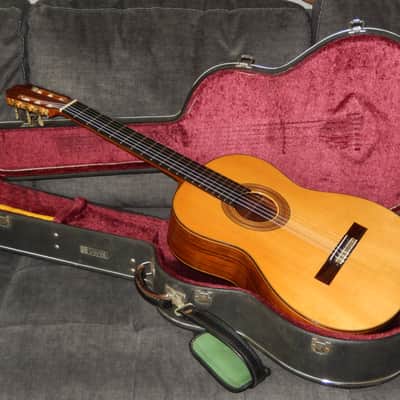
This guitar will be shipped in used Takabe hard shell case in still very good condition.
Real Value of Japanese Vintage Guitars
The key to understand value of vintage Japanese guitars is to acknowledge galloping devaluation of Japanese yen in 1960s & 1970s. This devaluation was somewhat slower in 1980s. The best measure of this devaluation is Starting Yearly Salary of Japanese College Graduate (SYSJCG).
SYSJCG in 1965 was 19 600 yen, in 1969 – 34 600 yen, in 1970 39 200 yen, in 1972 – 62 300 yen, in 1975 79 200 yen, in 1977 86 200 and in 1980 - 123 000 yen.
During 1960s and most of 1970s model numbers of Japanese guitars were strictly interconnected with their prices in Japanese yen. In late 1970s and during following decades model numbers were no longer strictly associated with their prices. Many Japanese guitar makers introduced model names instead of model numbers. Others were still using model numbers with addition of letter abbreviations or other symbols.
The best and only logical approach while evaluating real value (real grade) of vintage Japanese guitar is to compare its price in Japanese yen with SYSJCG during the year guitar was made.
Any guitar priced 100 000 in 1970 (labelled usually as No10) would be priced 200 000 yen in 1975 (relabeled to No20 or 2000), 300 000 yen in 1977 (labelled as No3, No30 or 3000). Starting in 1977 Masaru Kohno introduced his new models No40 priced 400 000 yen and No50 priced 500 000 yen. By 1984 Kohno started using model names instead numbers and was raising their prices as he was pleased. Model 50 became model “Maestro”, model 40 became model “Special”, model 30 became model “Professional-J”. Naturally other Master luthiers were doing the same name/price changes.
Knowing all of that, you can bet on that Masaru Kohno No50 made in 1982 is practically the same grade instrument as Kohno No20 made in 1972, or Kohno no 30 made in 1976. Kohno No40 made in 1982 is exactly the same grade instruments as Kohno No15 made in 1972 or Kohno No20 made in 1975.
It is very important to mention that if modern era luthiers are using 40 years old woods to make a classical guitar, its price is at least $8000.
Reverb Buyer Protection
Reverb has your back if your item is lost, damaged, or doesn't match its description. Simply report any issues within 7 days and we'll help you get a full refund.Learn more about Reverb Buyer Protection.
| Listed | 8 years ago |
|---|---|
| Condition | Very Good (Used) Very Good items may show a few slight marks or scratches but are fully functional and in overall great shape.Learn more |
| Brand | |
| Model |
|
| Finish |
|
| Categories | |
| Year |
|
| Made In |
|
| Body Shape |
|
Product safety information may be available here.