Gibson Les Paul Junior owned and used by Renee Schilhab of the B Girls Solid Body Electric Guitar (1958), ser. #8-2193, molded plastic hard shell case.

Gibson Les Paul Junior owned and used by Renee Schilhab of the B Girls Solid Body Electric Guitar (1958), ser. #8-2193, molded plastic hard shell case.
Price$8,500
+ $200 Shipping

Listed:a day ago
Views:318
Saves:34
Offers:0
Brooklyn, NY, United States
Our users rate Reverb
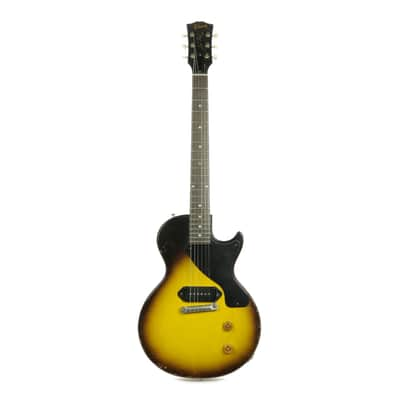
Gibson Les Paul Junior owned and used by Renee Schilhab of the B Girls Model Solid Body Electric Guitar (1958), made in Kalamazoo, Michigan, serial # 8-2193, sunburst top, dark back and sides finish, mahogany body and neck, rosewood fingerboard, molded plastic hard shell case.
This very battered and modified 1958 Les Paul Junior has a VERY major vibe and carries some serious Punk rock history; it was a gigging guitar for Renee Schilhab of the Toronto/New York based band the B Girls, one of the earliest all-female groups of the era and very much unsung pioneers. The B Girls only released one 45 but were fixtures on the scene playing venues including CBGB, Max's Kansas City, The Peppermint Lounge, and Hurrah on bills with many of the top Punk/New Wave acts of the 1979-1982 period including Elvis Costello, The Heartbreakers, The Stranglers, Sham 69, Crowded House, The B-52's, The Romantics, Levi and the Rockats, Nikki & the Corvettes, Richard Hell, The Cramps, Joey Ramone, Joan Jett, Johnny Thunders, and even Allen Ginsberg. Their most high visibility gig was opening for the Clash on their epochal North American tour also featuring New Orleans legend Lee Dorsey; they also contributed backing vocals to recordings by Blondie and Stiv Bators.
This juiced-up Junior was along for the ride. The guitar itself is a final-year single-cutaway Gibson Les Paul Junior from early 1958, originally one of the most elegantly simple electric guitars ever designed. It has old modifications converting it into a similar layout to the contemporary Les Paul Special; a second P-90 pickup was added in the neck position and the control cavity was enlarged to allow for a four-pot wiring rig to be installed; this was done with a hand chisel and is pretty crude! The two added pots are from 1980, so we would assume the re-work was done that year as the guitar was in use in its current form soon after. The original bridge position 1958 P-90 pickup and wiring remain in place, the added pickup is a 1960s P-90 under a "dogear" metal cover, as usually seen on ES-330s. These are wired to a standard Gibson style 4-pot rig with the selector switch slotted in between the original upper pots. These mount typical Gibson "speed" knobs from the late '70s.
The top sports a wide dark yellow-black sunburst finish, the rest of the guitar is natural dark mahogany. The one piece mahogany neck has a lovely feel, round and substantial but with a slightly less chunky profile than some 58-59 Gibsons. The original tuners were replaced with chrome Grover Rotomatics, a typical modification at the time, and the headstock has an old diagonal "smile crack" repair, neatly done and very solid.
In mid-1958 the design of the junior was altered to a double cutaway, cherry finished instrument so this example would be one of the last of the original design made. A total of 2408 Juniors were shipped this year, a good proportion of which would have been the new style model. While designed as a student guitar, the Junior is renowned as one of the crunchiest and most powerful of all straight rock guitars, with fantastic natural overdrive capabilities when paired with the right amp. These then-cheap and plentiful 1950s Gibsons were favorites on the 1970s NYC Scene, with Johnny Thunders (a close friend of the B girls) particularly associated with the TV Junior and special models. We don't know where Renee got this guitar, but it is exactly the sort of instrument that was a de facto standard at that time and place.
The B Girls formed in Toronto during 1977 and quickly became local favorites; according to most sources Renee Schilhab joined in 1979 just before they moved to New York, where they stayed until breaking up in 1982. They had a very 1960s-oriented pop-punk sound; despite having what in retrospect seems a potentially very commercial appeal on demos produced by Debbie Harry, Mick Jones, Craig Leon and Liam Sternberg they never signed a major record deal; their sole 45 was issued on Greg Shaw's BOMP label in 1979. Founder Cynthia Ross set rules: no politics, no short skirts on stage and no cleavage; she believes their refusal to be sex objects was the main reason they never scored a record deal. Over the next couple of years the Go-Gos and then the Bangles found major success with a very similar look and sound but the B Girls were largely forgotten.
Very sadly Renee Schilhab Bullock passed away in 2020, and her family has decided to send this prized guitar back out into the world after 45+ years. It bears the scars of many gigs long ago but is still a great instrument, a 7.5 Lb. piece of Gibson greatness and a true piece of history in more ways than one.
Overall length is 39 in. (99.1 cm.), 13 in. (33 cm.) wide at lower bout, and 1 11/16 in. (4.3 cm.) in depth, measured at side of rim. Scale length is 24 3/4 in. (629 mm.). Width of nut is 1 11/16 in. (43 mm.)., 7.54 lbs.
In this era of factory-created ersatz "Relic" guitars THIS is the real thing, a hugely worn guitar showing the effects of decades of play, likely beginning even before its stint in the B Girls. The finish is original but worn everywhere with particularly deep rub wear into the wood on the upper back and heavy checking, dings, dents and scrapes over the entire guitar. The back of the neck is heavily worn with finish chipping largely along the centerline. The edges of the headstock are heavily worn, with the serial number, Gibson decal and "Les Paul Junior" silkscreen all worn but not obliterated.
There is an ancient diagonal crack repair to the back of the headstock, solidly sealed and lightly finished over. The remainder of the lacquer is original. The chrome Grover Rotomatic tuners are a typical 1970s addition, the added P-90 pickup more unusual requiring significant routing into the face of the guitar and a downward extension of the control cavity, now covered by a typical Les Paul backplate. The stop tailpiece is chrome plated while the original studs are nickel. The guitar was played in the early 1980s in its current state.
Amazingly enough the small-wire frets appear to be original, crowned down but still fully playable. This is still a fine playing and great sounding guitar, very chunky sounding as one might expect from the twin P-90 layout. This is a real piece of history, a guitar that really was "there back in the day" with one of the earliest if sadly rather overlooked all-female bands of the early punk era. We are honored to offer this real relic guitar in our showroom, in memory of the places its been, music it has played and mostly the then-young lady who carried it along on part of a life's journey. It lives in a molded plastic "Chainsaw" Gibson case from in the early '80s, complete with some period stickers on the outside. Very Good Condition.
Reverb Buyer Protection
Reverb has your back if your item is lost, damaged, or doesn't match its description. Simply report any issues within 7 days and we'll help you get a full refund.Learn more about Reverb Buyer Protection.
| Listed | a day ago |
|---|---|
| Condition | Very Good (Used) Very Good items may show a few slight marks or scratches but are fully functional and in overall great shape.Learn more |
| Brand | |
| Model |
|
| Finish |
|
| Categories | |
| Year |
|
| Fretboard Material |
|
| Color Family |
|
| Body Material |
|
| Neck Construction |
|
| Model Sub-Family | |
| Right / Left Handed |
|
| Number of Strings |
|
| Body Shape |
|
| Neck Material |
|
| Model Family | |
| Bridge/Tailpiece Type |
|
| Finish Pattern |
|
| Body Type |
|
| Pickup Configuration |
|
| Scale Length |
|
| Number of Frets |
|
Product safety information may be available here.

