


Microtech Gefell MV 691 M70 Original Nickel Capsule | 48V XLR


GEFELL MV 691 + M70A CLASSIC OF GERMAN STUDIO ENGINEERING
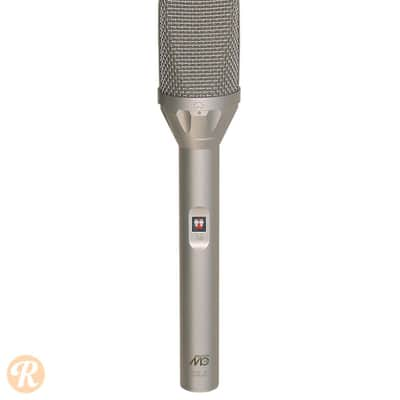
Professional FET Condenser Microphone | Original M70 Nickel-Diaphragm Capsule | Factory XLR | Excellent Original Condition
The Microtech Gefell MV 691 with M70 capsule represents a fascinating combination of traditional German condenser microphone engineering and a later generation of professional microphone electronics.
Developed within Gefell's celebrated modular microphone family, this system combines the distinctive acoustic qualities of the M70 nickel-diaphragm capsule with a later MV 691 microphone amplifier, believed to date from the 1990s.
The M70 is particularly interesting for its exceptionally thin metallic diaphragm, a sophisticated construction associated with some of the finest historical Gefell condenser microphones.
Its sound is articulate, natural and detailed, with a characteristic smoothness in the upper frequencies that distinguishes it from many contemporary small-diaphragm condensers.
What makes this particular microphone especially attractive is its remarkable original condition.
Both the M70 capsule and the MV 691 amplifier have been beautifully preserved, retaining their original construction and appearance.
Unlike many older Gefell systems that require connector conversions or electronic modifications, this later MV 691 features an original factory-installed three-pin XLR connection.
The microphone has not been modified or restored.
It has been used extensively in my own recording work, where it has consistently demonstrated excellent acoustic performance.
A beautifully preserved professional recording instrument, combining classic nickel-diaphragm technology with the practicality of a later-generation Gefell amplifier.
OPTICAL CONDITION
Excellent Original Condition
The microphone is preserved in exceptionally beautiful cosmetic condition.
The M70 is in good used optical condition and shows minor signs of use.
The capsule grille is exceptionally clean, with no significant signs of mechanical damage.
The MV 691 amplifier is well preserved.
Its original black finish, silver Microtech Gefell logo and metal connector assembly are all in excellent condition.
Both components have been carefully handled and maintained throughout their working lives.
An exceptionally clean example
Please examine the photographs for a detailed impression of its cosmetic condition.
TECHNICAL CONDITION
Fully Functional — Excellent Working Condition
The microphone is in excellent working condition.
Both the original M70 capsule and MV 691 amplifier are functioning correctly.
The microphone has been used extensively in my personal recording setup and has consistently delivered excellent results.
The original nickel-diaphragm capsule has not been reskinned or modified.
The amplifier retains its factory configuration, including its original three-pin XLR connector.
No aftermarket connector conversion or electronic modification has been performed.
The system is offered in its original configuration.
A fully functional professional condenser microphone, carefully preserved and ready for continued studio use.
BUILD & DESIGN — THE GEFELL MODULAR MICROPHONE SYSTEM
The MV 691 belongs to Gefell's distinguished family of modular professional condenser microphone systems.
This design philosophy originated during a period when professional recording equipment was expected to provide exceptional performance, long service life and considerable flexibility.
Rather than manufacturing microphones with permanently integrated capsules, Gefell developed systems in which the microphone amplifier and acoustic capsule were separate components.
This allowed engineers to combine different microphone capsules with a compatible amplifier, selecting the appropriate directional characteristics and frequency response for a particular recording situation.
The modular concept was especially valuable in professional broadcasting and recording environments.
A recording engineer could maintain a collection of capsules with different acoustic properties while using the same basic amplifier system.
The M70, M71 and M94 are among the well-known capsules associated with this modular tradition.
Each offers a different acoustic response, allowing engineers to adapt the microphone to different applications.
THE MV 691 — A SIMPLE, RELIABLE FET AMPLIFIER
The MV 691 represents a later generation of Gefell's modular condenser microphone system, retaining the interchangeable capsule design in a straightforward professional amplifier.
Within the family, the MV 691 is the simpler alternative to the MV 692. It has no onboard switches: there is no –10 dB attenuation pad and no low-cut filter. Instead, it provides an uncomplicated signal path without additional user-operated circuitry.
Its FET (field-effect transistor) amplification is well suited to condenser capsules, whose very high output impedance requires a suitable input stage.
FET electronics can provide low-noise, stable and transparent amplification when properly designed.
The absence of onboard switching also means fewer mechanical contacts and controls to maintain, although reliability ultimately depends on the complete circuit and its condition.
This example has the later black body, silver Microtech Gefell logo and original factory-installed three-pin XLR connector.
Unlike older examples adapted for contemporary connections, the amplifier has not been converted or modified.
The result is a particularly practical version of the Gefell modular system: a classic interchangeable capsule paired with a clean, uncomplicated amplifier designed for professional recording.
THE M70 CAPSULE — THE ART OF THE NICKEL DIAPHRAGM
The Gefell M70 is one of the most distinctive capsules developed for the company's modular condenser microphone systems.
Its defining characteristic is its exceptionally thin nickel diaphragm.
Unlike the polymer membranes commonly used in modern condenser microphones, the M70 employs a metallic diaphragm.
This represents a fundamentally different approach to condenser capsule construction.
The diaphragm of a condenser microphone forms one electrode of a capacitor.
As sound pressure causes the diaphragm to move relative to a fixed backplate, the capacitance changes, allowing the acoustic signal to be converted into an electrical signal.
The diaphragm's mechanical properties are therefore essential to the microphone's performance.
Its mass, tension, stiffness and damping all influence the way it responds to incoming sound waves.
NICKEL AS A DIAPHRAGM MATERIAL
Nickel diaphragms require highly specialized manufacturing techniques.
Producing an exceptionally thin and mechanically stable metallic membrane demands considerable precision.
The material must be sufficiently thin to respond to small variations in acoustic pressure while maintaining the mechanical stability required for consistent operation.
The diaphragm must also be tensioned with great accuracy.
Even relatively small variations in diaphragm tension can influence resonance behavior and frequency response.
This makes the manufacture of nickel-diaphragm condenser capsules a particularly demanding process.
The M70 belongs to a historical tradition in which microphone manufacturers explored metallic diaphragms as an alternative to conventional membrane materials.
The result is a highly specialized acoustic transducer with a distinctive response and considerable historical significance.
CARDIOID ACOUSTIC DESIGN
The M70 employs a cardioid pressure-gradient acoustic design.
Its directional characteristics provide sensitivity toward the front of the microphone while reducing sound arriving from behind.
This makes the capsule suitable for professional recording situations requiring a degree of separation between the intended sound source and the surrounding acoustic environment.
The M70 combines this directional behavior with the articulation and responsiveness expected from a professional small-diaphragm condenser microphone.
ORIGINAL NICKEL DIAPHRAGM — AN IMPORTANT DISTINCTION
One of the particularly attractive features of this microphone is the preservation of its original M70 capsule.
Nickel diaphragms are delicate components requiring considerable care.
Over decades of use, condenser microphone diaphragms can become contaminated or mechanically damaged.
In some historical microphones, the original membrane has therefore been replaced during restoration.
While professional restoration can return a microphone to excellent working condition, an original, properly functioning diaphragm is particularly interesting from a historical perspective.
The M70 offered here retains its original nickel diaphragm.
It has not been reskinned or modified.
The capsule is in excellent working condition and has demonstrated its performance through extensive practical recording use.
For engineers interested in the original acoustic characteristics of historical Gefell microphones, the preservation of the original capsule construction is an important consideration.
A PLACE IN GERMAN MICROPHONE HISTORY
Gefell's microphone tradition is closely connected to Georg Neumann.
During the Second World War, part of Neumann's production was relocated from Berlin to Gefell in Thuringia.
After Germany's division, the Gefell operation remained in East Germany while Neumann resumed production in West Berlin, and the two companies developed independently.
Gefell became an important manufacturer of professional microphones for broadcasting, studios and concert halls.
Its modular condenser systems combined interchangeable capsules with durable amplifier electronics, allowing engineers to choose different acoustic characteristics without replacing the complete microphone.
Following German reunification, the company continued under the Microtech Gefell name.
The later MV 691 reflects this continuity: its black body, MG branding and factory XLR connection belong to a newer generation, while its compatibility with the historical M70 nickel-diaphragm capsule preserves an earlier acoustic tradition.
A direct connection between two generations of German microphone engineering, brought together in one practical recording system.
SOUND & FREQUENCY RESPONSE
The Gefell M70 offers a distinctive interpretation of the classic small-diaphragm condenser microphone sound.
Its acoustic character is focused, articulate and natural, with a smooth midrange and a gently restrained upper-frequency response.
Compared with the more extended Gefell M94 capsule, the M70 exhibits a somewhat narrower frequency range, particularly toward the highest frequencies.
Where the M94 provides greater high-frequency extension and a more open upper register, the M70 presents a softer and more controlled top end.
This difference gives the M70 a particularly recognizable tonal character.
Rather than emphasizing the highest harmonics, the microphone maintains a natural balance between articulation and smoothness.
The upper-frequency response begins to taper earlier than on many contemporary small-diaphragm condensers.
However, this should not be confused with a lack of detail.
The M70 remains a precise and responsive professional condenser microphone.
Its small diaphragm provides excellent articulation, while its overall frequency balance avoids excessive brightness.
A MICROPHONE WITH CHARACTER
The M70 is particularly interesting for recording engineers who appreciate microphones with an individual acoustic personality.
Modern condenser microphones are frequently designed to provide extremely extended frequency responses and highly neutral reproduction.
The M70 approaches sound reproduction somewhat differently.
Its restrained upper register can produce a more relaxed presentation, particularly on sources that might otherwise sound overly bright or aggressive.
The microphone maintains excellent definition in the midrange, where much of the musical information of acoustic instruments and the human voice is concentrated.
This combination makes it particularly rewarding on acoustic instruments, strings, percussion, speech and other sources where natural articulation is important.
The cardioid directional pattern also provides useful separation in recording situations involving multiple instruments or less controlled acoustic environments.
PERSONAL RECORDING EXPERIENCE
I have personally used this microphone extensively in my own recording work.
It is one of those historical condenser microphones that remains genuinely rewarding to use, not simply because of its unusual construction or historical background, but because of its sound.
The combination of the M70 capsule and MV 691 amplifier performs beautifully.
The microphone delivers a detailed and articulate signal while retaining the distinctive tonal balance associated with the M70.
Its sound has consistently impressed me during practical recording sessions.
For me, this is an excellent example of why historical Gefell microphones remain relevant professional recording instruments today.
Their value is not limited to their age, rarity or engineering history.
They are microphones that can still deliver outstanding musical results.
A BEAUTIFULLY PRESERVED GEFELL CLASSIC
The Microtech Gefell MV 691 with M70 capsule represents a fascinating combination of historical microphone technology and later-generation German engineering.
At its heart is the original M70 cardioid condenser capsule, featuring one of Gefell's distinctive nickel diaphragms.
Its sophisticated construction and characteristic frequency response make it an especially interesting alternative to contemporary small-diaphragm condenser microphones.
The later MV 691 amplifier continues Gefell's modular design tradition while incorporating a factory-installed three-pin XLR connection.
Together, the two components form a practical professional recording system with a strong connection to the company's engineering heritage.
The original nickel diaphragm has been preserved, the amplifier remains unmodified, and the complete system performs excellently.
Having used this microphone extensively for recording, I can personally recommend it as a genuinely outstanding professional instrument.
For recording engineers, it offers a distinctive and musical alternative to modern condenser microphones.
For collectors, it represents a beautifully preserved example of Gefell's remarkable modular microphone tradition.
An exceptionally clean, entirely original Gefell MV 691 with M70 nickel-diaphragm capsule — a beautiful professional microphone with a distinctive sound and a fascinating place in German recording history.
| Pubblicato | 4 ore fa |
|---|---|
| Condizione | Eccellente (Usato) Gli articoli "Eccellenti" sono quasi completamente privi di difetti e altri difetti visivi e sono stati suonati o utilizzati con la massima cura.Scopri di più |
| Marchio | |
| Modello |
|
| Categorie | |
| Anno |
|
| Prodotto in |
|
| Tipo di microfono |
|
| Con cavo/senza cavo |
|
| Elettronica |
|
| Figura polare |
|
Le informazioni sulla sicurezza del prodotto sono disponibili qui.

Protezione di Reverb
Resi semplici, transazioni sicure, assistenza di persone in carne e ossa
Scopri di più