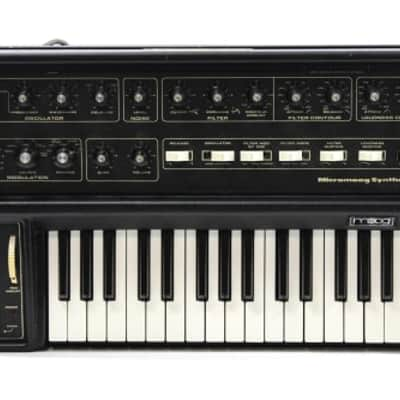
Moog MicroMoog 1975 - 1979 - Black

Moog MicroMoog 1975 - 1979 - Black
Dieser Verkäufer hat keine Versandkosten für Malta hinterlegt. Bitte Kontakt ihn bezüglich Versand.

Unsere Benutzer bewerten Reverb
lovelyyy little moog monosynth with a vintage tone that dreams are made of.
this one is super rad and ballsy, extremely fun and has served me incredibly well the past 5 years.
incredible bass sounds, leads, and sound fx stuff!
purchased at switched on in Austin, Tx! they serviced it as well, this one’s ready to go!
tuning is stable but don’t press to hard on the plastic panel surrounding the knobs, it causes the pitch to drift.
i’ve included excellent detailed photos so you can inspect the condition!
message me through here if you have any questions, you can also find me @ imperialsoundst on IG!
here’s some info taken from aos-pro:
Moog Micromoog is a monophonic analog synthesizer produced between 1975–1979 as a more affordable alternative to the legendary Minimoog. Although designed as a simplified model, the Micromoog retained the distinct Moog sound, flexible modulation options, and unique control features, making it a sought-after instrument among musicians and collectors to this day.
History and Development of Moog Micromoog
The Micromoog was developed as a budget-friendly alternative to the Minimoog, one of the most popular analog synthesizers at the time. Its goal was to offer an accessible entry into synthesis for musicians who couldn’t afford more expensive models.
The development of the Micromoog involved Jim Scott, who collaborated with Tom Rhea and David Luce, with final electronic refinements by Robert Moog himself. The result was a compact yet powerful synthesizer, maintaining the classic Moog sound while introducing several innovations that set it apart from other models.
The Micromoog later became the foundation for the Multimoog, which expanded its capabilities by adding a second oscillator, a larger keyboard, and advanced modulation features.
Technological Innovations – What Makes Micromoog Special?
The Micromoog introduced several key innovations that distinguished it from other analog synthesizers:
• Single Variable VCO – The oscillator allowed continuous waveform blending from sawtooth
to pulse.
• Sub-octave generator – Added one or two octaves below the main oscillator, creating richer
bass tones.
• 24dB/oct 4-pole low-pass filter – A classic Moog filter with its own envelope generator and
frequency modulation via the oscillator.
• Two envelope generators – Instead of a standard ADSR, the Micromoog featured two
A(S)R envelopes, enabling rapid dynamic changes.
• Ribbon controller – Instead of a traditional pitch-bend wheel, the Micromoog included a built-in
ribbon controller for fluid pitch changes.
• Moog Open System – A pre-MIDI system allowing connection with other Moog synthesizers
and external modules.
Oscillators and Sound Architecture
The Micromoog used a single VCO, offering continuous waveform control between sawtooth and pulse. Thanks to its sub-octave generator, it could add one or two octaves below the main oscillator, giving the sound depth and power.
The filter was a classic Moog low-pass, featuring its own envelope generator and oscillator-driven frequency modulation, enabling complex sonic variations.
Modulation and Parameter Control
The Micromoog provided wide modulation possibilities, which were uncommon in synthesizers at this price point:
• LFO with pulse and sawtooth waves – Enabled modulation of oscillator frequency, filter
cutoff, and amplifier.
• Sample & Hold – Generated random modulations, adding an experimental character to the sound.
• External CV/Gate inputs – Allowed connection with other Moog synthesizers or modular systems.
Expanded Features
The Micromoog contained several unique functions, expanding its sonic capabilities:
• VCA bypass – Enabled sustained tones without triggering via keys, ideal for drone sounds.
• VCF tone mode – Switches between standard filter behavior and an alternative tonal
mode, providing brighter characteristics.
• Release on/off – Allowed quick envelope changes, useful for live performance dynamics.
Connectivity and Studio Integration
The Micromoog was equipped with CV/Gate inputs and outputs, enabling integration with other analog synthesizers. Additionally, it featured:
• Moog Open System – A pre-MIDI system for connecting with other Moog modules.
• Cinch Jones connectors – Standard Moog S-triggering for external sequencer compatibility.
Conclusion
The Moog Micromoog is a compact analog synthesizer, offering unique sonic possibilities at an affordable price. It has become a key instrument in film music, funk, jazz, and experimental electronic production.
With flexible modulation, a sub-octave generator, and the classic Moog ladder filter, the Micromoog has cemented itself as an icon of analog synthesis. Even today, like most Moog instruments, it remains a source of inspiration for many musicians and producers.
Dieser Artikel wird verkauft "wie beschrieben"
Dieser Artikel wird verkauft "wie beschrieben" und kann nicht retourniert werden, es sei denn er kommt anders als beschrieben oder fotografiert an. Artikel müssen im Originalzustand mit allen gelieferten Teilen und Zubehör in ursprünglicher Verpackung zurückgesendet werden.Mehr erfahren
| Inseriert | vor 10 Tagen |
|---|---|
| Zustand | Sehr gut (Gebraucht) Artikel im Zustand Sehr gut können ein paar Makel oder Macken haben, aber funktionieren einwandfrei und sind ingesamt gut erhalten.Weitere Informationen |
| Marke | |
| Modell |
|
| Farbe |
|
| Kategorien | |
| Jahr |
|
| Hergestellt in |
|
| Keyboard-Action |
|
| Anzahl der Tasten |
|
| Analog/digital |
|
| Polyphonie |
|
| Tastengröße |
|
Möglicherweise sind hier Informationen zur Produktsicherheit verfügbar.


Reverb-Schutz
Einfache Rücksendungen, sichere Transaktionen, Support von Experten
Weitere Informationen