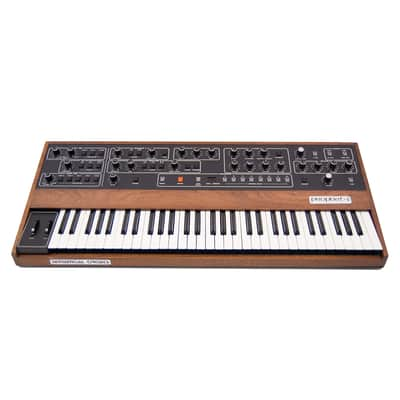
The Cars | Greg Hawkes Stage-Played & Studio Used Sequential Circuits Prophet 5 Rev3 61-Key 5-Voice Polyphonic Synthesizer

The Cars | Greg Hawkes Stage-Played & Studio Used Sequential Circuits Prophet 5 Rev3 61-Key 5-Voice Polyphonic Synthesizer

I nostri utenti valutano Reverb
A Sequential Circuits Prophet-5 synthesizer (serial #1000-6055) from the personal collection of Greg Hawkes of The Cars, stage-used and studio-used by Hawkes with documented use circa 1982–1984, including the Heartbeat City album and The Cars’ tours of that period. By its serial number it is a Revision 3 unit. Hawkes discusses this instrument on video and credits the Prophet-5 as the source of the oscillator-sync lead on “Let’s Go” (Candy-O, 1979), a recording that predates this unit.
Performance References (links provided upon request)
These performances show Hawkes with the Prophet-5 across The Cars’ career and are not all offered as a match to this specific unit.
- Greg Hawkes of The Cars — Discussing His Sequential Circuits Prophet-5 Synthesizer
- The Cars — “Let’s Go” — Midnight Special (09/28/1979)
- The Cars — “Touch and Go” — Fridays (10/31/1980)
- The Cars — “Shake It Up” — Fridays (01/08/1982)
- The Cars — “Bye Bye Love” — US Festival (09/04/1982)
Historical Context
The Cars were a Boston-based new wave and rock band comprising Ric Ocasek (vocals, guitar), Ben Orr (vocals, bass), Elliot Easton (guitar), Greg Hawkes (keyboards, synthesizers), and David Robinson (drums). The band released six studio albums between 1978 and 1987, and their synthesis of new wave aesthetics with melodic rock songwriting placed them at the commercial and critical forefront of American rock for a decade.
Greg Hawkes was the primary synthesist in The Cars and is widely credited as a central figure in establishing the polyphonic analog synthesizer as a defining voice of the new wave era in American rock. His instrument choices — and the specific sounds he programmed on them — are inseparable from The Cars’ identity as a recording and performing act.
The Sequential Circuits Prophet-5, introduced in 1977 and produced until 1984, was the first fully programmable polyphonic analog synthesizer with onboard patch memory, fundamentally changing the possibilities of keyboard performance in both studio and live contexts. Its five-voice polyphony, dual-oscillator architecture, and distinctive analog filter became foundational to the sound of late-1970s and early-1980s pop and rock production. The Prophet-5 was used by virtually every major synthesizer-oriented artist of the era, and Greg Hawkes was among its most prominent and identifiable practitioners.
Studio & Stage Use
On video with this instrument, Hawkes describes his history with the Prophet-5 in his own words: “The Prophet-5. One of my favorite synths of all time for sure. It was used to make the ‘Let’s Go’ sound — the ‘bow-bow-bow.’ And this one was used on all the Cars tours from Candy-O on. Used it on Heartbeat City album, Shake It Up album, as well as those tours. It’s just one of those synths that’s always sort of been associated with the sound of The Cars.”
The oscillator-sync lead on “Let’s Go” (Candy-O, 1979) — one of the most immediately recognizable Prophet-5 patches in pop music history — was created on a Prophet-5; that 1979 recording predates this unit. The serial number of this unit indicates manufacture circa 1982–1983, consistent with Hawkes’ use of this unit in the Heartbeat City era and on the tours of that period. Hawkes confirmed the Prophet-5’s role in a contemporaneous published interview: in the January 1982 issue of Musician Player & Listener, discussing the “Let’s Go” riff, he stated: “It’s a Prophet 5. The break is actually a Prophet doubled with a real guitar, but that part is just a synthesizer.” This 1982 interview — published shortly after the release of Shake It Up — provides period-contemporary documentation corroborating Hawkes’ later video testimony. The Prophet-5 is also present throughout the band’s subsequent studio albums and is visible in multiple documented live appearances from the period, including the performances listed above, offered as references for his use of the Prophet-5. The instrument was part of Hawkes’ keyboard rig alongside the ARP Omni, Mini Korg, and other period synthesizers throughout The Cars’ active years.
Specifications
- Sequential Circuits Prophet-5, Model 1000, Revision 3 (circa 1982–1983)
- Serial: 1000-6055 — mid-to-late Rev 3 production; Rev 3 introduced CEM chips (CEM3340 VCOs, CEM3320 filters) replacing the earlier SSM chips, providing improved tuning stability while retaining the Prophet’s warm analog character
- 61-key keyboard (C–C); pitch and mod wheels
- Five-voice polyphony
- Voice architecture per voice: dual VCO (oscillator A and B) with frequency, pulse width, waveshape — sawtooth/square/triangle — sync, and low-frequency modes; noise generator
- Filter: 24dB/octave 4-pole low-pass (cutoff, resonance, envelope amount)
- Envelopes: Dual ADSR — one for filter, one for amplifier
- Modulation: LFO; poly-mod; wheel-mod; glide/unison
- Programmer: 40-patch memory (8 banks) with red 2-digit LED display; cassette interface for patch storage and recall
- Rear panel: Audio out; trigger/gate/voltage in and out (sequencer interface); cassette in/out; footswitch; amplifier/filter control voltage jacks
- Walnut side panels with “Sequential Circuits” and “prophet-5” badging
- Minor modifications present
- Represented as tested and functional at acquisition; not powered on since; offered as-is, with no warranty of function
- No power supply included
Condition
The instrument shows wear consistent with professional studio and touring use. The top panel and walnut sides present well. The bottom panel shows scuffing and two tape remnants consistent with touring use. Minor modifications are present as noted.
It was represented by Greg Hawkes as tested and functional at the time of sale. It has not been powered on since entering my collection and is sold as-is, with no warranty of function. The instrument shows wear consistent with professional studio and touring use. A power cable is not included.
Included Items
Three unused original tour laminates from The Cars’ Door to Door tour (1987): one V.I.P. laminate, one Backstage laminate, and one Staff laminate — all unused extras from the touring production.
Original issue of Musician Player & Listener magazine (January 1982), featuring The Cars as the cover story, with Greg Hawkes’ contemporaneous statement confirming the Prophet-5’s use on “Let’s Go.” 1 photo.
Provenance
From the personal collection of Greg Hawkes. Originally offered as Lot 725 at Weiss Auctions, Sale 378 (Historical Memorabilia, Rock N Roll, Hollywood, Advertising), November 20, 2020, Lynbrook, NY, cataloged as “owned and used by Greg on The Cars Recordings and Live in Concert.” Passed at auction; acquired directly from Weiss post-auction at reserve.
Nostalgia Bandit Letter of Provenance
This item will be accompanied by a Nostalgia Bandit Letter of Provenance — a document printed on official Nostalgia Bandit letterhead, signed by Nostalgia Bandit’s principal, and affixed with the official Nostalgia Bandit embossed seal. The Letter of Provenance reproduces the complete final auction description for this item in full, memorializing all provenance documentation, attribution, supporting evidence, and condition details as presented herein. It is designed to travel with the item through all future ownership transfers as a permanent, platform-independent physical record of the item’s documented history.
Measurements
» Item: 37.5 x 16 x 6″ · 32.88 lbs.
Shipping
All items ship tracked and insured, with adult signature required. An adult (21+) must be present to sign for delivery, and packages are not left without a signature. Larger pieces may need professional packing or freight; message us before purchasing if you’d like a shipping quote.
All sales are final.
About
Nostalgia Bandit is a boutique online auction house and source for authenticated, one-of-one artifacts from contemporary music, film, television and pop culture. Highlights include stage-played instruments, stage-worn and music video-used wardrobe, and studio and tour gear.
The focus is post-1980 pop culture.
Founded by Jason DeBord, whose 25 years in pop culture run from leading a major auction house to journalism and authentication. Independent, founder-led, and built on documented provenance and honest disclosure.
Every artist-used music artifact is researched, photo-matched where possible, and accompanied by a Nostalgia Bandit Letter of Provenance.
This is the official Nostalgia Bandit shop on Reverb, carrying select pieces from the Nostalgia Bandit collection and consignments.
Protezione di Reverb per gli acquirenti
Reverb ti protegge nel caso in cui il tuo articolo venga perso, danneggiato o non corrisponda alla descrizione. Basta segnalare eventuali problemi entro 7 giorni e ti aiuteremo a ottenere il rimborso completo.Scopri di più sulla Protezione di Reverb per gli acquirenti.
| Pubblicato | un mese fa |
|---|---|
| Condizione | Molto buono (Usato) Gli articoli "Molto buoni" possono mostrare qualche piccolo segno o graffio ma sono pienamente funzionali e in buone condizioni generali.Scopri di più |
| Marchio | |
| Modello |
|
| Finish |
|
| Categorie | |
| Anno |
|
| Prodotto in |
|
| Numero di tasti |
|
| Azione della tastiera |
|
| Analogico / digitale |
|
| Polifonia |
|
| Dimensione del tasto |
|
Le informazioni sulla sicurezza del prodotto sono disponibili qui.

Protezione di Reverb
Resi semplici, transazioni sicure, assistenza di persone in carne e ossa
Scopri di più