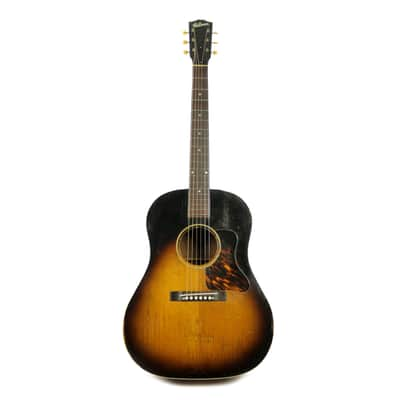
Gibson J-35 Flat Top Acoustic Guitar (1939), ser. #EG-6674, period brown hard shell case.


Gibson J-35 Flat Top Acoustic Guitar (1939), ser. #EG-6674, period brown hard shell case.
This seller has not set a shipping cost for Denmark. Please contact them to ask about shipping.
Pricekr.100,776.36
+ Shipping
Listed:11 days ago
Views:241
Saves:31
Offers:0

Brooklyn, NY, United States
Our users rate Reverb
Gibson J-35 Model Flat Top Acoustic Guitar (1939), made in Kalamazoo, Michigan, serial # EG-6674, natural lacquer finish, mahogany back and sides, spruce top; mahogany neck with rosewood fingerboard, period brown hard shell case.
While not the cleanest J-35 we have had this is one powerful Gibson Jumbo, a real boomer of a J-35 and still nearly all original. This late 1939 guitar shows a decent amount of repair work but is an early example of the natural top option first cataloged that year. It has a slightly chunkier feel than the subsequent J-35s built in 1941-42, and a bigger if marginally less sweet sound.
The neck is carved with a substantial "V" profile, an older feature which at that point was about to be replaced with a slimmer "C" shape. The heel is the earlier wider style. Other original features include the branded openback Kluson strip tuners with cool amber plastic buttons, "firestripe" tortoise celluloid pickguard and silkscreen white script Gibson logo. The top is built with tapered X-bracing and the older style three tone bars making for a powerful yet still responsive guitar.
The J-35 was Gibson's "working man's" Jumbo flattop in the late 1930's and early '40's. Selling on introduction for under forty dollars it was a direct competitor to Martin's D-18, and has since been similarly recognized as one of the all time classic flat-top designs. This well-used guitar has a sound to be reckoned with, big and powerful but still very responsive-a punchy good flatpicker and a nice fingerpicking guitar as well. This is one of the best sounding old Gibson flat tops we've had recently, an old road warrior with a lot of kick left in it!
Overall length is 40 3/4 in. (103.5 cm.), 16 in. (40.6 cm.) wide at lower bout, and 4 7/8 in. (12.4 cm.) in depth at side, taken at the end block. Scale length is 24 3/4 in. (629 mm.). Width of nut is 1 3/4 in. (44 mm.).
This J-35 has been played a LOT and sounds like it, but also looks like showing a number of repairs typical for a long serving instrument. The finish remains all original, with general wear over the entire guitar. The top has less pickwear than one might expect, with just the lower edge of the soundhole worn to the wood and a small spot to the wood off the back edge of the pickguard. The area below the fingerboard extension in front of the guard has wear to the wood either from pick action or possible sticker removal. The back and sides have numerous dings, dents and scratches with a an area of deep scraping on the side at the turn of the upper treble bout. The back of the neck is worn down to the wood on both sides in the lower positions, with feelable thumbwear on the upper side by the first fret. The same area has a couple of feelable capo dings closer to the spine, while the headstock has a number of dings and dents.
There are quite a few repaired spruce grain splits to the top, with a number running forward from the back edge, some as far as the bridge, and a few running down from the bridge in the other direction. Two more run near the upper edge of the pickguard, another from the front edge of the bridge to the top of the soundhole rim, two more off the front edge of the top above the soundhole, another from the front edge just below the fingerboard extension to the soundhole, and a number of small splits along the rim between the soundhole and end of the fingerboard. All these have been sealed solidly; as one might imagine there are numerous small cleats and a goodly amount of glue spread around the underside of the top.
The back has a couple of sealed cracks near the upper side, while the side has a pair of small impact cracks along the turn of the lower bass bout, sealed up but not perfectly level. Through all this the bridge and small maple bridgeplate have remained original, the bolts have been removed and the bridge reglued, probably more than once. The bracing remains original as well with some regluing; the top has some light bellying behind the bridge as is common with these lightly built Gibsons but all is solid.
The fingerboard has been refretted with a correct style wire, the rosewood showing some light wear in the lower positions. The bone nut remains original, as do the cool early Kluson tuners including the lovely amber buttons, the plates have a lot of aged patina but the machines still work fine. Amazingly enough there was never any strap button added to the heel; the endpin is one of those old metal DeArmond ones with a hole allowing a cord to pass through. This is a real veteran instrument that has definitely seen many adventures since before WWII but it still sings with a superbly muscular sound and performs very well. It resides in a slightly later period 1940s hard case Overall Very Good + Condition.
| Listed | 11 days ago |
|---|---|
| Condition | Very Good (Used) Very Good items may show a few slight marks or scratches but are fully functional and in overall great shape.Learn more |
| Brand | |
| Model |
|
| Finish |
|
| Categories | |
| Year |
|
| Pickup |
|
| Fretboard Material |
|
| String Type |
|
| Model Family | |
| Right / Left Handed |
|
| Number of Strings |
|
| Neck Material |
|
| Body Shape |
|
| Top Material |
|
| Series | |
| Back Material |
|
| Sides Material |
|
| Color Family |
|
| Active Preamp |
|
| Number of Frets |
|
Product safety information may be available here.

