Radial JS3 Mic Splitter


This Radial JS3 is in like-new condition.
Radial JS3: Send One Microphone to Three Destinations at Once
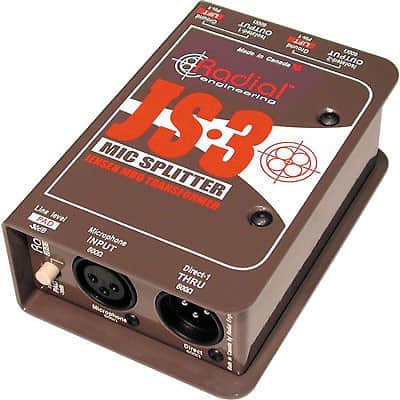
The Radial JS3 is a passive, transformer-isolated three-way microphone splitter that takes a single mic-level source and delivers it to three destinations simultaneously without noise, hum, or signal degradation. It splits one XLR input into one direct output and two Jensen transformer-isolated outputs, so front-of-house, stage monitors, and a recording rig can all share the same microphone at the same time. When the show gives you one shot at a clean feed to every console in the building, the JS3 makes sure every destination hears the same pristine signal.
What a Microphone Splitter Actually Does
A mic splitter solves a problem that appears the moment more than one console needs the same source: you cannot simply Y-cable a microphone to two mixers without inviting ground loops, level loss, and crosstalk. A splitter takes one mic input and fans it out to multiple isolated feeds, each electrically separated so that a hum-inducing ground loop in one console cannot travel back up the line and pollute the others. The JS3 does this three ways at once, giving you a direct throughput for your main console and two galvanically isolated outputs for everyone else.
Passive by Design: Why the Jensen Transformer Matters
The JS3 is a fully passive device with no power, no batteries, and nothing to fail on stage, and its performance rests entirely on a premium Jensen JT-MB-DPC transformer wired in a 1:1:1 ratio. That transformer provides galvanic isolation between outputs while preserving an exceptionally wide 20 Hz to 20 kHz bandwidth within +0/-2 dB, total harmonic distortion of just 0.0005% at 1 kHz, and a sweeping 140 dB dynamic range. A dual Faraday shield inside the transformer rejects noise, and phase deviation stays as low as 0.7 degrees at 100 Hz, so the split signal arrives coherent and true to the source.
One Direct Output and Two Isolated Outputs
The three outputs are not identical, and knowing the difference is how you wire the JS3 correctly. The direct output is a hardwired pass-through that carries the signal straight from the input, and it is the one path that lets phantom power reach a condenser mic or active DI plugged into the input. The two isolated outputs pass through the Jensen transformer, breaking any ground connection between the consoles they feed. Send your direct out to the mixer that supplies phantom, then use the isolated outs to feed monitors and a recorder without ever creating a loop.
Ground Lift and the -30 dB Pad
Two switches let the JS3 adapt to real-world stages. A ground lift on the isolated outputs disconnects the shield to kill any remaining hum path between systems, the classic cure for the 60-cycle buzz that appears when two consoles draw power from different circuits. A -30 dB input pad drops the sensitivity so the transformer never overloads when you feed it something hotter than a microphone, such as a keyboard, a media player, or the output of a JDX amp DI, reducing that line-level source down to a clean mic-level feed the splitter is built to handle.
Phantom Power and the Splitter
A common question on stage is whether 48-volt phantom power will damage a passive splitter, and with the JS3 the answer is no, because phantom power cannot pass through the isolation transformer and is safely blocked from the two isolated outputs. To power a condenser mic or active direct box, simply send phantom from your preamp into the direct connection, which carries it straight back to the source. This keeps your powered microphones alive while the isolated feeds stay galvanically separated and hum-free.
Where the JS3 Earns Its Keep
This is a working splitter for working stages. Feed the main mixer, stage monitors, and a live recorder from a single vocal mic during a concert, or split a broadcast feed so a house console and a broadcast truck both get a clean line. In a house of worship or a corporate AV install, share one lectern microphone between the main system and an overflow room without noise. Because the JS3 and its two-way sibling the JS2 slide into the Radial J-Rak, you can rack up to eight of them into a permanent multi-channel splitting system.
Built to Survive the Road
Like every Radial J-Class device, the JS3 is wrapped in a 14-gauge steel chassis and outer shell that shrugs off the abuse of touring, while an internal MuMETAL shield wraps the transformer to keep stray magnetic interference out of the signal. It is a plug-and-play tool with no menus, no firmware, and nothing to charge, so you connect the input, patch your three outputs, and trust it to deliver the same clean microphone signal night after night.
Reverb Buyer Protection
Reverb has your back if your item is lost, damaged, or doesn't match its description. Simply report any issues within 7 days and we'll help you get a full refund.Learn more about Reverb Buyer Protection.
| Listed | 15 hours ago |
|---|---|
| Condition | Excellent (Used) Excellent items are almost entirely free from blemishes and other visual defects and have been played or used with the utmost care.Learn more |
| Brand | |
| Model |
|
| Finish |
|
| Categories | |
| Year |
|
| Made In |
|
Product safety information may be available here.