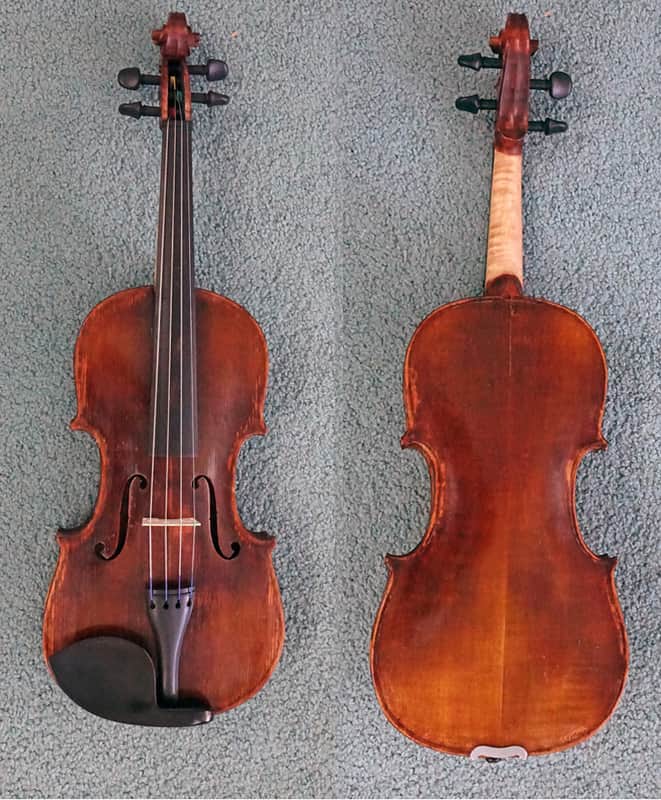
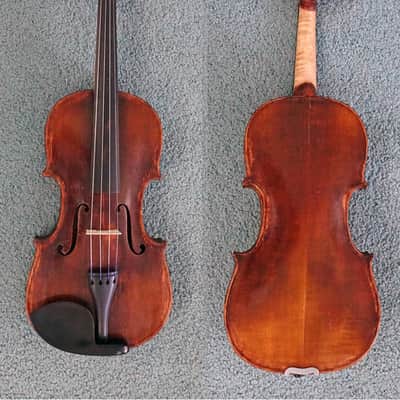
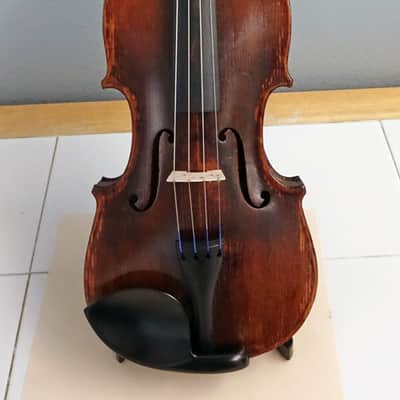

RESTORED ANTIQUE HOPF 4/4 GERMAN TRADE VIOLIN STRADIVARIUS COPY WITH CASE


Our users rate Reverb
RESTORED ANTIQUE HOPF 4/4 GERMAN TRADE VIOLIN STRADIVARIUS COPY WITH CASE - CIRCA 1900
You are invited to purchase a very nice antique handcrafted 4/4 (full size) Hopf trade violin from Germany. This instrument has been fully repaired, re-graduated, updated and fully restored to playability. Included with the violin is a nice new cloth internally padded carrying case. No bow or other accessories are included.
We have completed a complex series of relatively difficult repairs and restorative actions associated with this violin including the repair and stabilization of a centerline crack in the top plate, a re-graduation of the top plate interior, bass bar replacement and the installation of a soundpost patch on the interior of the top plate (See details below). We also installed new corner blocking, replaced the lower block, reattached the ribs to the bottom plate in the area of the lower bout, and installed a new replacement neck and fingerboard. The violin has also been upgraded and modernized with a new Wittner geared pegs, new Ebony endpin, reconditioned Ebony tailpiece and new modern steel strings making it ready to be played and enjoyed by its new owner.
VIOLIN MAKER'S STAMP, INTERNAL LABELS & REPAIR LABEL:
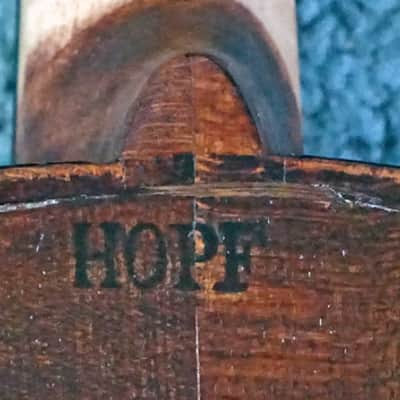
This violin bears the following burnished-in stamp on the top back of the violin under the button (See accompanying image):
"HOPF"
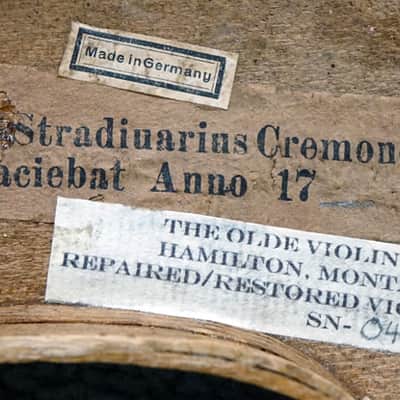
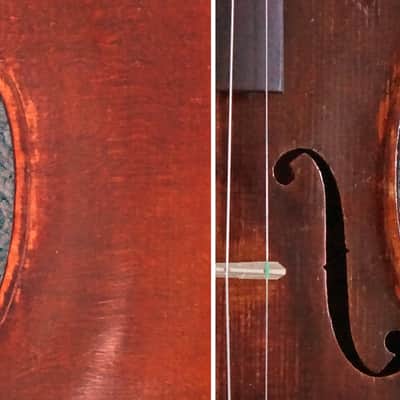
Also, this instrument has the following pasted-in labels under the left f-hole (See accompanying image):
"MADE IN GERMANY"
and
"Antonius Stradivarius Cremonensis
Faciebat Anno 17__"
Note: The latter paper label shows some age deterioration in the lettering and also includes the customary Stradivarius trade mark on the right side of the label consisting of the letters A and S separated by a central cross and enclosed within an outer circle.
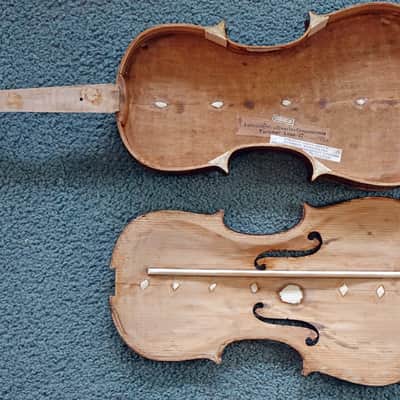
In addition, this violin bears a repair label and serial number from our workshop found inside the violin under the left f-hole (See accompanying image):
"THE OLDE VIOLIN SHOPPE
HAMILTON, MONTANA USA
REPAIRED/RESTORED VIOLIN ANNO 2026
SN-04232026"
VIOLIN ORIGIN & ESTIMATED DATE OF MANUFACTURE:
The dynasty of Hopf family luthiers is known to have consisted of somewhere between 18 and 40 individuals (Note: Some references say upward of 50 individuals) who were members of the Hopf String Instrument Guild or empire, which operated from the late 17th Century on through the early years of the 20th Century in and around the town of Klingenthal in the German province of Vogtland (now located in the Czech Republic).
The founding member of the Hopf family was Caspar Hopf (1650-1711). He was later followed by his son David Christian Hopf (birth and death dates unclear) and his grandson, David Hopf (1762-1786). This family of luthiers produced fine German cellos, violas and violins. Many of the violins were stamped under the button on the outside top of the back plate with the guild name "HOPF" and some productions even had the name stamped inside the violin as well.
The Hopf family members overall were known to be quite industrious, literally building tens of thousands of instruments under the family signature in a production-line assembly with individual scroll cutters, back and top carvers, rib makers, and even peg makers, etc. The work produced by the family guild is superficially in the Stainer style, but with noticeably squared-off upper and lower bouts.
As time went on, other violin making families joined in with the numerous Hopfs, with members of the Dorfel, Hoyer and Glass families being particularly significant. But, by the mid-19th Century, the boom in production had already reached its peak followed by a very dramatic bust and by the year 1887, the Hopf family guild in Klingenthal had essentially ceased to exist leaving just a few independent cottage-based craftsmen still producing the Hopf violins into the early years of the 20th Century.
Based in part on the amount of repair work it took to restore this violin to the point of playability (see below for details), the nature and presence of the pasted-in labels and the type of wood and methods used in its original production, we estimate that this particular Hopf violin likely dates from Circa-1900.
IMAGES:
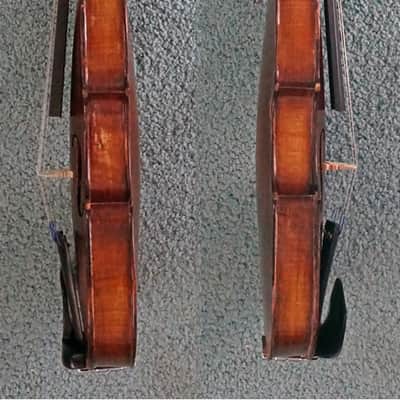
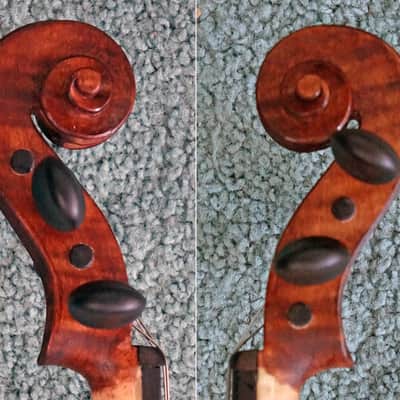
Images of the restored violin including views of the internal repairs are included with this listing. Click on the images for a larger view.
KEY PHYSICAL FEATURES:
* A warm, attractive dark amber brown spirit varnish.
* Two piece Maple back with ribs of Maple to match the back (See images).
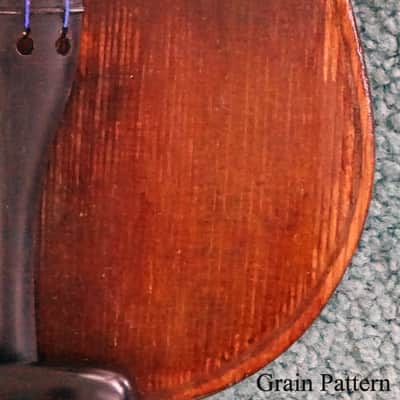
* Two piece Spruce top with a wider grain pattern at the edges with a slightly tighter grain pattern towards the central seam (See images).
* Top plate has a moderate arch.
MEASUREMENTS:
* Length Overall (Loa): 23 1/4"
* Length of the body (LoB): 14"
* Rib Height: 1 1/4"
* Max Width of Upper Bout: 6 3/8"
* Avg. Width at Waist or C-Bout: 4 3/8"
* Max. Width of Lower Bout: 7 3/4"
NATURE OF REPAIRS & RESTORATION:
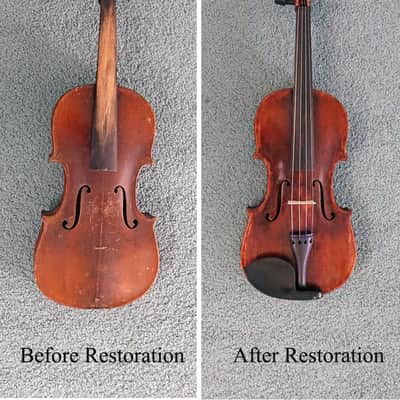
This antique violin was received by us in overall apparently good structural condition, but with evidence of a centerline crack in the top plate, an inferior black painted wood fingerboard and a rather thin pegbox that had some drilled-in or insect caused holes found therein (See accompanying image of the violin before restoration). It was also in need of a good external and internal cleaning.
Once the top plate was removed from the violin, we discovered that there was a relatively short, improperly situated and poorly formed carved-in bass bar present. Thus, this bass bar needed to be replaced by a new properly designed and situated glued-in bass bar. Also, the interior of the top plate was roughly carved with residual ridges and valleys necessitating the need to re-graduate the top plate for a more smooth and relatively consistent thickness.
Unfortunately, typical of many trade violins, none of the corners were blocked by the maker. Thus, new blocking to all four corners would need to be added. The center seam of the top plate showed the beginnings of a separation in places even though it had some prior reinforcement by the maker from dabs of Hide glue. We thus saw the need to repair the crack and to install proper cleats along the center seam. Due to the proximity of the crack to the soundpost location we also decided it would be best to install a soundpost patch to mitigate any future stress on the centerline crack from mechanical pressure from the soundpost.
Following is a summary of the actions taken by us to repair and restore this antique Hopf violin to full playability:
1. Once the top plate was removed from the violin, we cleaned and glued the center seam of the top plate and added cleats to reinforce the repair. We also added a soundpost patch in top plate to prevent any future advancement of the centerline crack caused by the stress of the soundpost placement. In addition, we added new cleats to the center seam of the bottom plate. (See accompanying images that show the repairs made to the top and bottom plates).
2. None of the corners were blocked by the maker. We installed new blocking to all the corners. Thus, now all four corners are blocked (See image showing the blocking).
3. The poorly designed and placed carved-in bass bar in the top plate was removed and the interior of the top plate was re-graduated to a relatively uniform thickness and smooth surface. Then, a new properly designed and profiled bass bar was installed in the proper location on the inside of the top plate (See image of the top plate interior with the new glued-in bass bar).
4. The lower block was found to be damaged and the ribs on either side of the block were found to be separated from the bottom plate. We installed a new lower block and re-glued the ribs to the bottom plate after cleaning the joint area of any residual dried glue and dirt.
5. Due to its narrow configuration by several mm and associated structural problems with the original pegbox, we decided to remove the original neck and to replace the entire neck of the violin with a new neck that included a properly sized pegbox.
6. We reattached the top plate to the ribs with Hide Glue. Before restoring the top plate we added our shop repair label to the bottom plate.
7. The original black painted wood fingerboard was discarded and replaced by a new Ebony fingerboard. The top of the fingerboard was properly profiled and sanded smooth. At this time, we also added a new Ebony nut, which was properly trimmed in size and height. Grooves for the strings were reset in concert with standard design specifications.
8. At this time, the exterior surfaces of both the top and bottom plates as well as the ribs and scroll box were wet sanded with successive grades of sandpaper (600 followed by 1,000 git) thereby removing most age related surface imperfections. The surfaces were then cleaned with denatured Alcohol and Brown stain was added to areas needing it. This was followed by a coating of Brown Spirit Varnish to restore all exterior surfaces to a like new condition. A coating of French Polish was then added to all exterior surfaces of the violin as a final cosmetic treatment.
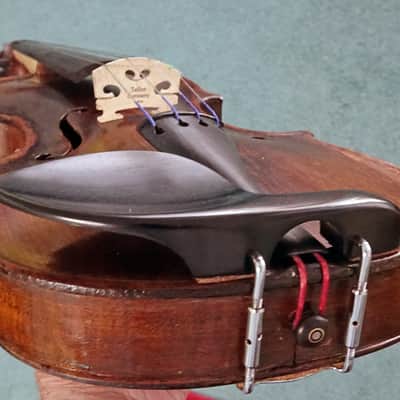
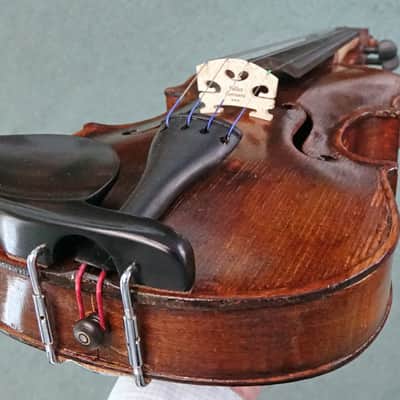
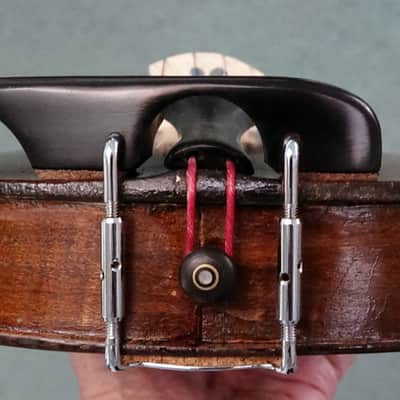
9. At this time we added a new Ebony endpin onto the violin. In addition, a new full-size Guarneri-style Ebony Chinrest was added to the violin along with a reconditioned Ebony tailpiece.
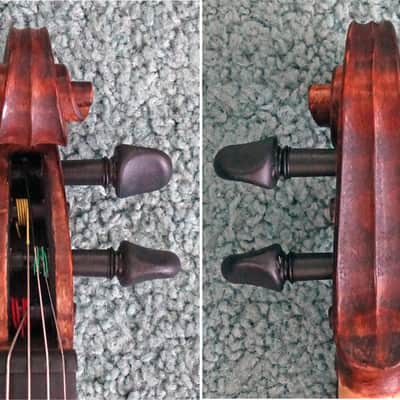
10. The pegbox was fitted with Wittner Finetune geared Pegs (Made in Germany). These geared pegs eliminate the need for fine tuners on the tailpiece as they are permanently set within the pegbox and have an 8:1 gear ratio, making for very precise tuning. Only the central knurled spool segment of the peg rotates so peg slippage is prevented. So once the Wittner pegs are set, they are not designed to be removed from the pegbox. The geared pegs are also unaffected by temperature and humidity changes.
NOTE: Conventional wood peg slippage is a big problem with most violins, something that a player definitely does not want to happen in the middle of a concert solo in front of a large audience. Wittner geared pegs totally eliminate peg slippage so one can play the violin even with vigor without worry.
10. Finally, we completed the setup of the violin by properly fitting a new Teller Maple bridge, installing a new Spruce soundpost along with a new set of D'Addario Prelude medium tension steel strings.
All of the aforementioned repairs have resulted in a completely restored, re-graduated and upgraded Hopf violin that has significantly improved the overall tonal response and sound quality of this instrument. Thus, this antique instrument that could have easily been lost to time has been fully repaired, improved and reborn to live a second life in the present.
VIOLIN CASE:
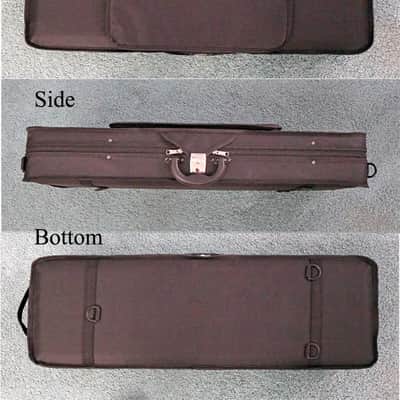
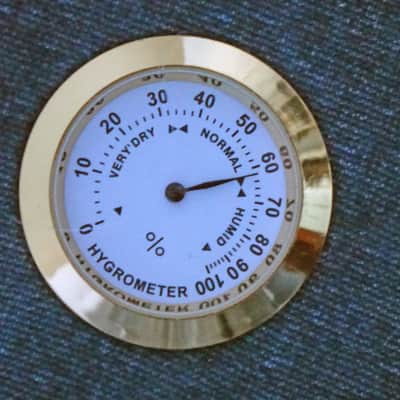
Included with this restored Hopf trade violin is a very nice new rectangular cloth covered internally foam formed carrying case with side and end carrying handles, dual zipper closure, lock with key and a set of additional shoulder straps for the back. Also included inside the case are dual racks for bows (no bow included), a hygrometer or humidity meter (see close-up image), a soft cloth cover for the violin, a pocket for accessories and a formed niche for an optional shoulder rest (not included). In addition, there is a zippered pocket on the top of the case for carrying sheet music. The case measures 31 inches long by 10 inches wide and 5 inches deep (See images of this case). This case is suitable for safe shipping of the violin to its new owner and for ongoing use by the new owner for both storing and transporting the violin after it is received.
Reverb Buyer Protection
Reverb has your back if your item is lost, damaged, or doesn't match its description. Simply report any issues within 7 days and we'll help you get a full refund.Learn more about Reverb Buyer Protection.
| Listed | 5 days ago |
|---|---|
| Condition | Good (Used) Good condition items function properly but may exhibit some wear and tear.Learn more |
| Brand | |
| Model |
|
| Finish |
|
| Categories | |
| Year |
|
| Made In |
|
Product safety information may be available here.