
Köln, Germany
About this listing
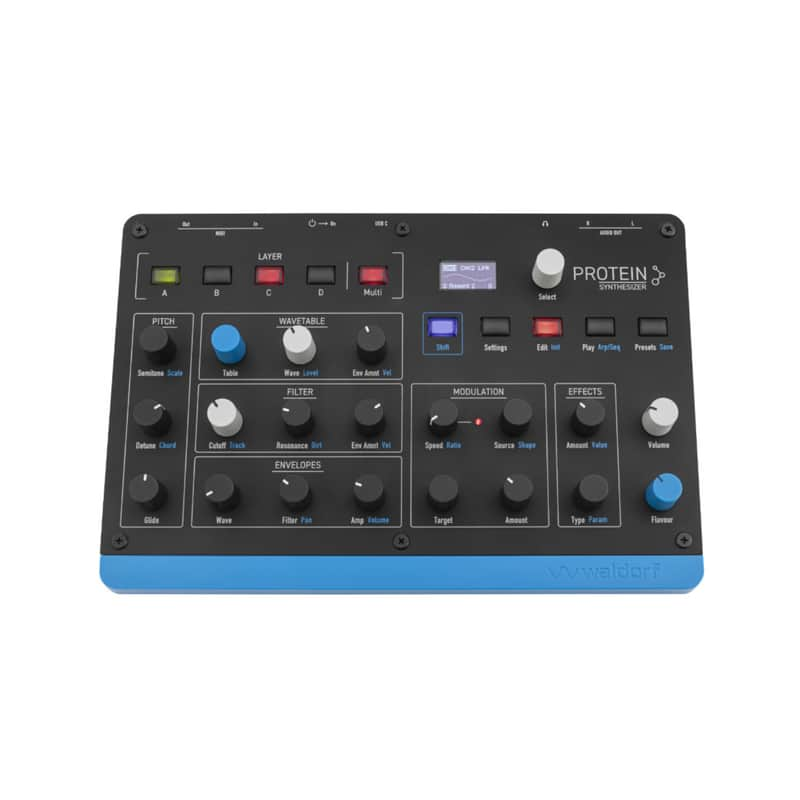
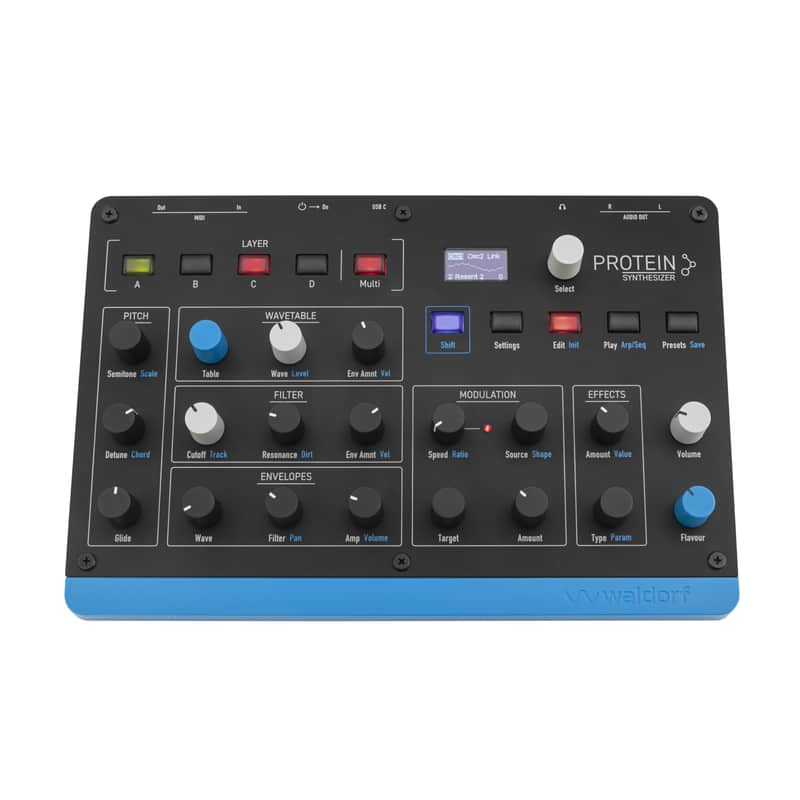
Original ASIC oscillators from Microwave 1 (1989)authentic reproduction of the original 8-bit waveforms (250 kHz sample rate)incl. algorhythmic & voice wavetablesdigital ASIC noise generatordigital, accurate CEM filter (24dB lowpass)Flavor control for subtle micro fluctuations3 envelopes2 synchronizable LFOsmodulation matrix with 8 slotspolyphonic aftertoucharpeggiatorStep sequencer (pattern length up to 32 steps)Chord & Scale Mode2 effect slots (reverb, delay, chorus, phaser, flanger, drive, EQ, compressor, tremolo)8 voices / 4 layers - perfect for multi-layered soundsMultimode with 4 partsLoad layer function - swap sound layers100 Factory presets + 250 User presets with category filterincl. 2 MIDI-TRS adapters & USB-C cableModernized wavetable classic with chord & layer featuresWith the Protein, Waldorf introduces its most compact wavetable synthesizer to date a purely digital reimagining of the classic Microwave 1. The original, released in 1989, was inspired by the PPG Wave synthesizers of the time. As a compact rack unit with two digital oscillators and an analog filter, it was a groundbreaking instrument. The Protein faithfully reproduces the signature MW1 oscillators and the popular CEM filter, while digital implementation brings several conceptual advantages, especially in voice architecture, making it easier to integrate and experiment musically.Sound architecture based on the classic modelEach of the Protein’s 8 voices features two wavetable oscillators, closely modeled on the original ASIC oscillators of the Microwave 1 from 1989. These oscillators offer an authentic reproduction of the original 8-bit waveforms at a 250 kHz sample rate, including algorhythmic and speech wavetables. Additionally, the sound palette is expanded by a digital ASIC noise generator. The resulting sound spectrum is carefully constructed and can even be modulated (if desired), leading into a digital 24dB lowpass filter that delivers the signature Curtis CEM sound. With these features, it’s clear that Waldorf has captured the DNA of the "post-PPG era" while adding modern features in a sleek, compact package.Two ADSR envelopes are permanently assigned to the filter and VCA, while a third envelope is used to modulate the wavetables. Modulation options are further enhanced with two BPM-synchronizable LFOs, as well as various controllers such as the modulation wheel, random, velocity, or polyphonic aftertouch, which can be assigned to any of the 8 slots in the modulation matrix.A standout feature is the Flavour control, which allows you to shift the precise, digital circuits (oscillator drift, filter, envelope behavior, etc.) towards the warm, component-related inaccuracies often found in older synthesizers.Finally, the two effect slots offer a range of algorithms: reverb, delay, chorus, phaser, flanger, drive, EQ, compressor, and tremolo, rounding off the signal path with versatile processing options.8 voices - stacked, arranged or all togetherThe Protein’s voice architecture is a particularly unique feature. The synthesizer offers 8 voices, each of which can be used in several ways. First, there’s Layer Mode, which lets you stack up to four sounds (presets!) on top of each other. This mode is ideal for creating complex, multi-layered sounds that a single voice can’t achieve. The Load Layer function allows you to swap sound layers as needed.Like many other Waldorf synths, the Protein also includes multimode functionality, enabling you to use different sounds on four separate parts, each with its own MIDI channel, all within the eight-voice polyphony. The arpeggiator and polyphonic step sequencer (with a pattern length of up to 32 steps) are powerful performance tools. And for fans of dub genres, the Chord & Scale mode provides an excellent creative outlet.
Price€340.63
Incl. VAT
+ €7.14 Shipping
shipping when combined

30-Day Return Policy
Enjoy peace of mind with your new gear