


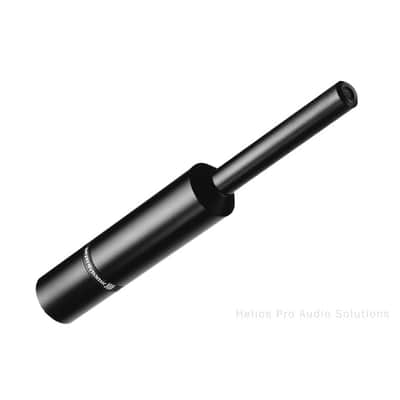
Beyerdynamic M100 1956 - Historical Omnidirectional Dynamic Microphone



Rare Find
These don't show up often
Our users rate Reverb
A MASTERPIECE OF GERMAN MICROPHONE ENGINEERING
Omnidirectional Dynamic Microphone
The Beyerdynamic M100 is a fascinating example of early German microphone engineering, dating from an era when manufacturers were pushing the technical boundaries of what a moving-coil microphone could achieve.
Introduced during the 1950s, the M100 was an exceptionally compact, high-quality omnidirectional dynamic microphone, developed for demanding professional audio applications.
What makes the M100 especially remarkable is its original published frequency response of 40 Hz to 18,000 Hz, with a tolerance of just ±2.5 dB — an impressive technical achievement for a miniature dynamic microphone of the early 1960s. also one of the most iconic design of minimalism - and a very limited production.
Its appeal lies not only in its relative scarcity but also in its unusual engineering concept: a miniature omnidirectional moving-coil microphone offering a frequency response more commonly associated with professional condenser designs.
Today, the M100 is a seldom-encountered historical microphone, representing an interesting chapter in Beyerdynamic's development.
OPTICAL CONDITION
Good Vintage Condition
The microphone displays normal signs of age and use, consistent with its approximately six decades of history. the front mash shows minute disformations
original appearance is preserved.
Please examine the photographs for a detailed impression of its cosmetic condition.
TECHNICAL CONDITION
Fully Functional
in this example - the bass roll starts below approximately 75 Hz when compared which is higher when compared with the 1963 factory specifications we found. this slight deviation does not mean a defect/ in fact the microphone satisfies test on fq reach of 50 and above 18khz as well as sensitivity of - 80db 01mv bar at 1000hz.
It retains its six-pin small Tuchel connector, a connection format specifically offered as a factory option in Beyer's original 1963 documentation.
The microphone is therefore in original technical state - and close with the microphone's original spec .
CONNECT TO XLR
We have a very limited amount of small 6 pin Tuchel connectors -
adapters cables to XLR Can be made upon request to desired length.
provided together and wired especially for this microphone
Please contact for further details.
FACTSHEET / TECHNICAL SPECIFICATIONS
Manufacturer: Beyerdynamic / Eugen Beyer
Model: M100
Country of Manufacture: West Germany
Production Period: Introduced in the 1950s; documented in the 1963 Beyer catalogue
Microphone Type: Dynamic moving-coil microphone
Polar Pattern: Omnidirectional (Kugel)
Frequency Response: 40 Hz – 18,000 Hz (original factory specification)
Frequency Response Tolerance: ±2.5 dB (original factory specification)
Sensitivity: 0.1 mV/µbar at 1 kHz (−80 dB)
Nominal Impedance: 200 Ω
Dimensions: 22 × 120 mm
Weight: 115 g
Optional Factory Connector: 6-pin Beyer T 3402
Connector on This Example: 6-pin small Tuchel
Serial Number: 4056
Historical Documentation: Original Beyer M100 technical brochure, March 1963
BUILD & DESIGN — A STUDIO MICROPHONE IN MINIATURE
The M100 was not simply another general-purpose dynamic microphone.
Its design reflects the increasingly sophisticated requirements of professional audio engineering in postwar Germany, particularly in broadcasting, recording and sound reproduction.
One of its most striking achievements was miniaturisation.
Measuring just 22 mm in diameter and 120 mm in length, the M100 approached the proportions of contemporary small-diaphragm condenser microphones while employing an entirely different transducer principle.
Achieving such an extended and remarkably linear frequency response from a compact moving-coil assembly was a significant engineering accomplishment for its time.
The original Beyer documentation from March 1963 specifies a frequency response extending from 40 Hz to 18,000 Hz, with deviations of only ±2.5 dB.
Even by modern standards, these are ambitious published specifications for a miniature dynamic microphone.
The original frequency-response graph illustrates a particularly even response throughout the central frequency range, with relatively modest variations extending well into the upper frequencies.
Unlike directional microphones, the M100's omnidirectional pressure transducer does not exhibit the conventional proximity effect, making it particularly suitable for applications where a natural and consistent tonal balance is desirable.
Its small dimensions, broad frequency response and unobtrusive construction made it a technically sophisticated solution for professional recording and broadcasting applications.
A PLACE IN BEYERDYNAMIC HISTORY
The M100 belongs to an important period in the development of German professional microphone technology.
Following the destruction of its Berlin factory during the Second World War, Eugen Beyer re-established production in Heilbronn in 1948.
During the following decade, the company developed an increasingly sophisticated range of professional microphones, including the celebrated M160 ribbon microphone, introduced in 1957.
The M100 belongs to this same pioneering generation.
While models such as the M160 and the later M88 became internationally recognised classics, the M100 gradually disappeared from the professional microphone landscape.
Its historical significance, however, remains.
It represents an ambitious attempt to combine the compact proportions associated with condenser microphones with the practical advantages of dynamic technology.
An original Beyer technical brochure dated March 1963 survives in the Echoschall historical archive, documenting the M100's construction, electrical characteristics, frequency response and available accessories.
Particularly interesting is the variety of professional accessories offered for the microphone, including stands, mounting systems, windscreens, extension cables and alternative connector configurations.
This extensive accessory programme illustrates that the M100 was part of a developed professional microphone system rather than merely a simple consumer recording accessory.
RARITY & COLLECTOR'S INTEREST
Today, the Beyerdynamic M100 is considerably less frequently encountered than many of the manufacturer's better-known historical microphones.
Although surviving documentation establishes its presence in Beyer's professional microphone range during the early 1960s, the exact number of units manufactured has not been established.
This particular example carries serial number 4056.
While the serial number provides an interesting historical identification, it cannot independently establish the microphone's exact production date or the total number manufactured.
The M100 occupies a distinctive position among collectible German microphones in general- and this is still undoubtedly an early serial number
Unlike many vintage microphones that have become famous through particular recordings or celebrated studio applications, the M100 remains relatively unfamiliar even among enthusiasts of historical recording equipment.
For collectors of early German professional audio technology, it represents an opportunity to acquire a less commonly encountered example of Beyer's engineering heritage.
Its historical importance is supported by surviving original technical documentation, while its distinctive construction makes it an especially interesting addition to a collection of early professional microphones.
SOUND & FREQUENCY RESPONSE
The M100 was designed around the principle of natural, balanced acoustic reproduction.
Its omnidirectional capsule captures sound from all directions without the pronounced proximity effect associated with directional pressure-gradient microphones.
The original 1963 frequency-response graph is particularly noteworthy.
Beyer's stated frequency range of 40 Hz to 18,000 Hz, within ±2.5 dB, demonstrates the considerable technical ambition behind the design.
Such an extended and even published response is especially unusual for a compact moving-coil microphone from this period.
The measurement of this particular example reveals a remarkably smooth midrange, good high-frequency extension and a somewhat reduced bass response below approximately 75 Hz compared with the historical factory curve.
Considering the differences between historical and modern measurement methods, this variation cannot automatically be attributed to ageing or deterioration.
Rather than emphasising the pronounced midrange coloration commonly associated with classic broadcast dynamics, the M100's original design appears to have prioritised extended, balanced reproduction.
Its omnidirectional construction also makes it particularly interesting for natural acoustic recording, room ambience and applications where a consistent tonal balance at different microphone distances is desirable.
The Beyerdynamic M100 is one of those microphones whose modest appearance conceals a surprisingly interesting history.
Compact, elegant and technically ambitious, it belongs to a formative period of German professional audio engineering.
Its remarkably extended published frequency response, miniature moving-coil construction and surviving historical documentation distinguish it from many of the more familiar dynamic microphones of its generation.
More than six decades after its appearance in Beyer's professional catalogue, surviving examples offer both a functional recording instrument and a tangible connection to the early development of modern studio microphone technology.
A rare opportunity to acquire an original example of this distinctive and historically significant Beyerdynamic design.
| Listed | 9 hours ago |
|---|---|
| Condition | Excellent (Used) Excellent items are almost entirely free from blemishes and other visual defects and have been played or used with the utmost care.Learn more |
| Brand | |
| Model |
|
| Categories | |
| Year |
|
| Made In |
|
| Polar Pattern |
|
| Microphone Type |
|
| Wired/Wireless |
|
Product safety information may be available here.

