Solid State Logic E-Series EQ 500-Series Module

Envío gratis
desde Irmo, SC


Política de devoluciones de 14 días
Disfruta de tu nuevo equipo sin preocupaciones
Nuestros usuarios valoran Reverb
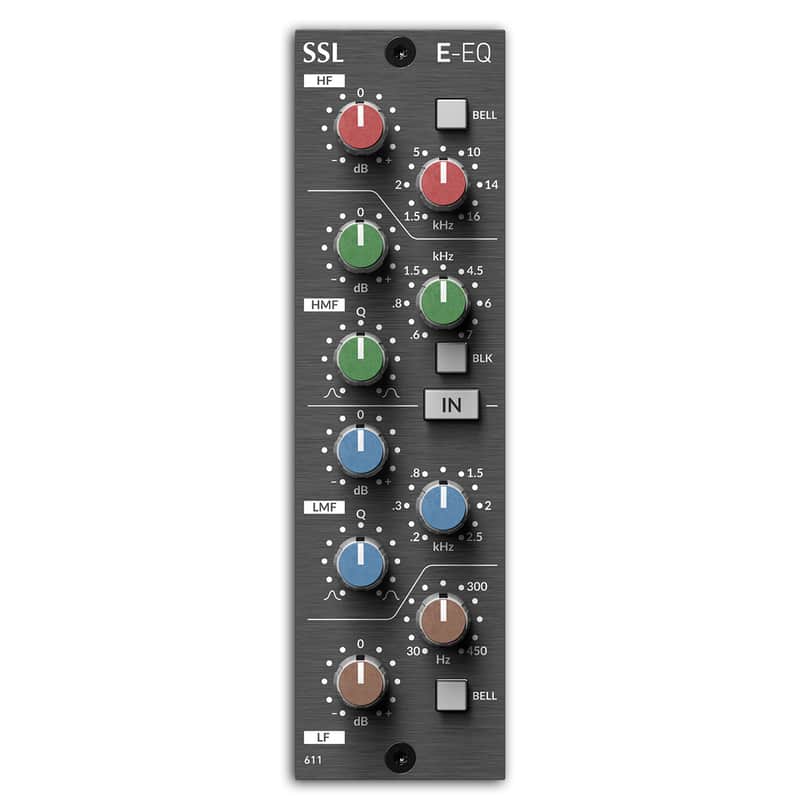
The Solid State Logic E-Series EQ 500-Series Module is the legendary 4000 E-Series channel EQ with its classic gritty tonal response in a 500 Format Module. It switches between "Brown" and "Black" EQ response curves, each offering their own tonal character.
The Solid State Logic E-Series EQ 500-Series Module reproduces the legendary sonic signature of an early 80's classic, the Solid State Logic SL 4000 E console channel strip, which has featured on countless classic recordings from the 1980's to the present.
The Solid State Logic E-Series EQ 500-Series Module features two different EQ's found on editions of the console produced between 1981 and 1989. Each EQ has unique response curves and tonal character. Historically the type of EQ fitted in an individual console was distinguished by the colors used on the LF knob caps so the two flavors have become known as the 'Brown' and 'Black' EQ's. On the Solid State Logic E-Series EQ 500-Series Module you can switch between these two different flavors of EQ that have been loved by generations of professional producers.
The 'Brown' EQ, featured on the discontinued SSL E-Signature Channel Strip, is now uniquely available on the Solid State Logic E-Series EQ 500-Series Module.
A Little SSL EQ History
Prior to 1987 SSL used the colour of the Low Frequency EQ knob caps to indicate which type of EQ was fitted. All consoles were custom built and could feature different combinations of EQ module. The following colour codes apply:
- E-Series BROWN: The original SSL EQ fitted to all consoles prior to the summer of 1985. Despite the rumours these equalisers only came in one version. The EQ card was called the '02'.
- E Series ORANGE: The infamous EQP equaliser. This was a variation on the Brown EQ with controls simulating the curves of a valve type EQ. Very few were sold. This card was named the '132'.
- E-Series BLACK: The last version of the standard E series EQ. It evolved in the early 1980's from discussions with many top engineers and proved very popular. The EQ card was called the '242'.
- G-Series: With the arrival of the G Series console in 1987 the colour coding was abandoned and the classic SSL end cap colour scheme used today was adopted. First introduced in 1987 the original G Series EQ introduced Q characteristics which were proportional to gain settings and had a degree of over shoot when boosting and under shoot when cutting.
The current generation of SuperAnalogue console EQ (featured on Duality, AWS 900 + SE & the X-Rack EQ module) are switchable between EQ characteristics that offer either the E-Series 'Black' EQ or the G Series EQ.
Solid State Logic E-Series EQ 500-Series Module Features
- Immortal SSL 4000 E Series circuitry
- "Black-242" and "Brown-02" twin EQ design
- Versatile 4 band channel EQ
- Bell curve option on HF and LF
- Fully parametric LMF and HMF with Q
- Based on classic 611E console channel strip
Solid State Logic E-Series EQ 500-Series Module Specifications
- No. of Channels: 1
- No. of Bands: 4
- Q Type: Selectable
- Frequency Ranges:
- High: 1.5kHz-16kHz
- Hi-Mid: 600Hz-7kHz
- Lo-Mid: 200Hz-2.5kHz
- Low: 30Hz-450Hz
- Bypass: Yes
Solid State Logic E-Series EQ 500-Series Module Includes
- Solid State Logic E-Series EQ 500-Series Module
- 1 Year Warranty
| Estado | Nuevo (nuevo) Productos nuevos son vendidos por tiendas oficiales o por el fabricante original e incluyen todo su empaquetado original.Más información |
|---|---|
| Marca | |
| Modelo |
|
| Categorías | |
| Electrónica |
|
La información de seguridad del producto se encuentra disponible aquí.

Protección de Reverb
Devoluciones sencillas, transacciones seguras, asistencia personal
Más información