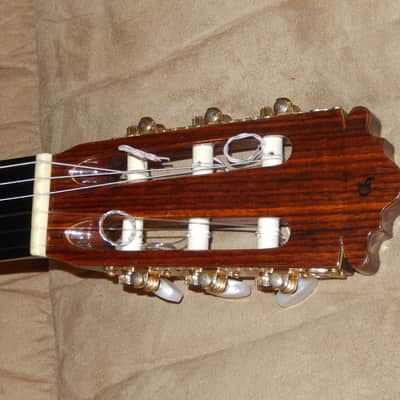
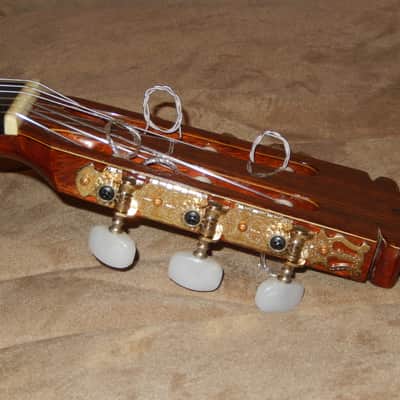
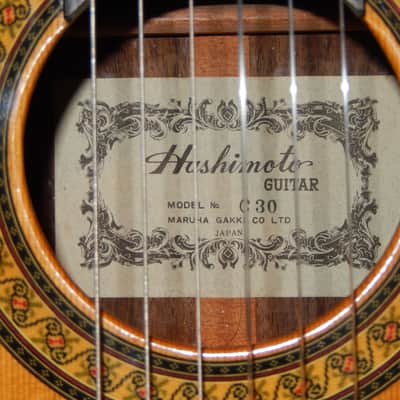
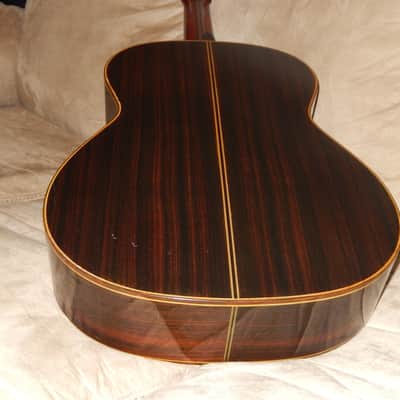
Made in 1974 by Kazuo Hashimoto - Model C30 - Fantastic Vintage Japanese Made Classical Guitar
This listing has ended
See similar gear from other Reverb sellers

Our users rate Reverb
If you'd like to see pictures of over 500 classical & flamenco guitars that I've sold in the past, please visit "Victor's Guitar Gallery" on Facebook
Beginning January 2017, all species of rosewood belonging to genus Dahlbergia spp. are added to CITES Appendix II. This means that any guitar that has any part made from one of these rosewoods can’t be shipped internationally without CITES export permit. CITES import permit is required only with regard to guitars which have at least one part made from Brazilian "Rio" Rosewood Dahlbergia nigra.
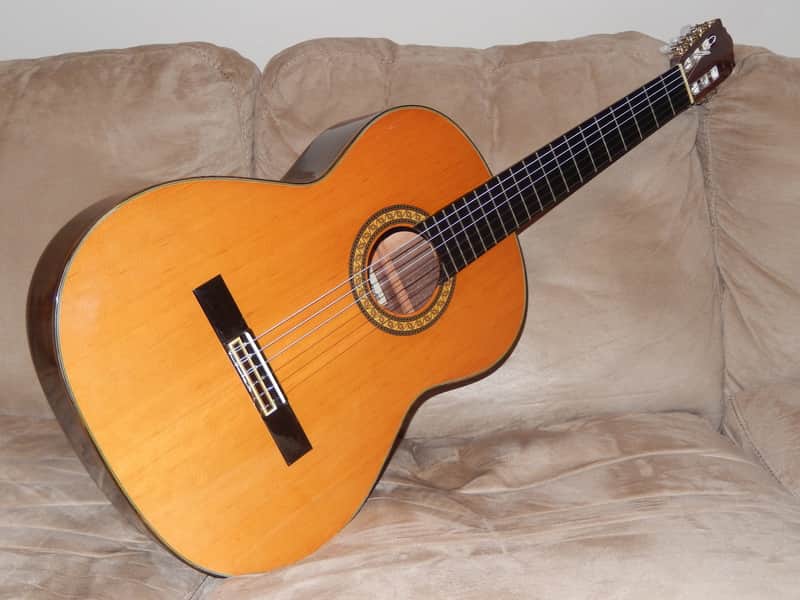
Kazuo Hashimoto C30 in excellent condition
Kazuo Hashimoto was one of the pioneers of classical guitar making in Japan. He was making relatively limited number of high quality guitars during 1950s,1960s Nd 1970s under “Maruha” brand, which went bankrupt in mid 1970s. His guitars are highly valued by not only Japanese players.
This particular guitar most likely was made in early to mid 1970s. This guitar was priced $30 000 yen and was quite valuable item. For many Japanese guitar lovers, purchase of a guitar was “an investment” and serious decision. These guitars were treated like most precious jewels. That’s why it is possible to find in Japan 40+ years old guitar that looks like it was made yesterday.
Real Value of Japanese Vintage Guitars
The key to understand value of vintage Japanese guitars is to acknowledge galloping devaluation of Japanese yen in 1960s & 1970s. This devaluation was somewhat slower in 1980s. The best measure of this devaluation is Starting Yearly Salary of Japanese College Graduate (SYSJCG).
SYSJCG in in 1965 was 19 600 yen, in 1969 – 34 600 yen, in 1970 39 200 yen, in 1972 – 62 300 yen, in 1975 79 200 yen, in 1977 121 200 yen and in 1980 - 163 000 yen.
During 1960s and most of 1970s model numbers of Japanese guitars were strictly interconnected with their prices in Japanese yen. In late 1970s and during following decades model numbers were no longer strictly associated with their prices. Many Japanese guitar makers introduced model names instead of model numbers. Others were still using model numbers with addition of letter abbreviations or other symbols.
The best and only logical approach while evaluating real value (real grade) of vintage Japanese guitar is to compare its price in Japanese yen with SYSJCG during the year guitar was made.
Any guitar priced 100 000 in 1970 (labelled usually as No10) would be priced 200 000 yen in 1975 (relabeled to No20 or 2000), 300 000 yen in 1977 (labelled as No3, No30 or 3000). Starting in 1977 Masaru Kohno introduced his model No50 priced at 500 000 (skipping theoretical model 40). Soon other famous Japanese luthiers did the same. By 1983 Kohno started using model names instead numbers and was raising their prices as he was pleased. Naturally soon other Master luthiers did the same.
Knowing all of that, you can bet on that Masaru Kohno No50 made in 1982 is practically the same quality as Kohno No15 made in 1972, or Kohno no20 made in 1975 or Kohno No30 made in 1977. I know it for a fact.
The lowest grade models currently made by Matsuoka workshop are M75 and MH75. They are commonly considered as “beginner guitars”. Matsuoka model M30 made in 1973 is simply far, far better instrument. It is naturally better than model M50 made in 1977, model 80 made in 1982 or model M100 made in 1990. At present, the highest grade Matsuoka models are M300 and MH300. They absolutely stand no chance in competition with model M150 made in 1975… or model M200 made in 1977.
It is very important to mention that if modern era luthiers are using 40 years old woods to make a classical guitar, its price is at least $8000.
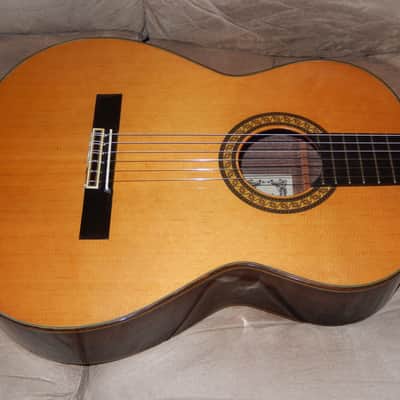
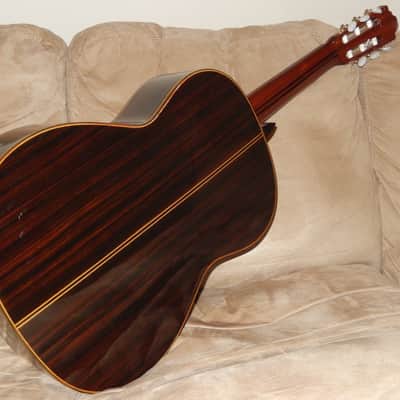
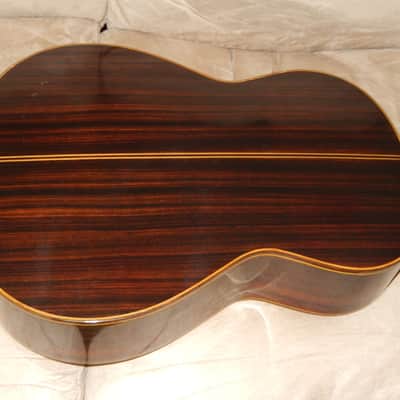
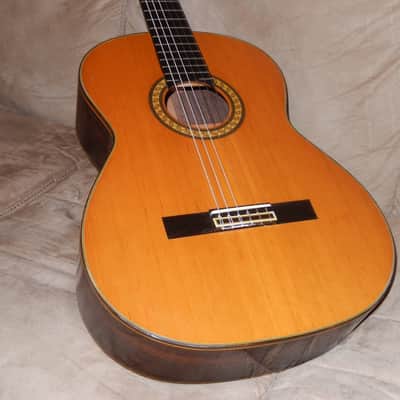
This guitar has few tiny cosmetic flaws on its top, couple of very light abrasions on the back. It looks like this guitar, instead of being played a lot was mostly stored in a case.
It produces clear & sweet treble notes with deep & resonating basses, all well balanced with great sustain and at impressive volume. Guitar is relatively light and very responsive.
Specification:
Top: Solid High Grade Spruce
Back & sides: Straight Grain Brazilian Rosewood Doubleplate
Calling this construction "laminates" would actually be very incorrect and quite misleading. This genuine Japanese invention has really nothing in common with modern era cheap particle-board laminates. This construction is nothing but 2 solid wood plates glued together, hence in fact nothing but reinforced solid woods. Such plates perform no different from solid woods, while don't crack as easily, are much easier to work with, and allow for much lower prices of these instruments. Such guitars have always been and still are a true blessing for all guitar enthusiasts with limited funds.
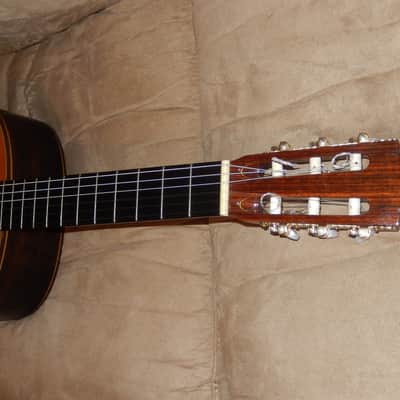
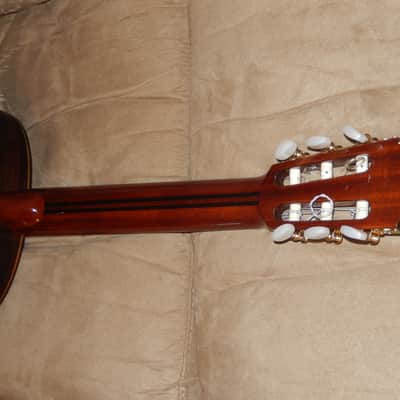
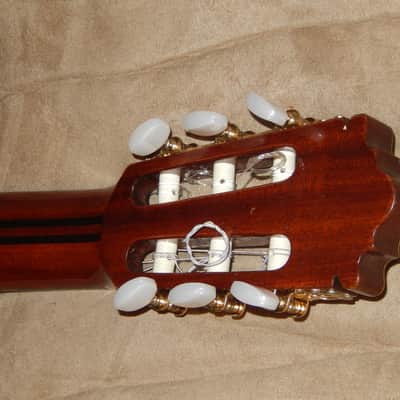
Neck: Mahogany
Fingerboard: Ebony Or Very Well Ebonized Rosewood
Scale: 650 mm
Nut width: 52 mm
Action is set to 3.5 mm under E6 and 3.00 mm under E1.
This guitar will be shipped in used case of minimal value. You don’t pay for the case. You only pay for the guitar. Please consider this case as a free bonus and don’t expect too much. I will not accept any complaints regarding the condition of the case.
Message to Australian buyers !!!!!
In order to ship a package with guitar to Australia at affordable rate +/- $100 (USPS International Priority Mail), height of such package can’t exceed 42” and its girth+ length can’t exceed 97”. Therefore I will pack the guitar into a case that is short enough to meet this requirement.
Returns
If you are not happy with your purchase you may return the guitar for a full refund less any shipping charges.
All you need to do is to:
1. Notify me within 2 days after delivery
2. Pack guitar the same way I do it, using the same box and materials
3. Ship it back to me no later than on 3rd day after delivery
Another words I expect this “trail” period to occur within +/- 3 days. Naturally if you expect to receive a full refund, guitar has to be returned in the same condition as I ship it to you.
Victor
Reverb Buyer Protection
Reverb has your back if your item is lost, damaged, or doesn't match its description. Simply report any issues within 7 days and we'll help you get a full refund.Learn more about Reverb Buyer Protection.
| Listed | 11 years ago |
|---|---|
| Condition | Excellent (Used) Excellent items are almost entirely free from blemishes and other visual defects and have been played or used with the utmost care.Learn more |
| Brand | |
| Model |
|
| Finish |
|
| Categories | |
| Year |
|
| Made In |
|
| Body Shape |
|
Product safety information may be available here.