Yamaha Pc-100 1982
This seller has not set a shipping cost for Continental U.S.. Please contact them to ask about shipping.


Rare Find
These don't show up often
Our users rate Reverb
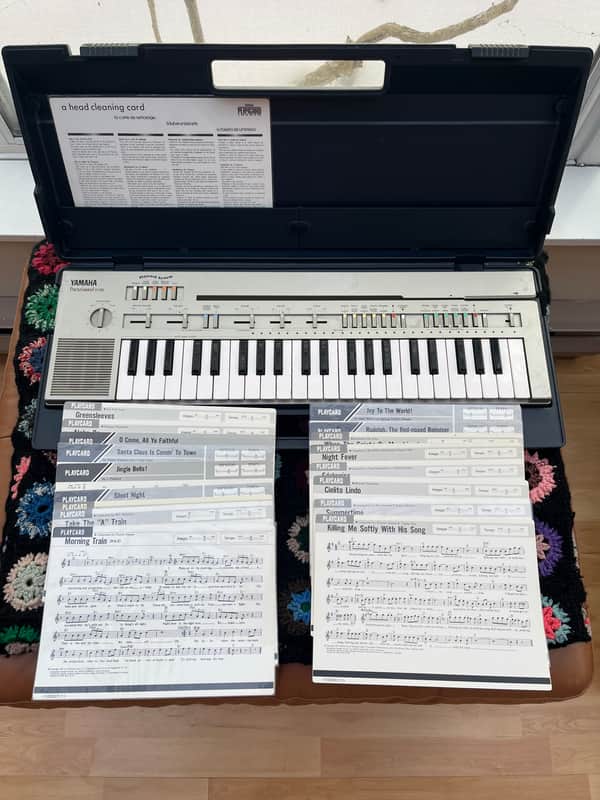
This Yamaha Portasound pc100 is a fun little keyboard. It has a play card system. It works as it should.
From the 1982 brochure
This latest addition to Yamaha's pc 100 is intended to be a revolutionary product that lets you enjoy playing and learning keyboard music in a variety of ways; obviously Yamaha have set themselves a difficult task to accomplish in a small keyboard, and yet in many ways they've achieved their aims with a certain flair not often seen these days.
The major feature on the learning side of the instrument is its use of the 'PlayCard' system, which is capable of programming and replaying melody, bass, chords, arpeggio and rhythm for an entire song. Each song is contained on a 13 x 9cm card bearing conventional top line musical notation, chord symbols, and a magnetic strip along the bottom carrying the programming information. As the melody plays, an indicator light goes on above the note sounding at the time (red for white notes, yellow for black) and it is possible to cancel the melody line and play it back by hand, following the indicator lights or the music score. After being pushed through the slot along the top of the instrument which contains the card reading head, the Playcard stands in the position of a normal music rest; eventually the aim is that the user will learn to play directly from the score and be able to switch off the indicator lights (using lamp cancel). The twelve cards provided range from the very simple 'Do-Re-Mi' to quite complex tunes such as Take the A Train', via an incredible version of 'Night Fever'!
After mastering right-hand technique, the learner can add one-finger chords read from the score by cancelling the autochord/bass facility. The remaining rhythms and arpeggios have individual volume sliders to balance the overall sound, and it's also possible to transpose all the functions up or down by anything up to half an octave, using the large dial on the left of the keyboard; this helps when accompanying a singer or, for instance, an instrument such as the B flat saxophone.
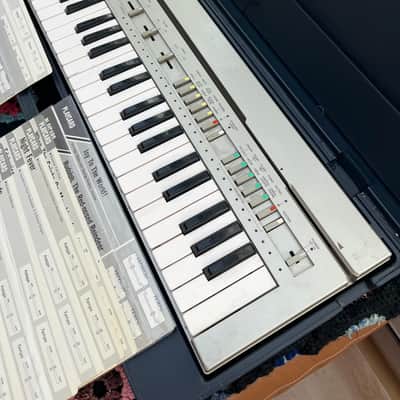
Although the magnetic strip selects an ideal rhythm and sound for each tune, this can be changed by the user after starting. There are ten rhythms and ten polyphonic sounds, selected by the now familiar system of five switches and a sixth 'a or b' selector. The organ and vibraphone sounds are particularly good, with added key-click and a slow tremolo respectively, while the violin and some other presets have a fixed delayed vibrato. The rhythm sounds are bright and convincingly metallic, certainly not a simple burst of white noise, and with autobass, arpeggios and sustain all in use the overall effect is very enjoyable.
Reverb Buyer Protection
Reverb has your back if your item is lost, damaged, or doesn't match its description. Simply report any issues within 7 days and we'll help you get a full refund.Learn more about Reverb Buyer Protection.
| Listed | a month ago |
|---|---|
| Condition | Very Good (Used) Very Good items may show a few slight marks or scratches but are fully functional and in overall great shape.Learn more |
| Brand | |
| Model |
|
| Categories | |
| Year |
|
| Made In |
|
| Keyboard Action |
|
| Number of Keys |
|
| Key Size |
|
| Analog / Digital |
|
Product safety information may be available here.