


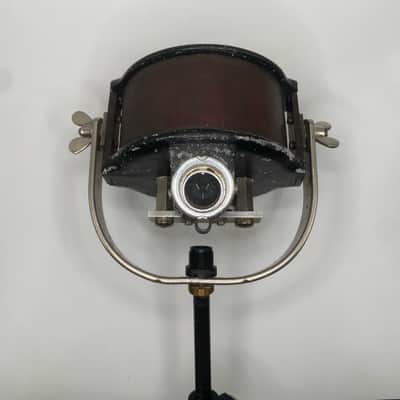
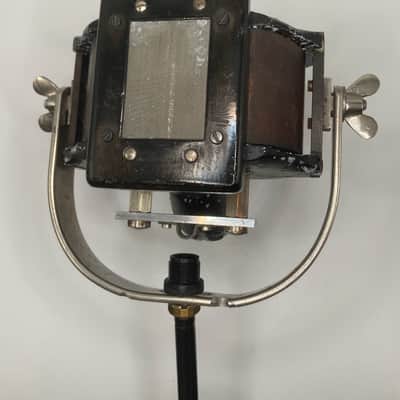
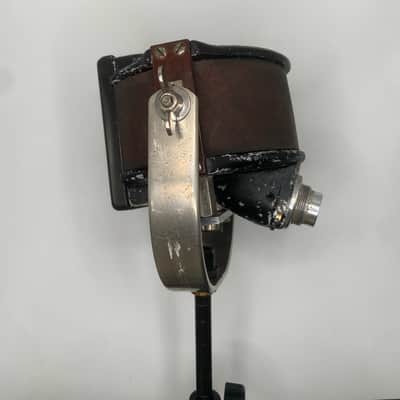
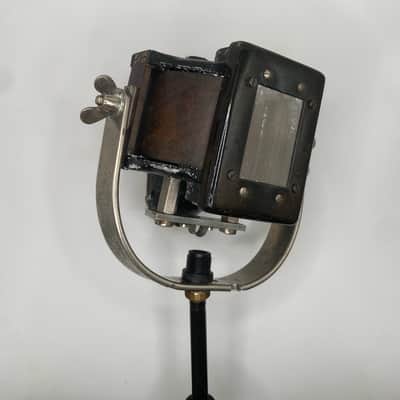
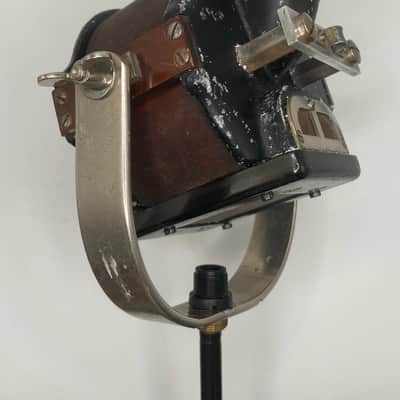
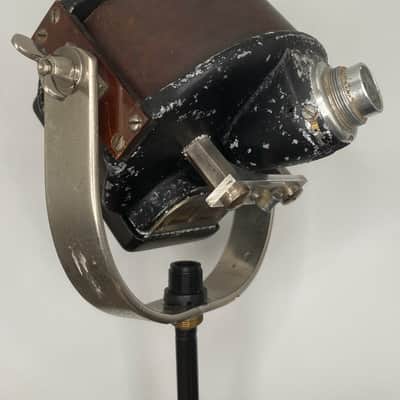
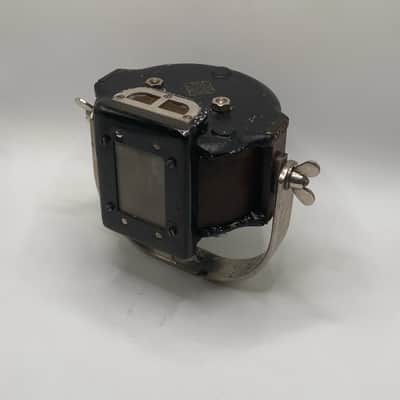
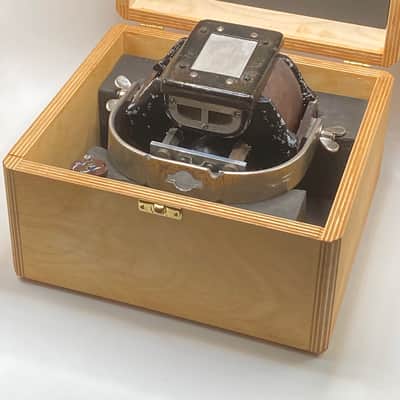
TELEFUNKEN ELA M25 1931 - HISTORICAL STUDIO RIBBON MICROPHONE


Our users rate Reverb
THE INVENTORS OF THE RIBBON MICROPHONE
Historic 1930s Siemens / Telefunken Directional Ribbon Microphone
THE ETERNAL MICROPHONE - TELEFUNKEN ELA M 25
A microphone standing remarkably close to the invention of the ribbon transducer itself.
Designed from the pioneering work of Siemens engineers Walter Schottky and Erwin Gerlach, the ELA M 25 belongs to the direct technological lineage established by the men behind the ribbon-transducer principle in Germany during the early 1920s.
Developed through a family of early microphones before reaching the Siemens & Halske ELM 25, one of the pioneering professional studio ribbon microphones of its kind. The ELM 25 appears in Siemens documentation by 1931/32. Telefunken subsequently offered the design as the ELA M 25, while related versions and later developments appeared under several Siemens and Telefunken designations, including the SM3 and later ELA M 201/1.
These still were not mass-produced microphones. They were highly specialized professional instruments, made in extremely limited numbers during the formative years of studio electroacoustics.
Almost a century later, this one is not merely operational.
It is an exceptional good recording microphone.
MODEL ARTICLETHE ORIGIN OF THE RIBBON MICROPHONE
During the early 1920s, Walter Schottky and Erwin Gerlach were working at Siemens in Germany on the principle that would become the ribbon transducer.
The concept is remarkably elegant.
An extremely light electrically conductive ribbon is suspended within a magnetic field. Sound moves the ribbon; its movement through the magnetic field generates an electrical signal.
The fundamental principle remains at the heart of passive ribbon microphones today.
Siemens' earliest implementations were experimental and physically substantial devices. During the following years, the company developed the principle through successive microphone designs, transforming a pioneering electroacoustic invention into practical professional recording technology.
By the beginning of the 1930s, that development had produced the ELM 25 — one of the pioneering professional studio ribbon microphones of its kind.
This is what makes the ELM 25 / ELA M 25 family particularly important.
It does not represent a later manufacturer adopting ribbon technology after the principle had become established. as RCA were adopting and developing their own take on this technology
This Design is a refined attempt that comes from the engineer and lineage that created the ribbon principle in the first place.
and it is experimental as it is excellent in many catagories.
Telefunken subsequently offered the design as the ELA M 25, while related Siemens and Telefunken versions continued development.
The result is an extremely limited-production professional microphone from the first generation in which ribbon technology had become a genuinely mature recording instrument. it came to a few studios radio and audio professionals.
FOUR KILOGRAMS TO MOVE A RIBBON
The ELA M 25 weighs approximately 3.9 kilograms.
Not including a floor stand or enormous external base.
The microphone itself.
And at the center of those almost four kilograms is one of the lightest possible moving elements: an extraordinarily thin metal ribbon.
That contrast explains much of the engineering.
The enormous permanent-magnet assembly establishes the magnetic field required by the ribbon motor. The substantial metal structure provides an exceptionally stable mechanical foundation. The acoustic construction behind the ribbon controls its behavior, while the internal transformer converts the extremely low electrical output of the ribbon motor into a useful microphone signal.
Mass here is functional.
A structure of this weight possesses enormous mechanical inertia. It provides the extremely light ribbon with a stable reference and greatly reduces the tendency of the surrounding microphone structure to participate in unwanted vibration.
In practical handling, this ELA M 25 is remarkably resistant to the small mechanical noises and resonances one might expect from such an early microphone.
The principle is almost beautifully simple:
The ribbon moves. The microphone does not.
A DIRECTIONAL RIBBON — IN THE EARLY 1930s
The ELA M 25 is not simply an early open figure-eight ribbon.
A freely exposed ribbon naturally responds to the pressure difference between its front and rear surfaces, creating the familiar bidirectional behavior associated with many ribbon microphones.
Siemens was already engineering around this.
Behind the ribbon of the ELM 25 / ELA M 25 is a substantial acoustically controlled structure. The rear side of the ribbon is loaded and damped rather than simply exposed to the surrounding sound field.
The huge physical construction behind the motor is therefore not dead space.
It is part of the acoustic circuit.
This allowed Siemens to achieve pronounced directional behavior at an extraordinarily early stage in ribbon-microphone development.
For this specimen, we prefer the historically appropriate description directional ribbon rather than forcing its behavior into a modern cardioid classification to which it does not precisely correspond.
BUILT TO BE RENEWED
There is another detail that changes how this microphone should be understood.
The ribbon was never expected to last forever.
Telefunken offered the ELA M 26 replacement ribbon assembly for the ELA M 25 system. The delicate moving element at the center of the microphone was therefore conceived as a serviceable part of the instrument.
That is extremely important when considering a surviving ELA M 25 today.
Replacing a damaged or exhausted ribbon does not contradict the philosophy of the original design.
Servicing the ribbon was part of the philosophy of the original design.
The permanent structure surrounding it is almost the opposite.
Nearly four kilograms of metal, permanent magnet, transformer and acoustic construction form an extraordinarily durable platform around a deliberately serviceable transducer element.
The fragile component can be renewed.
The machine continues.
RARITY
The ELA M 25 was never an ordinary microphone.
It was an expensive, highly specialized professional instrument intended for the broadcast, recording and institutional infrastructure of its period and produced only in extremely limited numbers.
And the period matters.
These microphones were built in Germany during the 1930s, immediately before Europe entered one of the most destructive periods in its history. Equipment of this size and specialization was never plentiful to begin with, and the upheaval and destruction that followed makes the survival of complete examples today still more remarkable.
It was built in 1930s Germany, survived the world that followed, and can still perform the same fundamental job today.
REFURBISHED BY DIETER SCHOPF / DS-AUDIOSERVICE
This particular ELA M 25 has been professionally refurbished by Dieter Schöpf of DS Audio Services, a specialist in historic ribbon microphones, ribbon motors and their restoration.
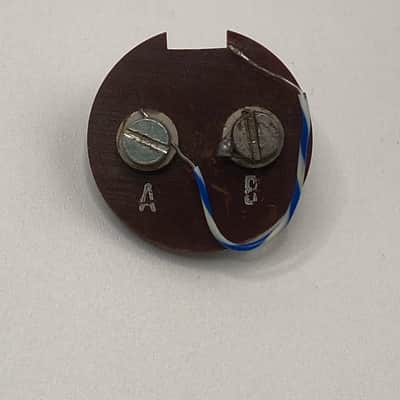
The microphone has received the necessary work to return its ribbon motor to proper operating condition, together with restoration of its acoustic and mechanical assembly. A layer of protective mesh has also been replaced in the front of the capsule - the connector changed to the period close LARGE TUCHEL connector with 3 pins. The original open wiring connector is available with the unit still.
A MUSEUM PIECE THAT SHOULD BE USED.
It would be easy to approach a microphone of this historical importance primarily as an artifact.
Then we listened to it. It has ultra low noise , a sense of space, and beautiful timber.
The ELA M 25 has body, reality, presence and an extraordinarily convincing sense of space.
It is a ribbon microphone. There is warmth and weight, and its upper range does not have the deliberately heightened brilliance
There is substantial midrange information, definition and a surprisingly complete upper response. Speech remains articulate while retaining a physical weight that makes the source feel unusually tangible.
At moderate distance, something particularly beautiful happens.
The microphone reproduces not only the source but the space around it. Room information arrives naturally and coherently rather than appearing as an unrelated layer of ambience.
Moving closer produces substantial low-frequency reinforcement. Extremely close placement is neither necessary nor particularly useful: direct air movement interacts strongly with the ribbon.
with a moderate distance the design begins to reveal itself.
Mechanically, this specimen is also exceptionally quiet. Its enormous mass and rigidity provide an extraordinarily stable platform for the ribbon motor, while the refurbished transducer performs beautifully.
The result is remarkable for one very simple reason:
It does not sound good "for a microphone from the 1930s."
without any historical sympathy-
It is simply a great-sounding microphone.
and unlike a tube condenser - it almost cannot fail.
The ELA M 25 was a serious professional recording instrument when it was produced, and this refurbished example can hold its place technically alongside serious microphones in a modern recording studio today.
THE ETERNAL MICROPHONE
special to see , to hold , to hear. this microphone tells a story from a mile away.
The pioneering engineering and the invention of ribbon
The production result of a different time - The Second World War
The story of excellent ground breaking technology.
Magnet. Transformer. Acoustic structure. Cast metal. Almost four kilograms of physical permanence surrounding a moving element weighing almost nothing. The ribbon can stretch, tear or eventually require replacement — and its designers knew that. They made provision for precisely that service.
making this microphone renewable to technical specs forever.
Very close to a century after this microphone was manufactured in Germany, its most delicate it can continue doing exactly what it was built to do.
Record sound in a professional matter.
That is why we called it:
THE ETERNAL MICROPHONE.
Reverb Buyer Protection
Reverb has your back if your item is lost, damaged, or doesn't match its description. Simply report any issues within 7 days and we'll help you get a full refund.Learn more about Reverb Buyer Protection.
| Listed | 3 days ago |
|---|---|
| Condition | Excellent (Used) Excellent items are almost entirely free from blemishes and other visual defects and have been played or used with the utmost care.Learn more |
| Brand | |
| Model |
|
| Categories | |
| Year |
|
| Made In |
|
| Wired/Wireless |
|
| Microphone Type |
|
| Polar Pattern |
|
Product safety information may be available here.

