Digital Gauge Radius Blocks precision measuring frets (3 radii) - Made in the USA
Digital Gauge Radius Blocks precision measuring frets (3 radii) - Made in the USA

Our users rate Reverb
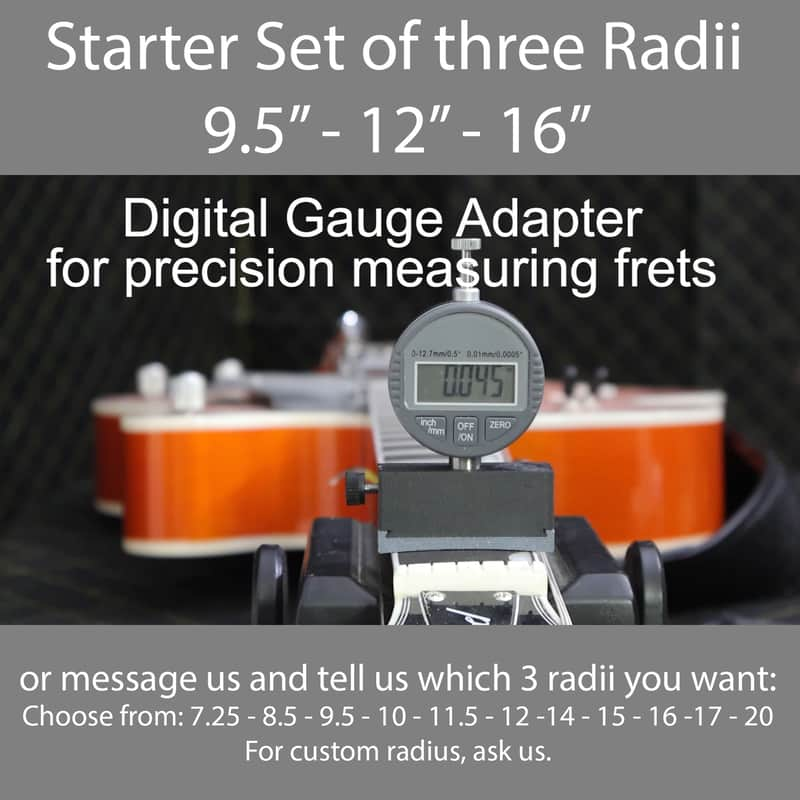
Digital Gauge Radius Blocks for easily and accurately measuring frets includes 3 radii:
Standard includes 9.5" - 12" - 16"
If you need different Radii, message me, we will get you what you want.
Or message us and choose 3 from the eleven:
7.25 - 8.5 - 9.5 - 10 - 11.5 - 12 - 14 - 15 - 16 - 17 - 20 inches
If you want customer radius measures, message us, we'll make and ship those per your request.
NOTE... DIGITAL GAUGES NOT INCLUDED
Precision Work begins with precision measuring:
Download free Fret Forensics Worksheet,
Clean the fretboard if needed.
Best gauge view is from the headstock.
Always zero the gauge butted to nut, centered to width of fretboard.
Slightly elevating headstock allows gravity to rest the gauge along oneside (the nut side) of the fret in parallel.
Glide the gauge along the fret, do not pick and drop.It takes a bit to get used to the touch and balance at low and high E.
Notate each measure on the worksheet. Completed worksheet, use highlighter to mark the shortest and tallest frets.
The numbers show no fret is level from fret to fret, nor on fret length to the width of the fretboard - does not agree with fretboard radius.You will see many fulcrum frets, these cause a sanding beam to rock up down left right and always at incline - The sanding beam must follow these resulting in wonky frets that lead to cutting nut slots wrong, wrong string action and forcing Neck Relief to compensate.
Neck Relief negates nut slots string action you thought you were setting. It is not as claimed, to allow for the oval vibration of strings, it is to hide shoddy frets, nut slots and action.
All these stacked errors rob your guitar of playability and tone.
Fret Forensics exposes the truth once and for all, it cannot be disputed.
FretMaestro is the only Tool than can correct this: True Level Frets makeaccurate nut slots and then string action possible, and zero neck relief.Fastest smoothest play, cleanest intonation, deepest no fret out bends,and sustain for days. Once experienced, there is no going back.
Carbon Fiber strong - Made in the USA
SixStringers Guitar Tools made for the 21st Century
White Paper: Fret Forensics
Document ID: WP-2026-FF-01
Subject: High-Resolution Topographical Metrology of Fretboard Assemblies
Methodology by: SixStringers
Target Tolerance Baseline: ± 0.0005"
1.0 Executive Summary: Fret Forensics = Deep Dive Insights and Empirical Verification:
Prior to the innovation of the Fret Forensics protocol, instrument owners lacked an empirical, scientific means to verify the structural state of their frets.
Players historically relied on blind trust regarding factory configurations on brand-new instruments, or accepted unverified assurances from repair shops following paid leveling services.
Fret Forensics establishes a non-destructive metrological standard that delivers a critical educational deep dive insight for the instrument owner.
By employing high-resolution digital scanning, this protocol provides irrefutable mathematical proof of macro-accumulated waves, unlevel milestones, and twisted planes.
Plotting an absolute coordinate matrix onto a visual chart reveals that brand-new factory builds and recently serviced instruments routinely harbor severe out-of-level profile deviations.
Seeing the numerical topography establishes that hard quantitative data is the only valid path to understanding the structural reality of the instrument. This prerequisite diagnostic grid scan serves as the unskippable foundation of modern fretboard metrology, isolating structural failure modes before any mechanical work begins.
2.0 Mechanical Instrumentation and Geometric Constraints
Traditional digital neck indicators utilize a standard brass chassis resting on four transverse contact points. These factory instruments feature an inherent geometric constraint: they are permanently fixed to a 16" transverse radius.
When applied to an instrument featuring a tighter radius profile (e.g., 7.25", 9.5", or 12"), the factory four-point orientation encounters an over-determined constraint system. The center contact legs strike the peak of the fretboard crown prematurely. This configuration induces severe transverse rocking across the radius apex, invalidating the indicator's vertical baseline and introducing measurement artifacts.
To bypass this geometric restriction, the SixStringers modification requires the mechanical removal of 1/16" of material from the two center contact legs. This structural modification alters the tool's kinematics from an over-determined four-point alignment into a stable two-point contact chassis that indexes exclusively off the outer perimeters of the neck. This geometric correction enables the indicator to bridge across any radius baseline without transverse rocking, ensuring universal calibration across all fretboard architectures.
[ Stock 4-Point Block: Rocks on Tighter Radii ]
o x x o <-- Center legs strike crown peak
------------------------------ (Tighter Radius Fretboard)
[ SixStringers 2-Point Modification: Universal Radius Bridge ]
o _ _ o <-- Center legs cleared 1/16"; registers flat
------------------------------ (Any Radius Fretboard)
3.0 Establishing the True Zero Reference Datum
To track vertical surface deviations consistently across a 24-fret matrix, the digital indicator must reference a static, unvarying control coordinate. The protocol mandates positioning the indicator stem immediately adjacent to the nut at the center of the fretboard width to establish the true zero reference datum.
This specific coordinate is selected due to a total absence of operational wear variables. While the middle and upper registers of a fretboard accumulate non-uniform material loss from string friction, finger contact, and transverse note bending, the center baseline directly adjacent to the nut remains entirely isolated from mechanical degradation. Zeroing the digital indicator at this precise coordinate ensures that all subsequent downstream measurements are absolute, mathematically pure comparative variables (+ or - deviations) relative to a pristine, unwearable structural control.
4.0 Neutralizing Visibility Limitations and Line-of-Sight Errors
Factory digital indicators feature an off-center dial placement. Because the gauge dial is off-axis, it is physically impossible to measure across the full width of the fretboard from a single working position without losing line of sight to the display screen. Attempting to rotate the gauge 180° to see the screen from the same side is an absolutely incorrect solution, as spinning the unit completely alters the zero setting and invalidates the baseline data. Consequently, a stock off-center tool forces the operator to physically relocate their body around the instrument to read the dial when moving from the treble register to the bass register.
The SixStringers True Radius Adapters completely resolve this visibility and operational limitation. By re-engineering the chassis with a center-mounted gauge, the adapter aligns the display directly along the central axis of the tool. This configuration enables the operator to measure both the high E and low E boundaries smoothly from a single, static vantage point. The display screen remains perfectly visible throughout the entire transverse sweep, maintaining a stable reference plane and removing operator relocation variables from the metrology workflow.
5.0 The Topographical Numerical Map
The data collection workflow executes a highly structured 3 × 24 (24 = 24 frets as delineated on the Fret Forensic Worksheet) coordinate matrix scan. The technician measures every individual fret along three precise linear tracking lines:
The High E Vector (Treble Perimeter)
The Center Width Vector (Radius Apex)
The Low E Vector (Bass Perimeter)
[Nut Datum: ZERO] ─── Fret 1 ─── Fret 2 ─── Fret 3 ─── Fret 4 ... Fret 24
High E Line: [Value] [Value] [Value] [Value] [Value]
Center Line: [Value] [Value] [Value] [Value] [Value]
Low E Line: [Value] [Value] [Value] [Value] [Value]
Logging these numeric values into the SixStringers Free Forensic WorkSheet Graph visualizes the numerical map. This data chart converts abstract dimensional variations into an instantly readable, topographical map of the entire fret array, providing unassailable empirical proof of structural warp or fret height non-uniformity before any tools are deployed.
6.0 Section Summary: The Metrological Conclusion
The SixStringers Fret Forensics protocol transitions fretboard diagnostics from a non-empirical guessing game into a strict quantitative science.
The resulting 3 × 24 (24 being the number of frets in the example) data matrix completely breaks the traditional narrative of manual setups. It translates hidden macro-accumulated deviations into a plain, undeniable visual map.
Seeing the numerical topography is the only path to believing the true structural state of the frets, this objective protocol serves as the mandatory, unskippable foundation of true instrument calibration.
This item is sold As-Described
This item is sold As-Described and cannot be returned unless it arrives in a condition different from how it was described or photographed. Items must be returned in original, as-shipped condition with all original packaging.Learn More.
| Condition | Brand New (New) Brand New items are sold by an authorized dealer or original builder and include all original packaging.Learn more |
|---|---|
| Brand | |
| Model |
|
| Finish |
|
| Categories | |
| Year |
|
| Made In |
|
Product safety information may be available here.

