


1933 Gibson L-1 – Rare Elevated Fingerboard – Early 14-Fret Model

Unsere Benutzer bewerten Reverb
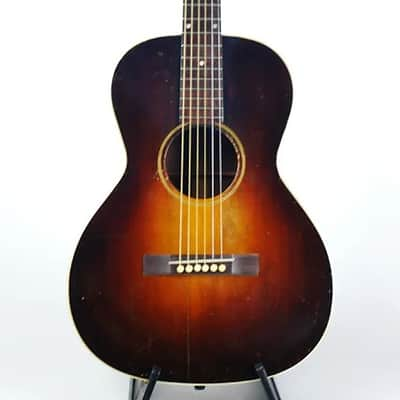
1933 Gibson L-1 acoustic guitar, featuring the rare early elevated/floating fingerboard and original-style small dark amber/brown sunburst finish.
A particularly interesting and collectible example from Gibson's transitional period in the early 1930s. This is the 14-fret L-1 with elevated fingerboard, one of the short-lived configurations produced as Gibson moved from the earlier 12-fret design to the modern 14-fret neck joint. Examples with this construction are considerably less commonly encountered than the later standard 14-fret guitars.
The guitar has the characteristics associated with the early-1930s L-1, including:
- Rare elevated/floating fingerboard
- 14-fret neck joint
- Dark amber/brown small sunburst finish
- Bound top and back
- Rosewood fingerboard
- Rosewood rectangular bridge
- Early Gibson small-body construction
- Tortoiseshell/firestripe-style pickguard
- Cream binding
- FON beginning 63... (the remainder is difficult to read and is therefore not being claimed as a complete number but I believe it is 632)
- Scale: approximately 24¾"
- Nut: approximately 1¾"
The bound back is an important identifying feature here. The L-1 was the more highly appointed model compared with the L-00, and surviving 1933 examples are documented with bound top and back. A documented 1933 L-1, for example, is described with a dark brown finish, small sunburst, bound top and back and 14 frets clear of the body.
This is a genuine 90+ year-old vintage guitar and has clearly been played and used throughout its life. It has extensive authentic age-related wear, finish checking, scratches, dings and marks consistent with its age. The finish is a particularly attractive very dark brown/amber, rather than black, with the original-looking small burst visible around the soundhole and bridge area.
There are also various signs of previous work/repair visible on the instrument, which is to be expected with a guitar of this age. I have photographed the guitar extensively so that its condition can be assessed properly. The elevated fingerboard is probably the most notable feature. Gibson briefly used this construction on the first generation of 14-fret small-body flat-tops during the 1932–33 transition. The fingerboard extension sits above the soundboard rather than being glued directly to it, giving these guitars a very distinctive appearance and making them particularly interesting to collectors of early Gibson flat-tops.
A very cool instrument for a serious pre-war Gibson collection, and equally appealing as a playing guitar for someone who wants an unusual piece of early Gibson history.
Dieser Artikel wird verkauft "wie beschrieben"
Dieser Artikel wird verkauft "wie beschrieben" und kann nicht retourniert werden, es sei denn er kommt anders als beschrieben oder fotografiert an. Artikel müssen im Originalzustand mit allen gelieferten Teilen und Zubehör in ursprünglicher Verpackung zurückgesendet werden.Mehr erfahren
| Inseriert | vor einem Monat |
|---|---|
| Zustand | Gut (Gebraucht) Artikel mit Zustand Gut funktionieren einwandfrei, können aber einiges an Makeln oder Spielspuren aufweisen.Weitere Informationen |
| Marke | |
| Modell |
|
| Farbe |
|
| Kategorien | |
| Jahr |
|
| Hergestellt in |
|
| Abholung |
|
| Griffbrettmaterial |
|
| Farbfamilie |
|
| Korpusform |
|
| Saitentyp |
|
| Rechts-/Linkshändig |
|
| Modellreihe | |
| Anzahl der Saiten |
|
| Halsmaterial |
|
| Finish-Muster |
|
| Finish-Stil |
|
| Deckenmaterial |
|
| Serie | |
| Bodenmaterial |
|
| Seitenmaterial |
|
| Aktiver Vorverstärker |
|
| Anzahl der Bünde |
|
Möglicherweise sind hier Informationen zur Produktsicherheit verfügbar.

Reverb-Schutz
Einfache Rücksendungen, sichere Transaktionen, Support von Experten
Weitere Informationen