


Sennheiser MD 4 EARLY 1950

Versandkostenfrei
von Freiburg, Deutschland


Unsere Benutzer bewerten Reverb
The Close-Speech Specialist
The Sennheiser MD 4 is an early German dynamic microphone built around one very specific idea: capture the person speaking directly into it while strongly suppressing sound farther away.
Introduced originally as the DM 4 in 1949, the design became Sennheiser's first Kompensationsmikrofon — a close-speech compensation microphone. Contemporary documentation from the 1950s already describes the MD 4 specifically in terms of its strong suppression of sound arriving from greater distances.
OPTICAL CONDITION
B- light marks of use. well preserved.
TECHNICAL CONDITION
A — fully functional
INDLUDING
Sennheiser mic holder
Microphone velvet Bag
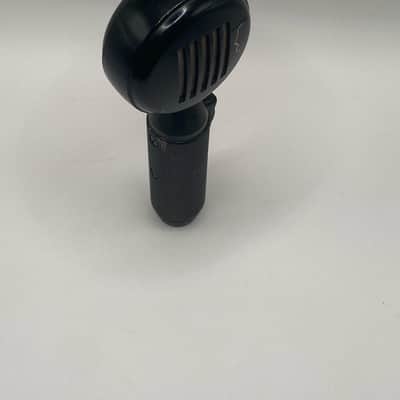
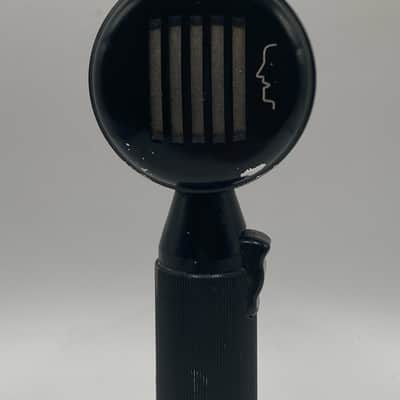
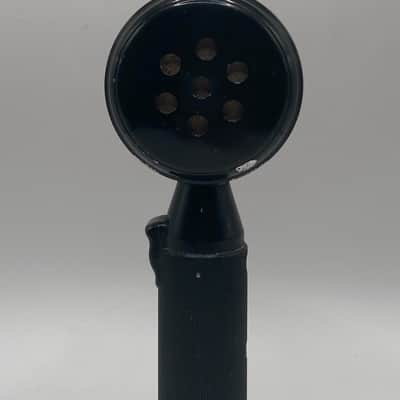
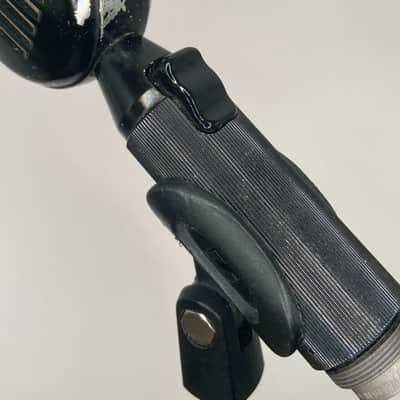
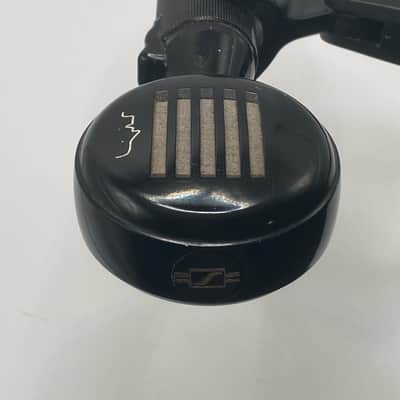
Physically, it is just as distinctive. The thick all-metal handle leads into a large rounded microphone head, with different acoustic openings at the front and rear. The connector, holder, handle and capsule form an exceptionally coherent piece of early Sennheiser industrial design.
But the MD 4 becomes most interesting when actually used: come close and it suddenly comes alive; move away and the sound rapidly disappears.
THE COMPENSATION PRINCIPLE
Technically, the MD 4 is a dynamic moving-coil pressure-gradient microphone, rather than a conventional cardioid dynamic.
Its directional characteristic is frequency-dependent: approximately figure-eight at lower frequencies, changing toward cardioid at higher frequencies. Later MD 4 variants retain this specification alongside the 50 Hz–10 kHz response and 200 Ω impedance.
The acoustic openings around the capsule are fundamental to this behavior. They allow sound to act on the transducer through different paths, producing strong cancellation when sound reaches the microphone from farther away.
A source immediately in front of the microphone behaves differently. At close range, the pressure difference across the system becomes much greater and the voice is reproduced strongly.
This is why the MD 4 behaves so dramatically with distance.
CLOSE-SPEECH BEHAVIOR
In practical testing, the effect is immediately noticeable.
At approximately 5 cm, speech becomes strong, present and intelligible. Move toward 10 cm and the level already falls considerably. At greater distances, surrounding sound and room ambience become remarkably subdued.
This corresponds closely with historical descriptions of the design. Period literature describes the MD 4 as largely insensitive to sounds arriving from more than approximately 30–50 cm away. A 1956 description similarly emphasizes its unusually strong suppression of sound arriving from greater distances.
It therefore doesn't merely reject sound from the rear.
It rejects distance itself remarkably effectively.
That is the defining characteristic of the MD 4 — and why The Close-Speech Specialist describes it so well.
BUILD & DESIGN
The MD 4 is an exceptionally robust microphone.
Its construction is dominated by thick metal, with a substantial handle and large rounded capsule housing. Straight grille openings define the speaking side, while circular openings at the rear form part of the acoustic system.
There is an almost architectural quality to the design. The connector, handle, mounting arrangement and capsule all follow the same rounded industrial language.
Nothing feels decorative or unnecessary.
It is a microphone designed as professional working equipment, yet more than seventy years later its exterior remains one of the most distinctive designs among early Sennheiser microphones.
SOUND
The MD 4 is fundamentally a speech microphone, and its sound reflects that purpose.
It is neither especially full in the low frequencies nor particularly extended by modern studio standards. Instead, the response is concentrated where speech needs it, with sufficient upper-mid detail to maintain very good intelligibility.
The documented frequency range is:
50 Hz–10 kHz
with an impedance of:
200 Ω.
At close range, the result has a distinctly radiophonic character: focused, somewhat filtered, but still detailed enough to preserve the articulation of the voice.
The more remarkable sonic characteristic, however, is the absence of the surrounding environment. The microphone creates an unusually isolated acoustic perspective, with the close source appearing while much of everything around it falls away.
CREATIVE APPLICATIONS
Today, the MD 4 is primarily interesting as a historical collector's microphone, but its unusual acoustic behavior also makes it a useful character microphone.
Placed very close to electric guitar, percussion, drums or other midrange-focused sources, its restricted bandwidth and strong distance rejection can create an intentionally vintage, isolated texture.
It is particularly interesting as a secondary microphone rather than as a neutral primary recording microphone.
The limitations are part of the effect.
Instead of capturing the complete source and surrounding space, the MD 4 can extract a narrow, close and strongly colored perspective from it.
TECHNICAL DATA
Transducer principle: Dynamic moving-coil
Acoustic principle: Pressure-gradient / compensation microphone
Directional characteristic: Frequency-dependent — approximately figure-eight at low frequencies, cardioid toward higher frequencies
Frequency response: 50 Hz–10 kHz
Impedance: 200 Ω
Output at normal speech level: approx. 4 mV
Application: Close speech / high-noise environments
Powering: Passive
Origin: Germany
THIS EXAMPLE
This particular MD 4 retains its distinctive original metal housing, capsule assembly and external design.
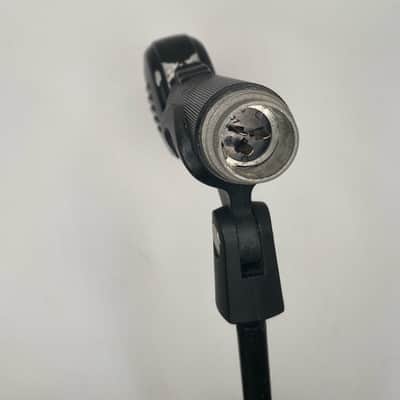
The microphone originally used a 5-pin large Tuchel connector. This example has been converted to 3-pin large Tuchel, making connection to modern XLR equipment considerably simpler.
The original on/off switch remains physically present but has been bypassed, so the microphone is permanently active when connected.
These functional changes leave the characteristic external design and acoustic system of the microphone intact.
THE CLOSE-SPEECH SPECIALIST
pressure-gradient system, frequency-dependent directionality and acoustic compensation were designed to make the nearby voice dominate while distant sound is strongly suppressed.
That principle shaped everything about the microphone — its acoustics, its intended working distance and ultimately its sound.
More than seventy years after the original DM 4 appeared, that behavior remains immediately impressive.
The Sennheiser MD 4 — The Close-Speech Specialist — is a microphone that was quite literally designed to make you come closer.
Dieser Artikel wird verkauft "wie beschrieben"
Dieser Artikel wird verkauft "wie beschrieben" und kann nicht retourniert werden, es sei denn er kommt anders als beschrieben oder fotografiert an. Artikel müssen im Originalzustand mit allen gelieferten Teilen und Zubehör in ursprünglicher Verpackung zurückgesendet werden.Mehr erfahren
| Inseriert | vor 4 Tagen |
|---|---|
| Zustand | Hervorragend (Gebraucht) Hervorragende Artikel sind fast ohne Gebrauchsspuren oder optische Fehler, aber wurden gespielt und vorsichtig benutzt.Weitere Informationen |
| Marke | |
| Modell |
|
| Kategorien | |
| Jahr |
|
| Hergestellt in |
|
Möglicherweise sind hier Informationen zur Produktsicherheit verfügbar.

Reverb-Schutz
Einfache Rücksendungen, sichere Transaktionen, Support von Experten
Weitere Informationen