Korg Radias module, keyboard stand and keyboard 2006

Korg Radias module, keyboard stand and keyboard 2006


Unsere Benutzer bewerten Reverb
Studio use only, 100% working. Main encoder knob slightly stiff to use.
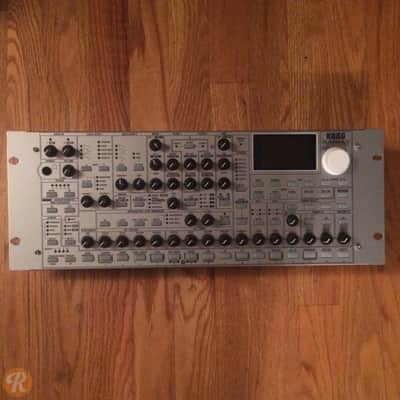
The Korg RADIAS is a virtual analog synthesizer and Vocoder, released by Korg in 2006. The RADIAS' MMT (Multiple Modelling Technology)[3] engine was based on the Korg OASYS synthesizer module, providing for several different synthesis methods, two of which may be combined in a single voice e.g. phase distortion synthesis can be combined with subtractive synthesis. The different synthesis methods employed by MMT represent the majority of methods used historically in other Korg synthesizers: digital waveguide synthesis Korg first used in the Korg Z1 and phase distortion synthesis was first used in the Korg DS-8. This flexibility allows for very realistic emulations of past Korg synthesizers (both digital and analog), though stays away from trying to emulate the Korg M1 and the Korg Wavestation, (these synthesizers used Pulse-code modulation, Sample-based synthesis and Wave sequencing/vector synthesis respectively, something that MMT does not emulate). As well as using the in-built waveforms (digital & analog emulations) for the basis of sound creation, the RADIAS allows for the input of an external signal which may be routed through the various sound shaping devices (filters / pitch envelopes etc.). The RADIAS has a comprehensive matrix modulation specification and to further enhance a sound the 'Wave Shaper' module allows for various sound distortion effects.
A 16-band vocoder with Formant Shift function is also available.
RADIAS also takes advantage of KKS Korg Komponent System which allows the user to detach the RADIAS-R module from the dedicated RADIAS-KB keyboard. The RADIAS-R module could be bought separately but the keyboard can not. The RADIAS-R module can be installed on the M3-73 or M3-88 and played simultaneously with the Korg M3 module using the M3's keyboard.
SuperSaw waveforms and Unison mode, the RADIAS has the ability to stack up to five waveforms in one oscillator, using only one voice of polyphony. Also, there is an additional unison mode, which can stack five waveforms, but uses additional voices. These modes can be used in conjunction with each other. Doing allows the user to create up to 25 "Super waveforms" (SuperSaws, but also super triangles, sines and squares).
All these functions with 24-voice capability are accomplished on two TMS320VC5502 DSP chips from Texas Instruments. Each DSP chip has up to 600 Millions Multiply-Accumulates Per Second with 16bit fixed point. Which is not to be confused with the audio interface that is a 24 bit processor.
Dieser Artikel wird verkauft "wie beschrieben"
Dieser Artikel wird verkauft "wie beschrieben" und kann nicht retourniert werden, es sei denn er kommt anders als beschrieben oder fotografiert an. Artikel müssen im Originalzustand mit allen gelieferten Teilen und Zubehör in ursprünglicher Verpackung zurückgesendet werden.Mehr erfahren
| Inseriert | vor 3 Tagen |
|---|---|
| Zustand | Gut (Gebraucht) Artikel mit Zustand Gut funktionieren einwandfrei, können aber einiges an Makeln oder Spielspuren aufweisen.Weitere Informationen |
| Marke | |
| Modell |
|
| Kategorien | |
| Jahr |
|
| Hergestellt in |
|
| MIDI-Ein- und Ausgang |
|
| Polyphonie |
|
| Analog/digital |
|
| Anzahl der Tasten |
|
Möglicherweise sind hier Informationen zur Produktsicherheit verfügbar.


Reverb-Schutz
Einfache Rücksendungen, sichere Transaktionen, Support von Experten
Weitere Informationen