


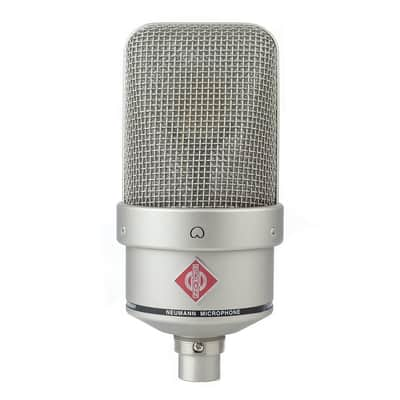
Neumann TLM 49 Condenser Microphone
This seller has not set a shipping cost for Canada. Please contact them to ask about shipping.
Original PriceC$2,366.27
14% price drop
New PriceC$2,057.63
+ Shipping

Only 1 left
Grab it before it's gone
Listed:over a month ago
Views:51
Saves:2

Hicksville, NY, United States

30-Day Return Policy
Enjoy peace of mind with your new gear
The TLM 49 brings back the vintage tone of Neumann's post-war classics. The TLM 49 uses the same K 47 capsule and the iconic large head-grille design of Neumann's legendary M 49, but instead of electron tubes the TLM 49 relies on trouble free FET circuitry with a special sound design for smooth vocals and acoustic instruments with timeless elegance.
Vintage Sound
As the model number implies, the TLM 49 is inspired by its famous precursor, the legendary Neumann M 49, a microphone associated with countless jazz and pop recordings of the 1950s and 60s. The TLM 49 shares the same large, acoustically open head-grille, and the same large-diaphragm condenser capsule design. This classic K 47 capsule, renowned for its unsurpassed sonic elegance, was also used in the Neumann U 47, the vocal mic of choice for Frank Sinatra, the Beatles, and scores of famous artists up to the present day.
RE-Engineering the Past
The main difference between the TLM 49 and its famous predecessors lies in its electronic circuit. Instead of electron tubes, the TLM 49's head amplifier uses reliable transformer-less solid-state technology – yet with a special sound design that closely reproduces the sonics of tube circuits. For instance, the TLM 49 intentionally produces soft saturation at higher sound pressure levels, resulting in a seemingly low max SPL figure of 110 dB for 0.5% THD, rising slowly to 5% at 129 dB SPL. The TLM 49 thus captures the sound and dynamic behavior of its legendary precursors without the inconvenience of an external PSU or expensive tube replacements, yet with a substantially improved self-noise figure of only 12 dB-A.
Applications
The TLM 49 has a fixed cardioid pattern and is designed mainly as a microphone for vocalists, but its clear bass and superb midrange with a gentle presence boost above 2 kHz will produce excellent results with various instruments, too, such as acoustic guitar and upright bass.
Features:
- Same capsule as legendary Neumann U 47 and M 49 microphones
- Cardioid pattern
- Classic sound for silky vocals
- Large, acoustically open head-grille
- Transformer-less solid-state circuit with tube sound characteristics
- Very low self-noise
- Includes shockmount
| Condition | Mint (Used) Mint items are in essentially new original condition but have been opened or played.Learn more |
|---|---|
| Brand | |
| Model |
|
| Categories | |
| Microphone Type |
|
| Wired/Wireless |
|
| Electronics |
|
| Polar Pattern |
|
Product safety information may be available here.

