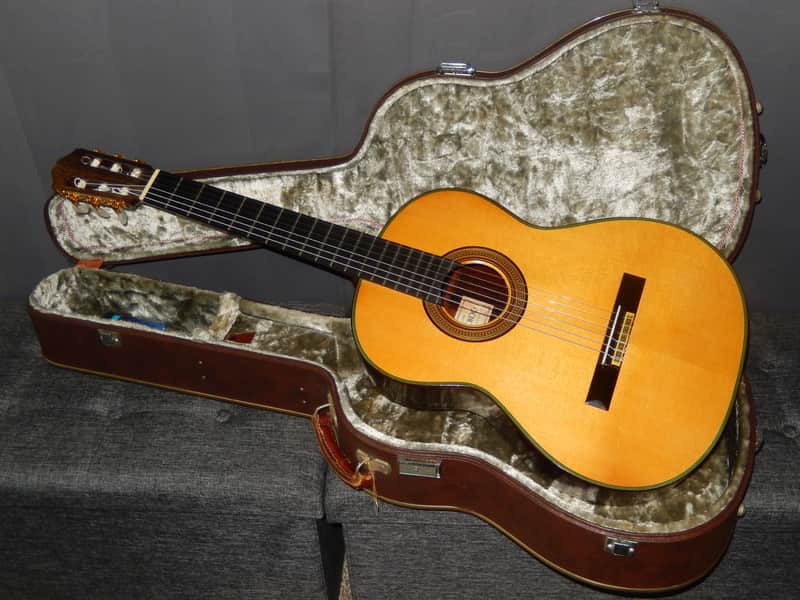
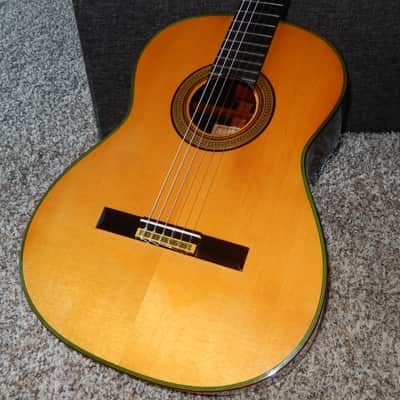
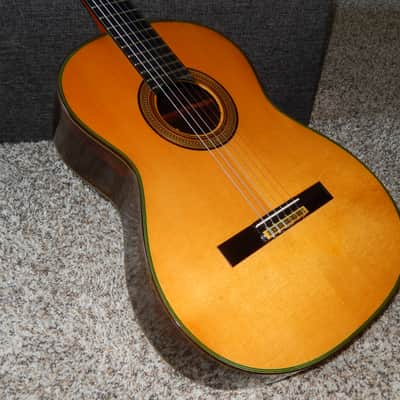
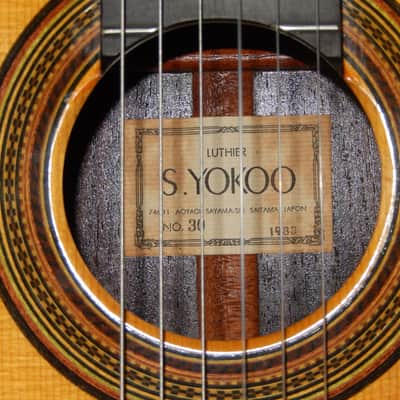
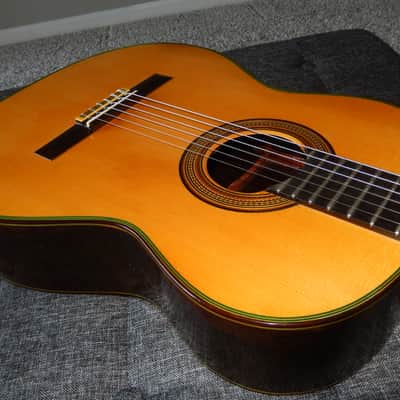
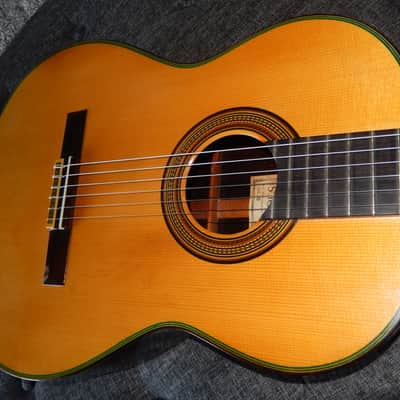
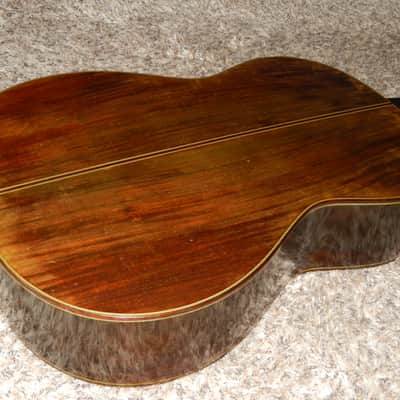
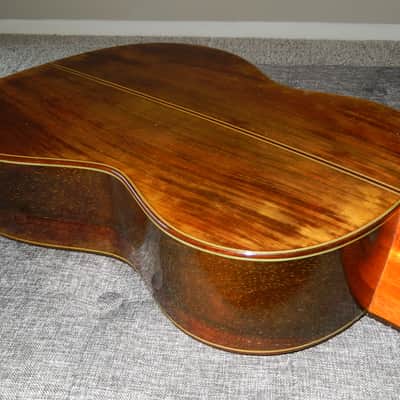
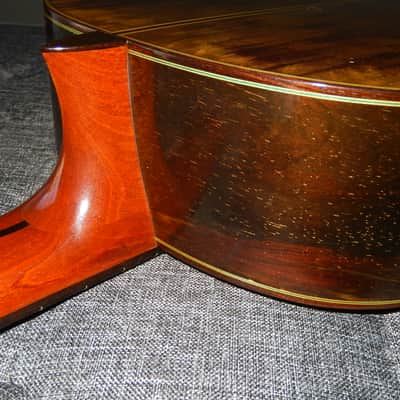
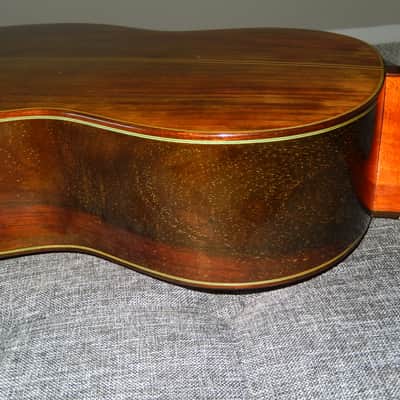
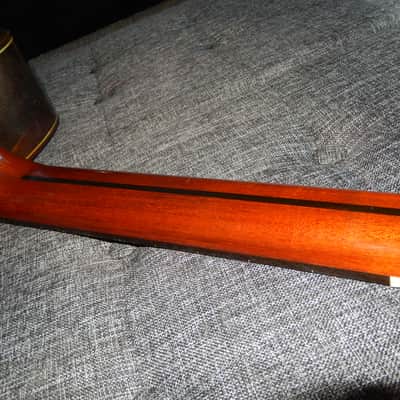
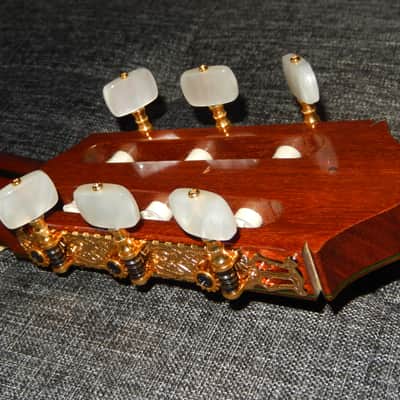
SHUNSUKE YOKOO No30 1983 - ROBERT BOUCHET CLASS CLASSICAL CONCERT GUITAR - BRAZILIAN ROSEWOOD
El vendedor no ha establecido un costo de envío para España. Por favor vendedor mensaje para preguntarle sobre el envío.

Nuestros usuarios valoran Reverb
YOU ARE LOOKING AT A WORLD CLASS INSTRUMENT PRICED AT THE BARGAIN LEVEL. CURRENTLY BRAND NEW GUITARS OF THIS CLASS MADE BY JAPANESE LUTHIERS USING OLD GROWTH FIGURED BRAZILIAN ROSEWOOD ARE PRICED MINIMUM $18000USD. DISCONTINUED IN 2025 YAMAHA GC70 WAS PRICED AT THAT LEVEL.
Shun Yokoo No.30 1983
Back in 1950s, although still young and not world famous yet, Masaru Kohno was gaining popularity among the players from Tokyo area. When in 1958 he received over 200 orders he knew it was the time for him to hire helpers. His first ever apprentice was Saburo Nogami, who in later years became a luthier legend on his own. The only other Kohno’s associates who made great independent careers are (Kohno’s nephew) Masaki Sakurai and Hiroshi Komori.
Yet there have been few other former Kohno’s associates who later gained high respect among Japanese players. One of them was Shunsuke Yokoo. He joined Masaru Kohno in 1964 and established his independent workshop in 1972. Although his guitars were often of higher class than Kohno models Mr. Yokoo couldn’t price them as high as his former boss.
Guitar you are looking at was made in 1983 and priced 300 000 yen. It sounds better than Kohno’s model 50 priced 500 000 yen.
In Japan of 1983, 300 000 yen models were top of the line for great majority of Japanese elite luthiers. Besides Masaru Kohno and Sakazo Nakade, very few luthiers could sell their very top custom models for 500 000 yen.
As of today, similar grade guitars made by Japanese elite luthiers with solid Brazilian Rosewood b/s are priced minimum $18000USD.
Even though Shun was trained by Masaru Kohno his guitars shouldn’t be considered as copy of Kohno guitars. Shun’s bracing is closer to Spanish fan bracing than to Kohno’s style lattice bracing. Shun has found his own ways of making guitars and mastered his own cashew lacquer formulas.
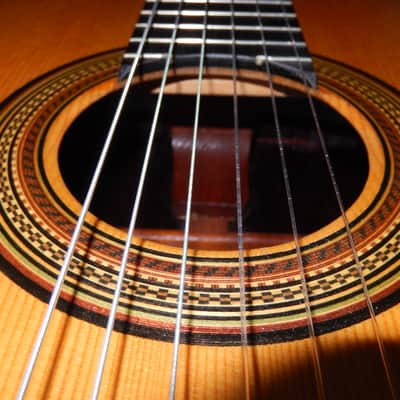
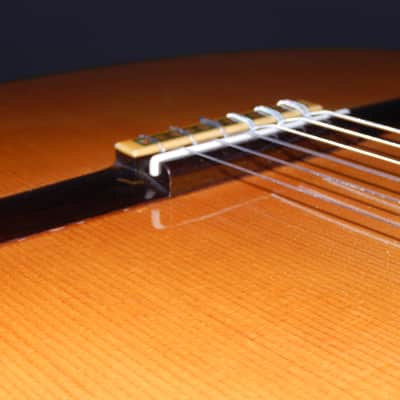
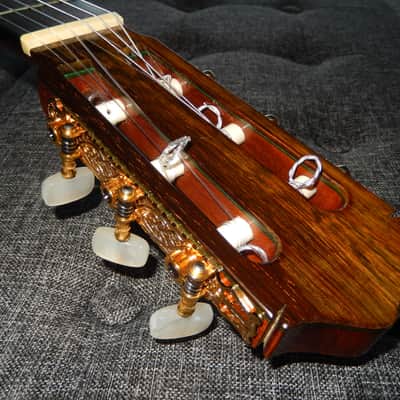
The construction of this guitar, however, was made mostly based on Robert Bouchet's blueprints and can easily challenge "the originals". On the outside it is manifested by Bouchet style headstock, rosette and bridge decoration. Several other Japanese makers of that era, were making super sounding "copies" of Bouchet's guitars.
In terms of volume and tonality this is simply a gorgeous instrument that not only rivals Kohno’s guitars but can easily outcompete many $15000+ “hand made in Spain” guitars. It is super powerful and very responsive, yet very “brightly” lyrical, with cello-like deep ultra-rich basses, super sweet and clear, piano-like trebles. When chords are played you hear bounty of beautiful overtones. When individual notes are played their clarity and separation is simply superb. It is all magnified by massive sustain. It is simply gorgeous instrument.
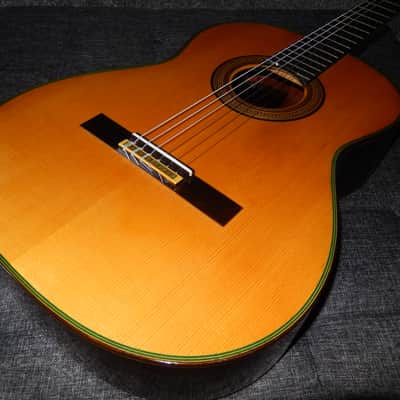
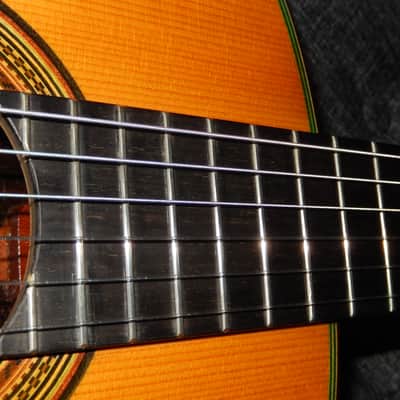
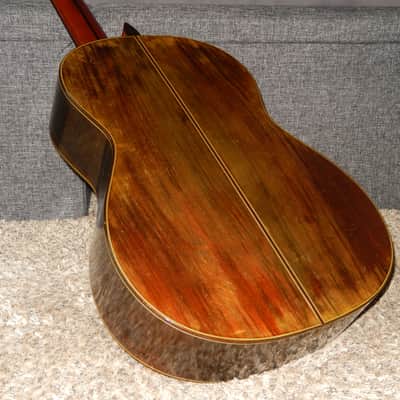
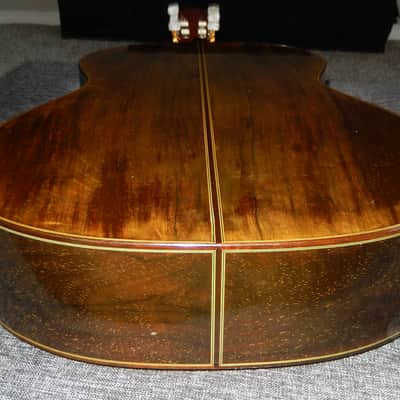
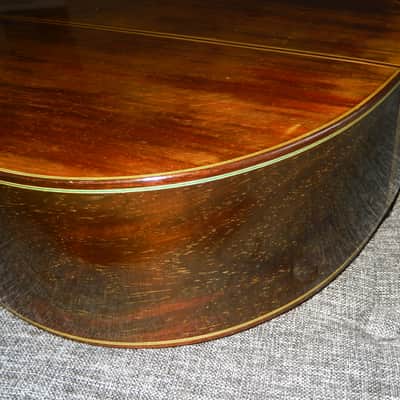
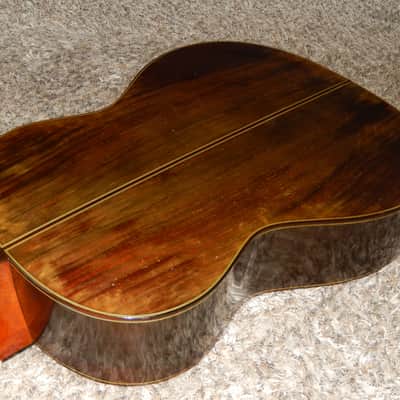
Overall condition of this guitar can be described as “excellent for its age”, even though within the finish on the soundboard there is a network of light scratches below string E1. These, however, can be repolished/removed at any guitar repair shop at relatively low cost.
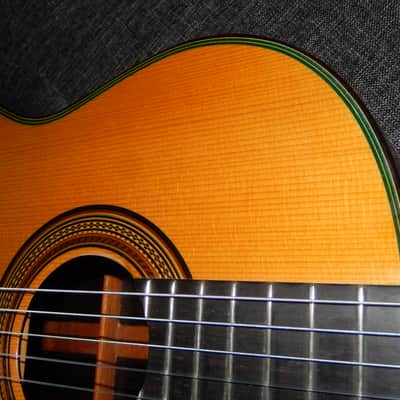
My pictures show a realistic view of these surfaces, and that is how you will see them in regular light even from a close distance. Only while flipping the guitar against the light, you will finally notice these “damages”. What you can really see in the pictures is a very precious tight grain, mountain grown Spruce. This 50 years old soundboard alone is worth at least $2500.
All other surfaces are relatively free from any cosmetic flaws.
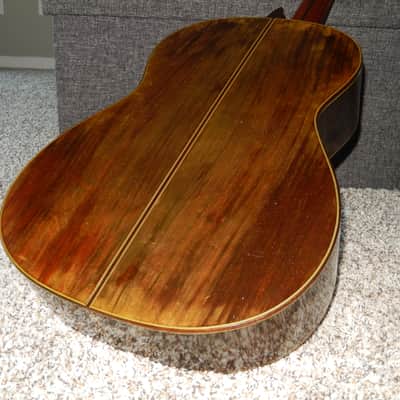
Finish discoloration (grayness) is quite common among Japanese guitars of that era finished with cashew lacquers and occurring exclusively on Brazilian Rosewood plates.
Should any of described above imperfections bother you, you can simply turn to American luthiers and with some luck you may get similar class instrument for below $25000.
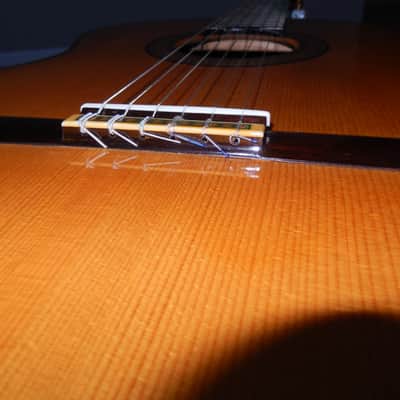
Because (visible in the picture) original saddle has been lowered to minimum to set the action at 2.50mm E6 and 2.20mm at E1, I have made a new saddle that sets the action at 4.5mm at E6 and 4.00 mm at E1. With such a plenty of extra room on that saddle you can lower the action any way you want, with 2.50mm at E6 and 2.20mm at E6 being the limit.
Specifications:
Top: High Grade Solid Spruce/ 7 braces fan/ cashew lacquer
Back & Sides: Solid Brazilian Rosewood/ cashew lacquer
Neck: Mahogany with Ebony reinforcement
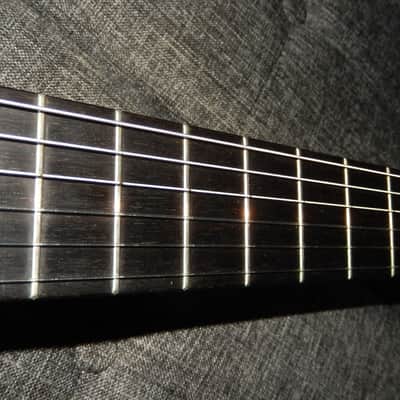
Fingerboard: Ebony
Scale: 650 mm
Nut width: 51.5 mm
Strings: Savarez Cantiga Premium Alliance Tension Forte
The current action is set to 4.50 mm under E6 and 4.00 mm with plenty of extra room on the saddle. This action can be lowered to 2.50mm E6 and 2.20mm E1 if desired.
The guitar will be shipped in a used hard shell case in very good condition.
THE ONLY PURPOSE OF THIS CASE IS TO PROTECT THE GUITAR DURING SHIPMENT. I WILL NOT PROVIDE ITS DETAILED DESCRIPTION OR MAKE ADDITIONAL PICTURES, NOR I WILL ACCEPT ANY COMPLAINTS. IF YOU DON’T LIKE THIS CASE YOU WILL NEED TO BUY A DIFFERENT ONE.
WHEN YOU BUY ANY GUITAR, YOU MUST ANTICIPATE TAKING IT TO YOUR LOCAL GUITAR SHOP FOR FINAL ADJUSTMENTS CALLED “SETUP”. DEPENIDNG ON YOUR PLAYING TECHNIQUE, THIS SETUP ON USED GUITARS MAY INCLUDE NEW CUSTOM-MADE NUT AND SADDLE. IF YOU HEAR STRING BUZZ IT DOESN’T MEAN THAT GUITAR IS DEFECTIVE. IF YOU PLAY HARD ENOUGH ALL BASS STRINGS WILL BUZZ OVER THE FRETS, UNLESS THEY ARE SUSPENDED VERY FAR FROM THE FINGERBOARD. UNLESS YOU PLAY QUITE GENTLY, YOU CAN’T HAVE LOW ACTION AND NO BUZZES. KEEP IN MIND THAT CELLO-LIKE BASSES ON HIGH GRADE CLASSICAL GUITARS HAVE THEIR NATURAL “BUZZ”.
Real Value of Japanese Vintage Guitars
The key to understand value of vintage Japanese guitars is to acknowledge galloping price inflation throughout the late 1960s and 1970s with its peak of 25% in 1974.
During 1960s and most of 1970s model numbers of Japanese guitars were strictly connected with their prices in Japanese yen.
The same class guitar sold in 1970 for 100 000 yen (labelled as model 10), would be sold for 150 000 yen in 1972 (labelled as model 15), 200 000 yen in 1974 (labelled as model 20) and 300 000 yen in 1978 (labelled as model 30). Therefore, you shouldn’t be surprised that two Yamaha GC10 guitars made 10 years apart are two instruments of totally different class. The same rule applies to all guitar models made by all other Japanese makers.
Japanese inflation slowed down in the 1980s. By the early 1980s and during following decades model numbers were no longer strictly associated with their prices. Some Japanese guitar makers introduced model names instead of model numbers. For several economic reasons, since 1980s Japanese made guitars were becoming more and more expensive, while their exports slowing down. Today (2025) Japanese high end classical guitar models are priced at $20000USD level.
| Publicado | hace 7 meses |
|---|---|
| Estado | Muy bueno (segunda mano) Productos en estado muy bueno pueden mostrar algunas señales de gasto físico o rayones pero funcionan debidamente y están en condiciones favorables.Más información |
| Marca |
|
| Modelo |
|
| Acabado |
|
| Categorías | |
| Año |
|
| Hecho en |
|
| Forma del Cuerpo |
|
La información de seguridad del producto se encuentra disponible aquí.

Protección de Reverb
Devoluciones sencillas, transacciones seguras, asistencia personal
Más información