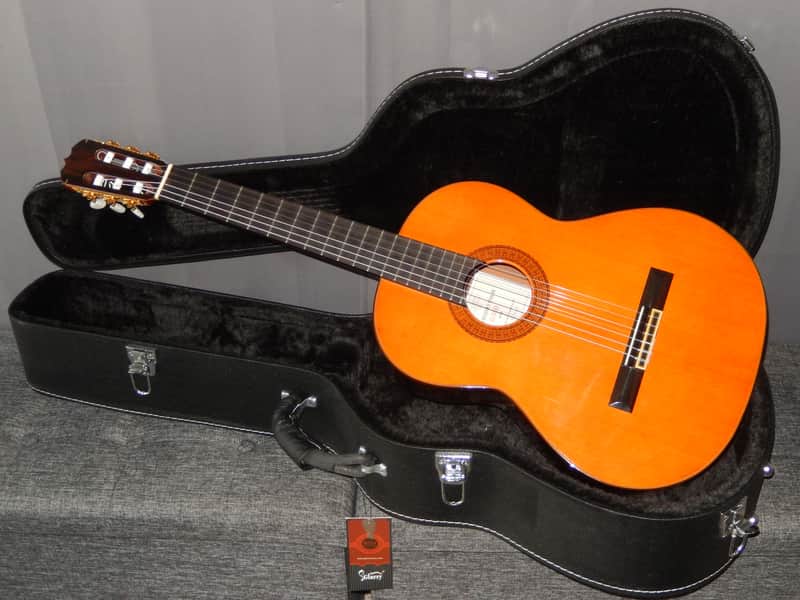
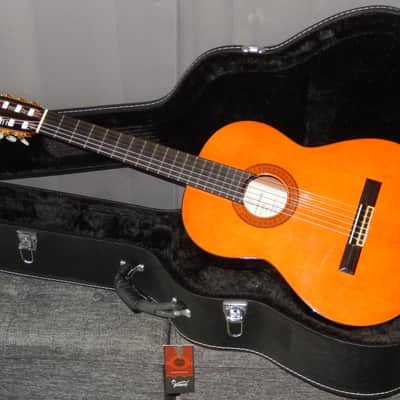
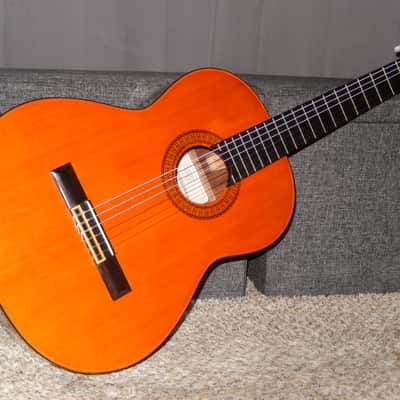
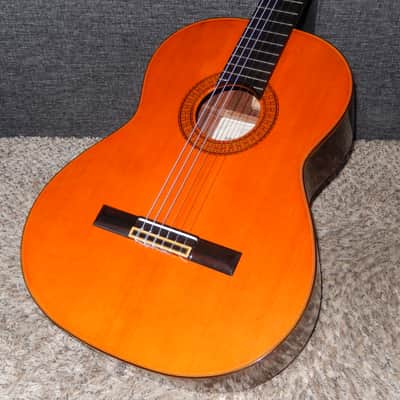
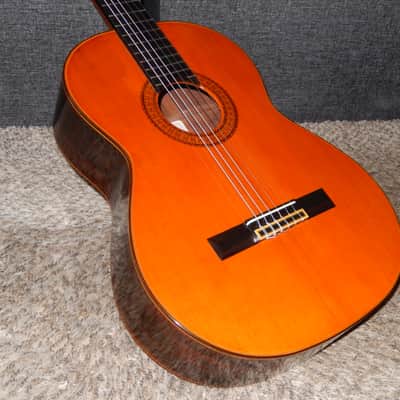
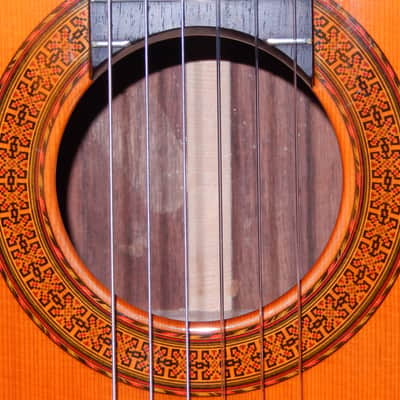
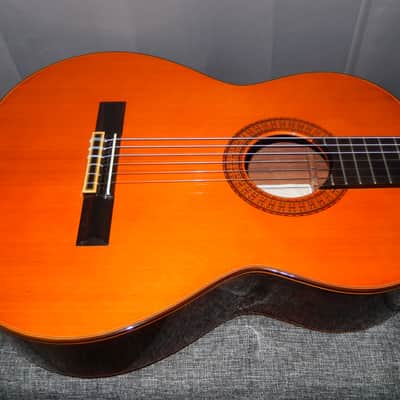
MADE IN 1970 - KISO SUZUKI VIOLIN G500 - RAMIREZ 1a CLASS CLASSICAL CONCERT GUITAR - CEDAR/BRAZILIAN ROSEWOOD
This seller has not set a shipping cost for Czech Republic. Please contact them to ask about shipping.


Our users rate Reverb
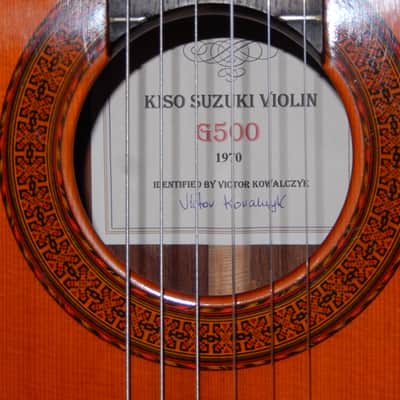
Kiso Suzuki Violin G500
Even though it is not "all solid woods" intrument, in terms of volume and tonality it can easily compete with many modern era "all solid woods" Japanese models sold for $12000 USD.
This wonderful guitar was made by Kiso Suzuki Violin around year 1970.
For the lack of original label, I have installed my own label as “certificate of its authenticity”. Sceptics are invited to look at my old Reverb listing with exactly the same model.
Masakichi Suzuki began making violins in 1887. He quickly established a reputation for making very good instruments. He founded Suzuki Violin Factory in 1900 in Nagoya, Aichi prefecture, and was the first person to open a company mass-producing violins. Passionate about making a range of instruments, Suzuki made a few guitars in the early 1900s. However serial production of Suzuki Violin guitars started in 1951. In the meantime, right after II World War Masakichi’s company was split into 2 entities: old Suzuki Violin (also called Nagoya Suzuki Violin) and Kiso Suzuki Violin located in small town of Kiso in Nagano prefecture. Both companies were managed by Masachichi’s sons. Kiso Suzuki Violin Co. went bankrupt in 1987. Nagoya Suzuki Violin still makes violins and mandolins but stopped making guitars in 1989. Suzuki Violin guitars are very popular all around the world. Although greatly underappreciated, many of them are of very high quality.
The instrument you are looking at is of the highest quality among Japanese made vintage classical guitars. It is one of the best sounding Japanese made guitars I ever had in my hands. Its greatness is only matched by Special model K3 made by Seiji Shinano in mid 1960s, Angel 602 made by Osamu Sakamoto in early 1970s, Seiji Inaba No30 made in 1976 and Yukinobu Chai No50 made in 1980.
I know that many of you will find it very hard to believe, but truly the highest class Japanese classical guitars were made by not famous luthiers and many of them were not “all solid woods” construction. Many of these finest guitars had solid tops, while backs & sides made from “non-solid” Brazilian Rosewood plates.
To recognize the true greatness of this fine instrument you first need to visit “highest end” guitar stores in your area and try their most expensive instruments. With such experience you may agree that guitar This this G500 guitar can easily compete with many $15000+ “hand made in Spain” instruments just as it easily challenges Yamaha GC70 that I have for sale, and which is currently one of the most expensive Japanese made guitars,
Every luthier and most experienced players know that the louder the guitar the lower is its note clarity & separation. This guitar has it all: high volume, superb response, great depth, plenty of warmth and sweetness, yet with quite crispy trebles, exceptionally high level of note clarity & separation, “almost never ending” sustain, great level of transparency and tonality “out of this planet”. Even the most demanding player will be amazed by its gorgeous sound. Only a truly talented poet can describe all its tonal beauty.
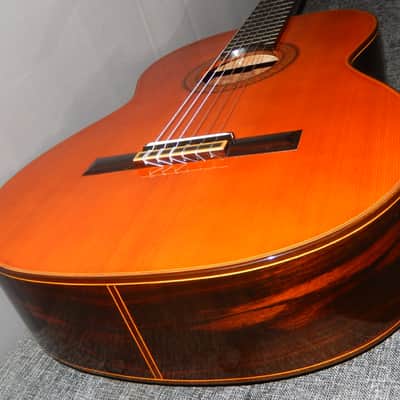
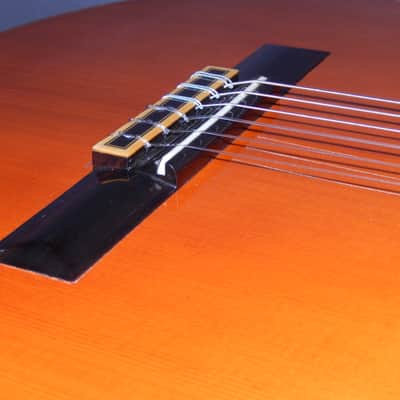
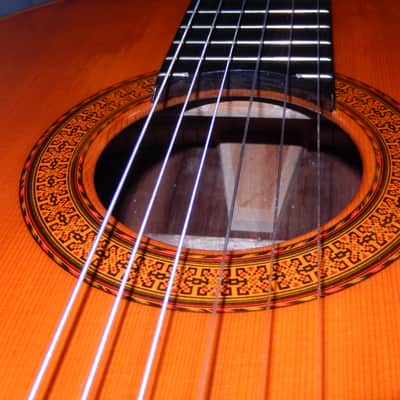
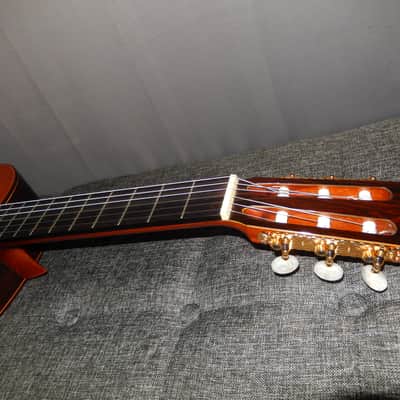
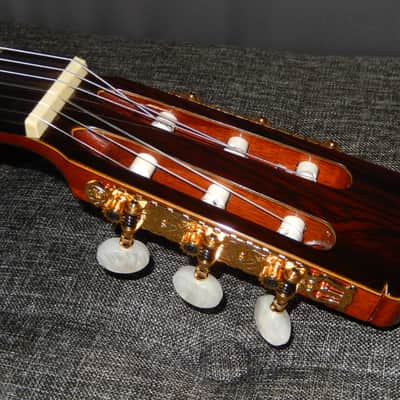
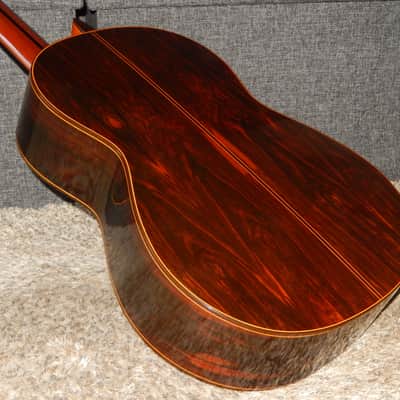
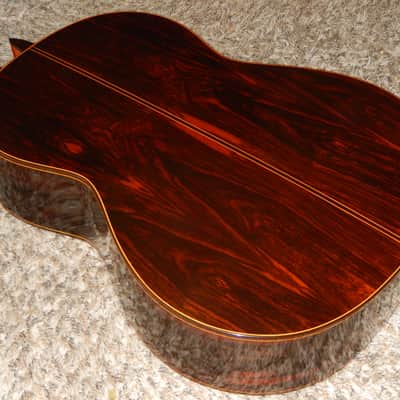
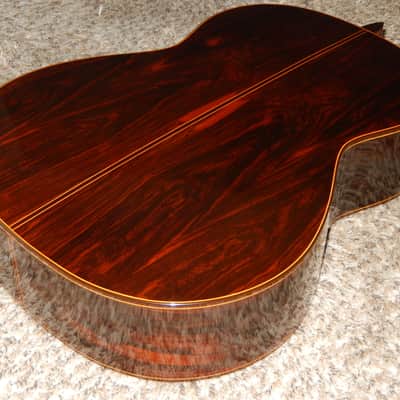
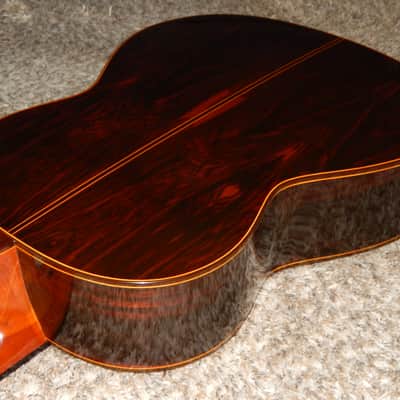
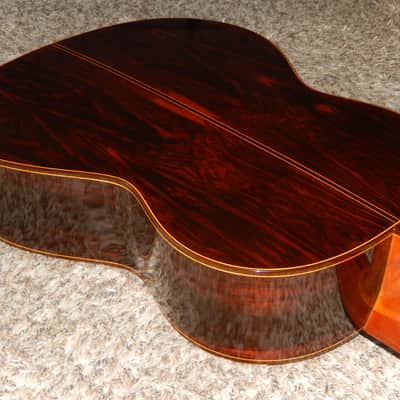
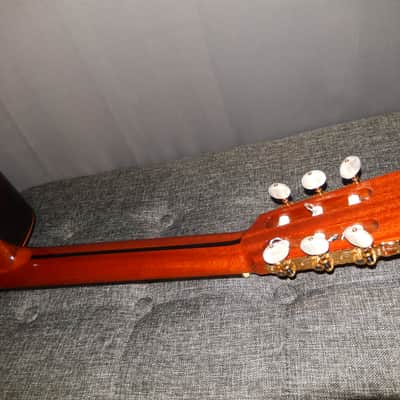
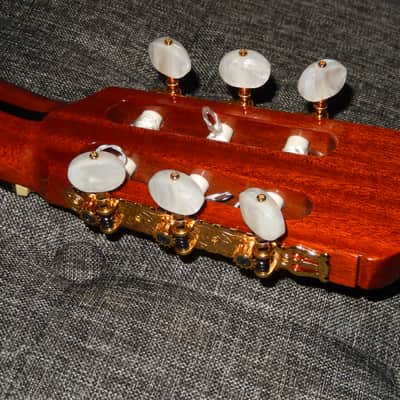
This guitar remains in perfect working and “practically mint” cosmetic condition. The only cosmetic flaws are a few very light rubbing marks on its back, all visible only at certain angles and from very close distance. Because original tuners were very hard to turn, they were replaced with brand new Gotoh set.
The construction of this guitar is based on Jose Ramirez blueprints and enhanced by Suzuki Violin luthiers. During the 1960s and early 1970s Jose Ramirez was making the same construction guitars and selling them at prices equal to $15000 today. Many Japanese luthiers were using the same blueprints. Double backs and/or double sides greatly reduce the effect of damping of the sound by the player’s body. The sound of such guitars is ultra-rich and greatly “amplified” at the same time.
Specifications:
Top: High Grade Solid Cedar/ Ramirez style bracing/cashew lacquer
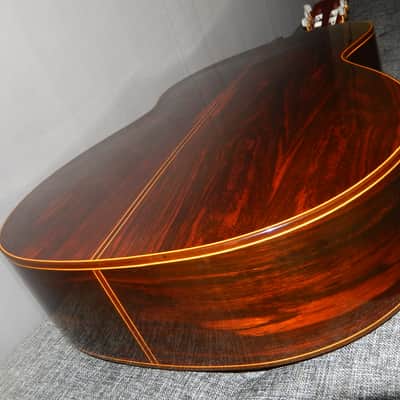
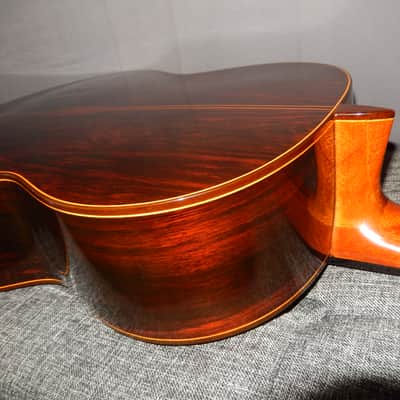
Double Sides: 2 separate plates of Figured Brazilian Rosewood “laminates”/cashew lacquer
Back: Figured Brazilian Rosewood “laminates”/cashew lacquer
“Laminated” is quite unfortunate term regarding Japanese made guitars. In recent years guitar makers around the world adopted new term "semisolid" that more precisely describes construction of such plates. These plates were made from 2 layers of solid wood glued together with natural resins. They were made so well that they performed as good as solid woods while being far less expensive in guitar production and far more resistant to cracking in regular use.
Neck: Mahogany
Fingerboard: Ebony
Scale: 652 mm
Nut width: 52 mm
Strings: Savarez Cantiga Premium Alliance Tension Forte
The current action is set to 3.30 mm under E6 and 2.80 mm under E1mm, just because it was possible. The second saddle sets this action at 4.00 mm E1 and 3.50 mm E1. The final setup is up to you.
The guitar will be shipped in brand new Geary hard shell case.
WHEN YOU BUY ANY GUITAR, YOU MUST ANTICIPATE TAKING IT TO YOUR LOCAL GUITAR SHOP FOR FINAL ADJUSTMENTS CALLED “SETUP”. DEPENIDNG ON YOUR PLAYING TECHNIQUE, THIS SETUP ON USED GUITARS MAY INCLUDE NEW CUSTOM MADE NUT AND SADLLE. IF YOU HEAR STRING BUZZ IT DOESN’T MEAN THAT GUITAR IS DEFECTIVE. IF YOU PLAY HARD ENOUGH ALL BASS STRINGS WILL BUZZ OVER THE FRETS, UNLESS THEY ARE SUSPENDED VERY FAR FROM THE FINGERBOARD. UNLESS YOU PLAY QUITE GENTLY, YOU CAN’T HAVE LOW ACTION AND NO BUZZES. KEEP IN MIND THAT CELLO-LIKE BASSES ON HIGH GRADE CLASSICAL GUITARS HAVE THEIR NATURAL “BUZZ”.
Real Value of Japanese Vintage Guitars
The key to understand value of vintage Japanese guitars is to acknowledge galloping price inflation throughout the late 1960s and 1970s with its peak of 25% in 1974.
During 1960s and most of 1970s model numbers of Japanese guitars were strictly connected with their prices in Japanese yen.
The same class guitar sold in 1970 for 100 000 yen (labelled as model 10), would be sold for 150 000 yen in 1972 (labelled as model 15), 200 000 yen in 1974 (labelled as model 20) and 300 000 yen in 1978 (labelled as model 30). Therefore, you shouldn’t be surprised that two Yamaha GC10 guitars made 10 years apart are two instruments of totally different class. The same rule applies to all guitar models made by all other Japanese makers.
Japanese inflation slowed down in the 1980s. By the early 1980s and during following decades model numbers were no longer strictly associated with their prices. Some Japanese guitar makers introduced model names instead of model numbers. For several economic reasons, since 1980s Japanese made guitars were becoming more and more expensive, while their exports slowing down. Today (2025) Japanese high end classical guitar models are priced at $20000USD level.
| Listed | 6 months ago |
|---|---|
| Condition | Excellent (Used) Excellent items are almost entirely free from blemishes and other visual defects and have been played or used with the utmost care.Learn more |
| Brand | |
| Model |
|
| Finish |
|
| Categories | |
| Year |
|
| Made In |
|
| Body Shape |
|
Product safety information may be available here.

