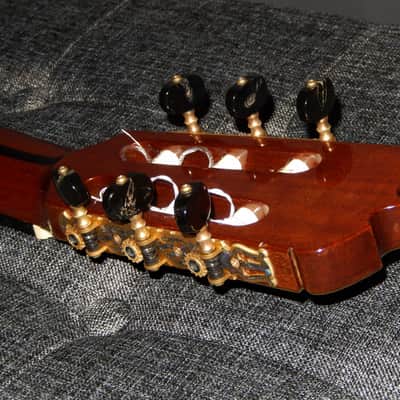
MADE IN 1970 - KISO SUZUKI VIOLIN NG500 - FINEST GRADE CLASSICAL CONCERT GUITAR
This gear has sold
See similar gear from other Reverb sellers
Our users rate Reverb
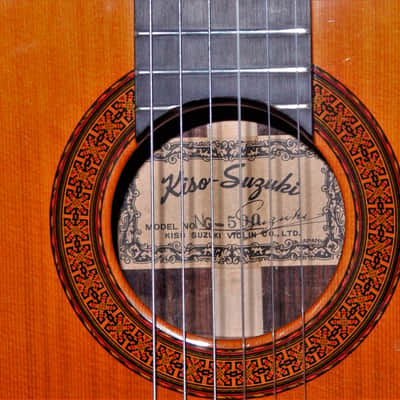
Kiso Suzuki Violin NG500
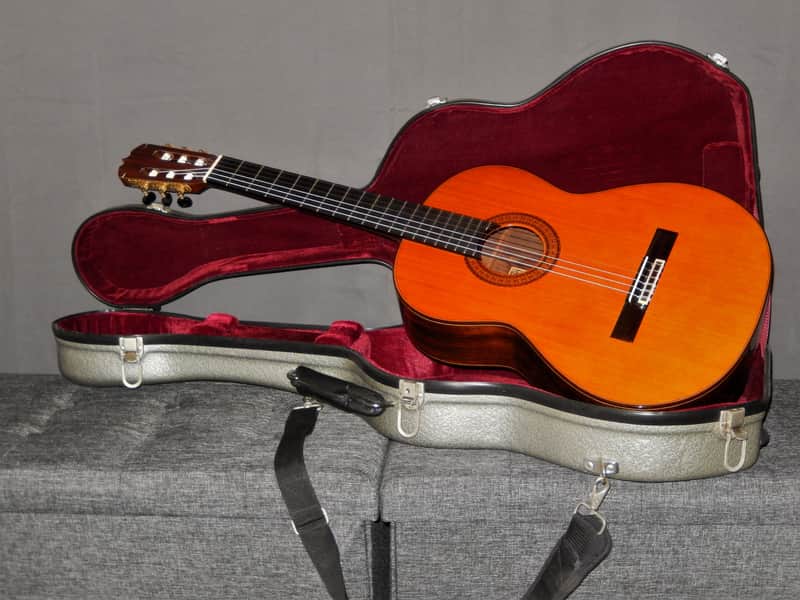
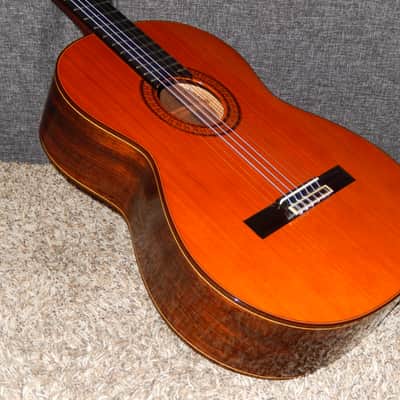
This wonderful guitar was made by Kiso Suzuki Violin. The construction, its looks, label design and model number tell me that this guitar was made around 1970.
Masakichi Suzuki began making violins in 1887. He quickly established a reputation for making very good instruments. He founded Suzuki Violin Factory in 1900 in Nagoya, Aichi prefecture, and was the first person to open a company mass-producing violins. Passionate about making a range of instruments, Suzuki made a few guitars in the early 1900s. However serial production of Suzuki Violin guitars started in 1951. In the meantime, right after II World War Masakichi’s company was split into 2 entities: old Suzuki Violin (also called Nagoya Suzuki Violin) and Kiso Suzuki Violin located in small town of Kiso in Nagano prefecture. Both companies were managed by Masachichi’s sons. Kiso Suzuki Violin Co. went bankrupt in 1987. Nagoya Suzuki Violin still makes violins and mandolins but stopped making guitars in 1989. Suzuki Violin guitars are very popular all around the world. Although greatly underappreciated, many of them are of very high quality.
The instrument you are looking at is of the highest quality among Japanese made vintage classical guitars. It is one of the best sounding Japanese made guitars I ever had in my hands. Its greatness is only matched by Special model K3 made by Seiji Shinano in mid/late 1960s, Angel 602 and Angel 100 made by Osamu Sakamoto in early 1970s.
I know that many of you will find it very hard to believe, but truly the highest class Japanese classical guitars were made by not famous luthiers and none of them was “all solid woods” construction. All these finest guitars had solid Spruce tops and backs/sides made from “non-solid” Brazilian Rosewood plates.
If you ever encounter one of these guitars in decent condition, consider yourself lucky. But to really recognize true greatness of these instruments you first need to visit “highest end” guitar stores in your area and try their most expensive instruments. With such experience you will agree that guitar This this NG500 guitar can easily compete with many $15000+ “hand made in Spain” instruments.
Every luthier and most experienced players know that the louder is the guitar the lower is it's note clarity and separation. This guitar has it all: high volume combined with exceptional note clarity & separation, "almost never ending" sustain and tonality as "out of this planet".
Fret inspection, leveling, crowning and polishing has been performed by Greg Hails (Aperio Guitar Johns Creek, GA)
The construction of this guitar is based on Jose Ramirez blueprints and enhanced by Suzuki Violin luthiers. During 1960s and early 1970s Jose Ramirez was making the same construction guitars and selling them at the prices equal to $10000 today. Many Japanese luthiers were using the same blueprint. This construction greatly reduces the effect of damping of the sound by player’s body. The sound of such guitars is ultra-rich and “amplified” at the same time.
Specifications:
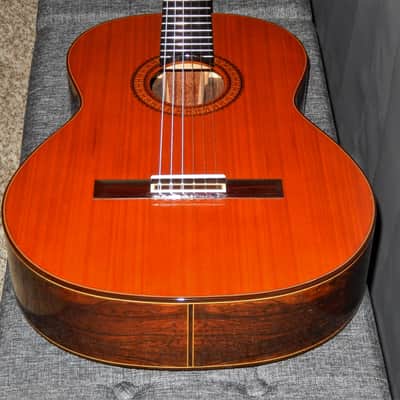
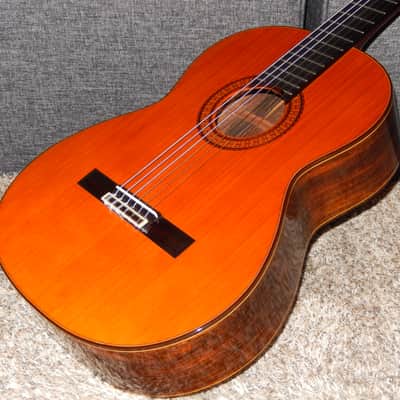
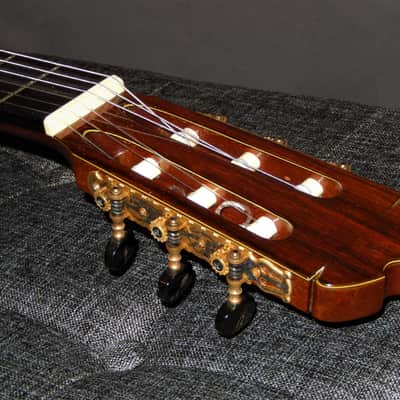
Top: High Grade Solid Spruce/ cashew lacquer
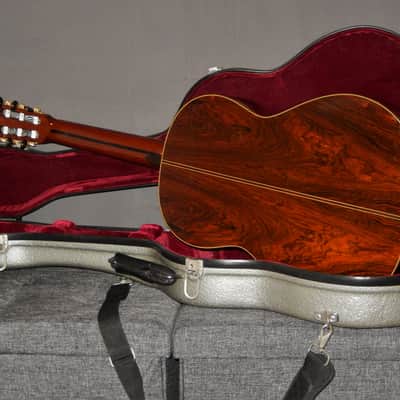
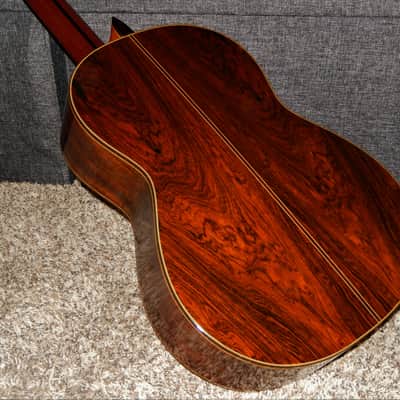
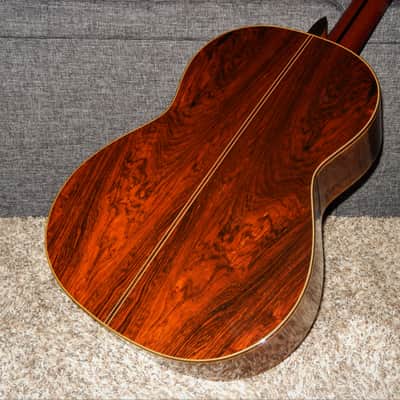
Double Sides: 2 separate plates of Figured Brazilian Rosewood “laminates”/cashew lacquer
Back: Figured Brazilian Rosewood “laminates”/cashew lacquer
“Laminated” is quite unfortunate term regarding Japanese made guitars. In recent years guitar makers around the world adopted new term "semisolid" that more precisely describes construction of such plates. These plates were made from 2 layers of solid wood glued together with natural resins. They were made so well that they performed as good as solid woods while being far less expensive in guitar production and far more resistant to cracking in regular use.
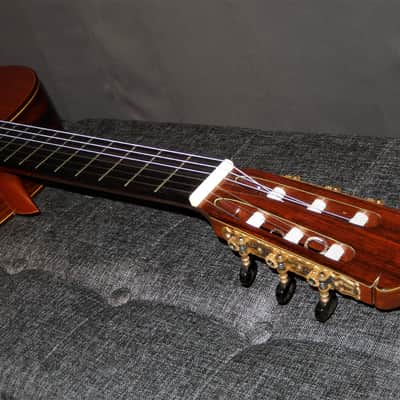
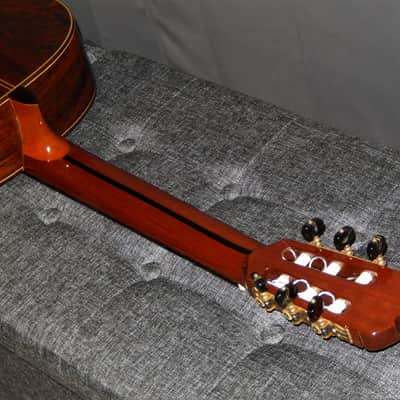
Neck: Mahogany
Fingerboard: Ebony
Scale: 655 mm
Nut width: 52 mm
Current action is set to 3.00 mm under E6 and 2.50 mm under E1, just because it was possible and some players you will find it very attractive. For all other players I have made second saddle that raises the action to about 3.5mm E6 and 3.00mm E1. This second saddle is longer, and by sliding it left/right you can slightly raise or lower this action.
Guitar will be shipped in lightly used appropriately fine hard shell case.
***********************************
Now it’s time for me to introduce you to the owner of Shinano K-3 (sold on eBay 11/29/2107 posting 192376192412) and his honest reflections describing this wonderful guitar.
Sam C. is a highly educated man, very accomplished in his professional career, scholar and author of an essay titled “Quest for the perfect guitar”. In his younger days being inspired by Andres Segovia, Sam started his personal adventure with classical guitar. He’s been playing guitar for nearly 60 years. Through all these years he’s been on his personal “quest for the perfect guitar” and he’s tried many “high end” guitars. After countless trials he picked 2 “best sounding Ramirez 1A guitars”. His quest however didn’t end there. He was still dreaming about “the perfect guitar”. When he found my posting, it caught his attention and his 7th sense told him that this Shinano K-3 might be “The One”. He registered with eBay and contacted me. Through several e-mails we’ve exchanged our thoughts about guitars and many other “Earthly matters”. I will only share with you his messages sent to me after he received the guitar:
New message from: December 2nd, 2017
Victor,
I got the guitar.
All I can say is WOW!!!
It is everything you said it was and more. I have never dreamed of hearing an instrument of this quality! It beats them all.
The x and y axes were reached. Segovia turned over in his grave when he heard me play (He got so perfectionistic that he once socked a guitar since it wouldn't give him the sound he wanted). He would cherish this guitar.
As my dad would say the old saying, Victor: "You are a gentleman and a scholar".
Cirano Debergerac said; "There is that one moment, and God help those that pass that moment by when "Beauty" stands staring into a man's soul with grave sweet eyes that sicken at pretty words". The Zen concept of the drawback of dualistic thinking and the power of the here and now.
Many Thanks, Sam C.
New message from: December 5th, 2017
Victor,
Of course it is very subjective, but the Ramirezes I have are on a par with the Shinano in all ways, each of the three having a quality slightly better than the other two. Like comparing a Cadillac with a Rolls Royce with a Lamborgini.
Ramirezes vary. The two I have are way superior to the many others I've played in the past.
Anyway the Shinano is a superb instrument, everything you described and more. I am indebted to you for getting it to me and for the discounted price!
Sam C.
New message from: December 5th, 2017
Victor,
You may be interested to know that I am amazed with the Shinano in comparing it with my two Ramirezes.
I find that they are equally great, each having a unique quality better than the other two. It appears that the Shinano has not been played a lot and is opening up some. It is superior to the Ramirezes in evenness, balance across notes and strings and sustain.
Sam C.
New message from: December 10th, 2017
Victor,
The Shinano is getting better each day. It is a sheer magical joy to experience it!
It gives me a better appreciation of my other guitars by comparing them.
Nothing will erase the indebtedness I feel to you.
I continue to thank you.
Sam C.
**********************************
The key to understand value of vintage Japanese guitars is to acknowledge galloping devaluation of Japanese yen in 1960s & 1970s. This devaluation was somewhat slower in 1980s. The best measure of this devaluation is Starting Yearly Salary of Japanese College Graduate (SYSJCG).
SYSJCG in in 1965 was 19 600 yen, in 1969 – 34 600 yen, in 1970 39 200 yen, in 1972 – 62 300 yen, in 1975 79 200 yen, in 1977 85 200 yen and in 1980 - 100 000 yen.
During 1960s and most of 1970s model numbers of Japanese guitars were strictly interconnected with their prices in Japanese yen. In late 1970s and during following decades model numbers were no longer strictly associated with their prices. Many Japanese guitar makers introduced model names instead of model numbers. Others were still using model numbers with addition of letter abbreviations or other symbols.
The best and only logical approach while evaluating real value (real grade) of vintage Japanese guitar is to compare its price in Japanese yen with SYSJCG during the year guitar was made.
Any guitar priced 100 000 in 1970 (labelled usually as No10) would be priced 200 000 yen in 1975 (relabeled to No20 or 2000), 300 000 yen in 1977 (labelled as No3, No30 or 3000). Starting in 1977 Masaru Kohno introduced his model No50 priced at 500 000 (skipping theoretical model 40). Soon other famous Japanese luthiers did the same. By 1983 Kohno started using model names instead numbers and was raising their prices as he was pleased. Naturally soon other Master luthiers did the same.
Knowing all of that, you can bet on that Masaru Kohno No50 made in 1982 is practically the same quality as Kohno No15 made in 1972, or Kohno no20 made in 1975 or Kohno No30 made in 1977. I know it for a fact.
The lowest grade models currently made by Matsuoka workshop are M75 and MH75. They are commonly considered as “beginner guitars”. Matsuoka model M30 made in 1973 is simply far, far better instrument. It is naturally better than model M50 made in 1977, model 80 made in 1982 or model M100 made in 1990. At present, the highest grade Matsuoka models are M300 and MH300. They absolutely stand no chance in competition with model M150 made in 1975… or model M200 made in 1977.
It is very important to mention that if modern era luthiers are using 40 years old woods to make a classical guitar, its price is at least $8000.
| Listed | 6 years ago |
|---|---|
| Condition | Excellent (Used) Excellent items are almost entirely free from blemishes and other visual defects and have been played or used with the utmost care.Learn more |
| Brand | |
| Model |
|
| Finish |
|
| Categories | |
| Year |
|
| Made In |
|
| Body Shape |
|
Product safety information may be available here.