


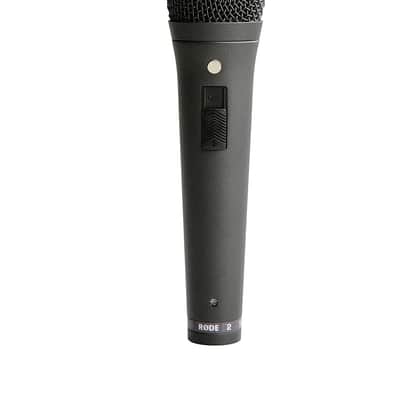
Rode M2 Live Performance Handheld Condenser Vocal Microphone — Supercardioid with Lockable On/Off Switch
Il venditore non ha impostato il costo di spedizione per Italia. Per favore contatta e chiedigli il costo della spedizione.

Solo 1 rimasto
Non fartelo sfuggire


Politica per i resi entro 30 giorni
Concediti il massimo della tranquillità con il tuo nuovo strumento
I nostri utenti valutano Reverb
The Rode M2 is the condenser-capsule companion to the M1 — same handheld form factor, same die-cast metal body, but a 1/2-inch externally polarized condenser capsule swapped in for the dynamic moving-coil. The result is a live vocal mic that delivers the air, articulation, and sibilance detail of a small-diaphragm studio condenser through a handheld a vocalist can grip on a club stage or a worship platform. A tightly controlled supercardioid polar pattern keeps gain-before-feedback margin in dynamic-mic territory even though the capsule is far more sensitive. 141 dB max SPL handling means the capsule doesn't overload on belting vocals or cupped technique. A lockable on/off switch lets a self-operated vocalist mute between songs — or lets the FOH engineer lock the mic on and remove the variable. Plug in 48V phantom from the mixer, ride the gain, and the singer reads through the PA the way a studio condenser reads through monitors.
Externally Polarized Condenser Capsule Captures What Dynamics MissThe capsule at the heart of the M2 is a 1/2-inch externally polarized condenser — the same operating principle as the small-diaphragm condensers studios reach for when they want detail, transient response, and an open top end. On a handheld mic intended for live use, that capsule technology has historically been hard to deliver because of feedback margin, capsule fragility, and the SPL handling required at the lip-line. The M2 solves those problems with deliberate engineering: a tailored midrange that dodges the 2-4 kHz feedback band where condensers usually ring, an internal elastomer shock mount that decouples the capsule from the body, hardened steel mesh in the head basket that shields the capsule from spit and impact, and 141 dB max SPL handling that gives the capsule the headroom to survive cupped close-up vocals without distorting. The audible benefit is direct: a singer with breathy delivery, sibilant articulation, or chest-voice harmonics passes through the M2 with the detail intact, instead of being smoothed out the way a dynamic flattens those textures.
Supercardioid Pattern with Feedback Margin That Reads Like a DynamicMost singers and engineers expect condenser handhelds to feed back faster than dynamics. The M2's supercardioid polar pattern is tightly engineered to behave the opposite way. The null is at roughly 110-120 degrees off-axis — exactly where a wedge monitor lives in a typical stage setup — so the monitor energy aimed at the back of the mic actually nulls out instead of reinforcing. The midrange voicing dips through the 2-4 kHz feedback band that often becomes the ringing frequency in untreated rooms, which means the engineer can push the channel hotter before the room talks back. The lockable on/off switch is the small detail that working engineers notice immediately — flush in the body, latches into either position, and stays put through accidental knocks. The vocalist gets a kill switch; the engineer can lock it on for self-operated cases where someone hands the mic to a guest and forgets to slide the switch back. 50-ohm output impedance drives any standard XLR cable run to FOH without HF rolloff.
P48 Phantom Power: The One Thing to Confirm Before the First ShowThe M2 requires 48-volt phantom power — supplied by any modern mixer, audio interface, or standalone mic preamp. Vocalists stepping up from dynamics sometimes get caught the first night when their PA's mixer doesn't supply phantom on the channel they patched into. The fix is a one-switch action on every modern mixer (a +48V button per channel or for the whole console). With phantom enabled, the capsule receives the +48V bias it needs to operate, the diaphragm becomes responsive at quiet stage levels where dynamic capsules lose nuance, and the signal-to-noise ratio (71 dB on the M2) stays clean. The mic ships with a clip and a zip pouch — there is no external phantom-power adapter required, no inline preamp needed, and no warm-up time. Plug in, enable phantom, and the mic is live.
Who the Rode M2 Is ForFor the lead vocalist whose breathy or sibilant vocal style gets buried by a typical handheld dynamic, the M2 is the upgrade that lets the audience hear the texture instead of the outline. For the worship pastor or worship-team vocalist running through wedge monitors or in-ear systems where intelligibility is non-negotiable, the M2's condenser top end carries consonant articulation cleanly to the back of the room. For the singer-songwriter or acoustic performer whose dynamic range covers quiet whisper to belted chorus on the same song, the 141 dB max SPL ceiling and the wide 35 Hz to 20 kHz response handle both extremes from the same capsule. For the spoken-word presenter, the conference emcee, or the wedding officiant who needs handheld portability with podium-condenser clarity, the M2 sits at the intersection. Bring it to the gig. Plug in 48V phantom. Ride the gain. Let the singer be heard.
| Condizione | Nuovo (Nuovo) Gli articoli "Nuovi” sono venduti da un rivenditore autorizzato o dal produttore originale e comprendono l’imballo originale.Scopri di più |
|---|---|
| Marchio | |
| Modello |
|
| Categorie | |
| Anno |
|
Le informazioni sulla sicurezza del prodotto sono disponibili qui.

Protezione di Reverb
Resi semplici, transazioni sicure, assistenza di persone in carne e ossa
Scopri di più