

2018 Fender American "Jazzblaster" 60th Anniversary Triple Jazzmaster Daphne Blue CuNiFe Wide Range MAJOR Upgrades USA G&G
This seller has not set a shipping cost for Norway. Please contact them to ask about shipping.
Our users rate Reverb
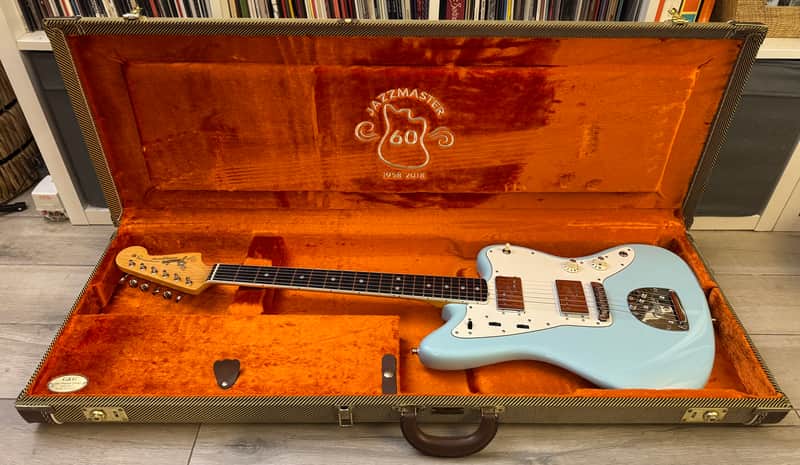
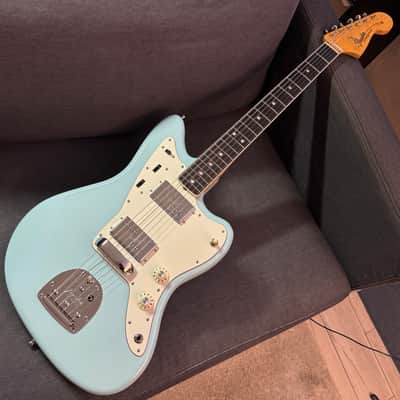
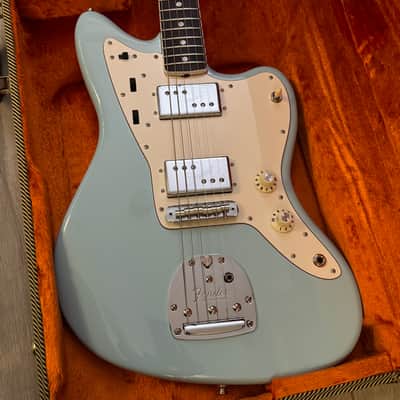
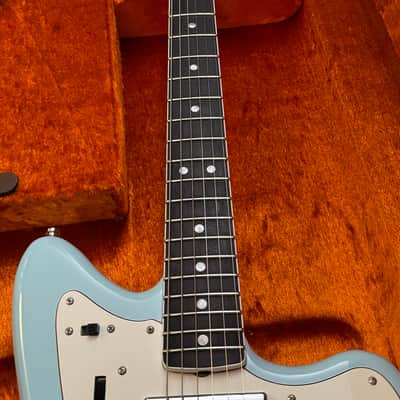
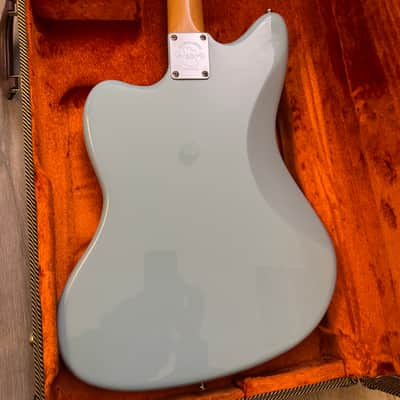
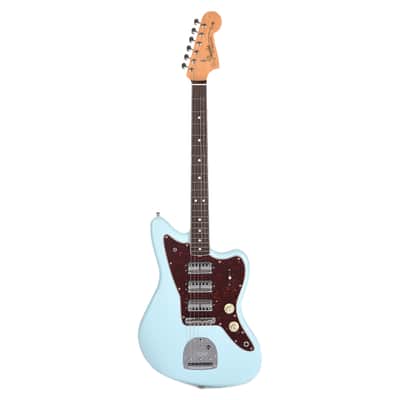
The last Jazzblaster I had listed recently sold so what better time to list my latest one. What started out as a 2018 Fender American 60th Anniversary "Triple Jazzmaster" which was an odd but really unique model with three Filter'Tron humbucker pickups, I felt the overall execution of it was really lacking. What I've done is completely reimagined it the way Fender should have released it had it been a couple years later with the remanufacturing of CuNiFe Wide Range pickups and still sticking with the idea of a Jazzmaster with humbuckers, a "Jazzblaster." This is also my first Jazzblaster I've done of the American Vintage class with nitrocellulose lacquer finish and neck binding. As you would expect the results are pretty awesome and the guitar is stunning.
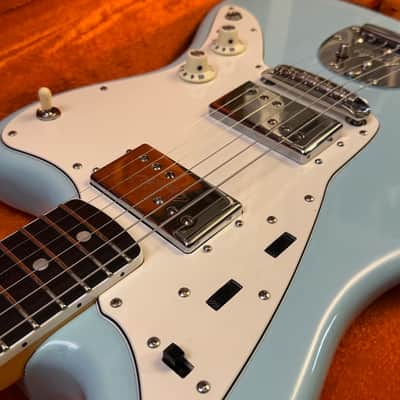
If you've followed me over the past few of years you know how much I love Jazzmasters and "Offset" Fenders in general. I've owned one of these models before when they first came out in 2018 but always knew what I would do if I got another one. One of the difficulties of doing a Jazzblaster with pickguard mounted humbuckers, is that the pickup cavities on the body are too shallow and need to be routed deeper (the only way to do it in my opinion as it looks much cooler with the metal covers than body mounted Wide Ranges in plastic Jazzmaster style covers). Since this body already has deeper pickup cavities there was no modification needed and ready go. I had a custom pickguard made in 3-ply Parchment and even that alone is a night and day difference over the stock Tortoise Shell one which I personally think never looks good on a pastel colored body. Parchment is a much better choice on Daphne Blue. Basically I'm building the guitars Fender won't.
The neck is essentially an American Original 60s Jazzmaster which has the modern 9.5" fretboard radius and 21 tall narrow frets, but the thing I've noticed on many of the American Original 60s models of the neck is the narrow tall frets aren't that tall, maybe a little higher than vintage frets. On this particular model the frets are noticeably higher like they should be for narrow tall ones.
Condition wise, it has some light scratches and a couple small nicks here and there but aside from that both the body and neck are in overall excellent condition with almost no fret wear, shiny and fresh. Conservatively you could say Very Good+, but I don't think most people would have a problem with it being labeled excellent.
I love nods to tradition but am in no way a purist and always appreciate subtle modern touches which is exactly what I was going for. Clearly this guitar demonstrates my flexibility haha. These Classic and American series vintage style "Offsets" from Fender sit on a great foundation, but I'm really surprised how they sell any of them because they're setup so horribly from the factory and buzz like crazy with anything less than a set of 12s. Starting with the American Original 60s Jazzmaster series, Fender started making the neck pockets angled which largely solved this problem and in most cases with those and the current American Vintage II series, you generally don't need to use shims anymore to increase the break angle on the strings after the bridge. That being said, this one could use a slightly higher neck pitch angle so you could string it up with 10s to play well.
Please read further to see the list of upgrades as well as how the guitar was setup:
Weight is a hair under 8 lbs which incredibly balanced not just for a Jazzmaster but especially for a Jazzblaster with heavier pickups.
-WD Music Custom made 3-ply Parchment Jazzblaster pickguard. As I mentioned part of the difficulty with building a Jazzblaster like this is that you're switching from body mounted pickups to pickguard mounted ones so you also have to route the pickup cavities of the body to increase the depth but didn't have to worry about that here. The good thing about this deeper routed body is you also reduce some of the weight since the Wide Ranges are also heavier than traditional Jazzmaster pickups. They do make these pickups now inside a traditional Jazzmaster style body mounted enclosure but it also doesn't look as cool without the chrome covers.
-Fender '65 Witch Hat Vintage White Knobs. The original knobs are aged white but I choice to go to vintage white for a more subtle contrast with the parchment pickguard and hard to argue with results.
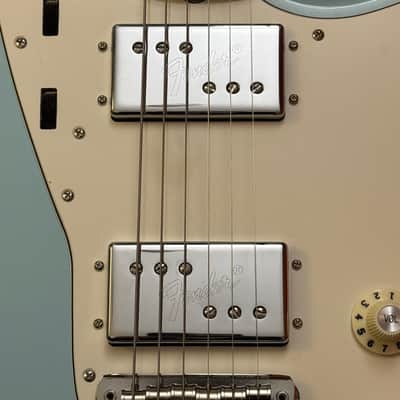
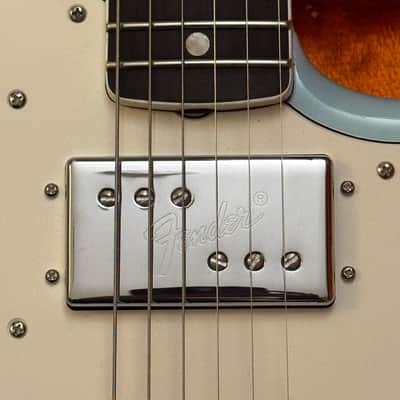
-Fender CuNiFe Wide Range humbucker pickups (a $600 upgrade alone). Unlike most reissue Fender Wide Range pickups, which are essentially PAF humbuckers with bar magnets underneath the covers, these pickups are built with individual adjustable pole magnets and full size bobbins, just like the vintage ones. The main difference is the bridge pickup has a higher output around 11k and over 5h induction while the neck has the output similar to the vintage ones around 10.3k and 4.3h induction and makes for a more balanced output. And without the $5000 Custom Shop price tag for a guitar like this!
-CTS 1Meg solid shaft audio pots. These are as the CuNiFe Wide Ranges originally came with in vintage Telecasters and give them more clarity and articulation. It's also inline with stock Jazzmaster pot values.
-Treble bleed cap/resistor circuits on the volume pot (1/4w 150k resistor in parallel with .001uf cap). This mod allows you to turn the volume pot down while still retaining the highs. A really nice mod especially for humbuckers
-Orange Drop .033uf and .022uf lead and rhythm circuit tone caps
-Fully shielded the pickup and control cavities with copper tape for reduced noise and much quieter operation. These guitars can be quite noisy without
-Gavitt 22 gauge vintage push back cloth wire. Since I'm basically starting over I built a new wiring harness from scratch much nicer than the original PVC wiring with vintage push back cloth wire and color coded just like in the American Vintage and American Original series
-Lock washer added to the 3-way toggle and also turned the switch 45 degrees so it's at an angle and easier to switch than side to side
-Revised 2018 American Professional Jazzmaster narrow spacing 9.5" radius bridge with Mustang style saddles. Despite being from the same year, this guitar had the original 2016 version of the bridge which had the wider vintage 56mm spacing bridge. This is the current updated version of the American Professional bridge that has the modern 2-1/16" (52mm) string spacing that brings the strings further away from the fretboard edge and a lot more comfortable to play. The original version of the American Professional bridge (and most stock vintage style Jazzmaster bridges) have the vintage 2-3/16” (56mm) spacing and are almost unplayable in my opinion. Fender quietly made this update in late 2018 and essentially makes this a lot more like a Staytrem bridge, which is a lot harder and more expensive to get outside of the UK (same spacing as the Mastery bridge too). Like the original, it still has the Mustang style saddles and tighter threading screw posts so it doesn't sink down overtime when you play
-American Vintage bridge thimbles retained. These have the wider standard diameter and are constructed better than the import version and didn't need to change (these are also wide enough to fit a Mastery bridge if for whatever reason you prefer those without worrying about changing the thimbles because it's already been done). When the neck pitch and break angle is setup properly on these guitars as I've done, I still prefer the American Professional bridge and also love the more traditional look over the Mastery
-American Vintage Jazzmaster Tremolo with pop-in arm. The original tremolo that came with this model was actually that of the American Professional (I) Jazzmaster which had a screw in arm and I just swapped it out with the American Vintage version which has a pop-in arm. Other than that the tremolo itself is identical.
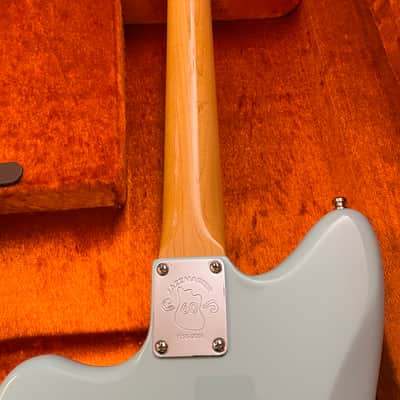
-StewMac 0.25 degree full wood neck pocket shim. This is one of the main reasons why these guitars are never setup right from the factory and buzz like crazy and don't sustain with lighter gauge strings. This allows the bridge height to move up and increase the break angle after the bridge and give you enough tension to use lighter gauge strings without having to use a Buzz Stop or heavier strings while still retaining that classic Jazzmaster feel. The problem with using a Buzz Stop is that it increases the string tension so much that it starts to feel and sound more like a Strat or Tele and that more loose Jazzmaster magic is gone
-Fender/Schaller strap locks and buttons with white felt washers
-Radius'd, Sanded, smoothed and polished the bone nut and sharp edges for a more comfortable exceeding that of a fully built American Original/Vintage guitar neck. This is a lot more comfortable now.
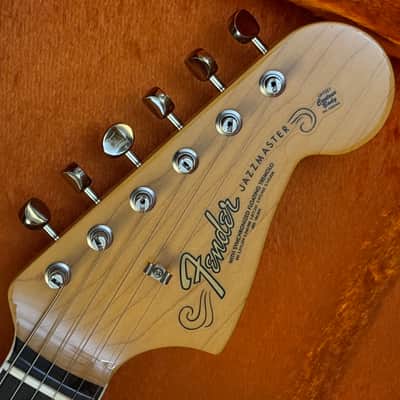
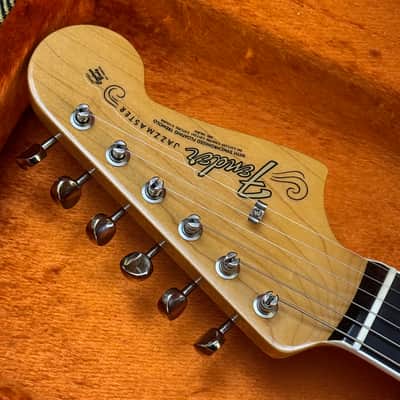
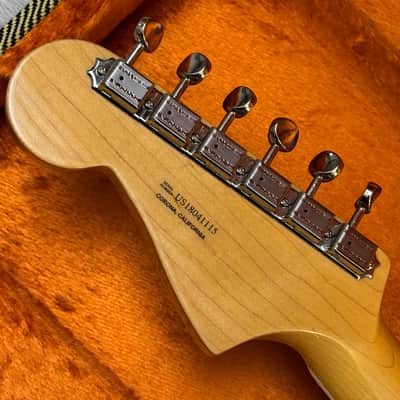
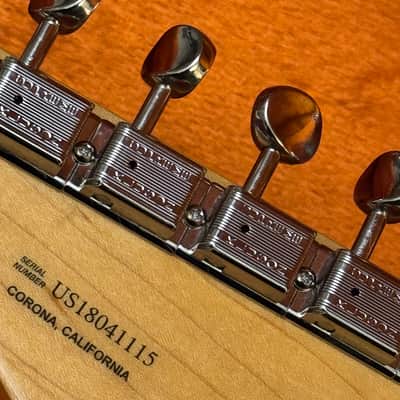
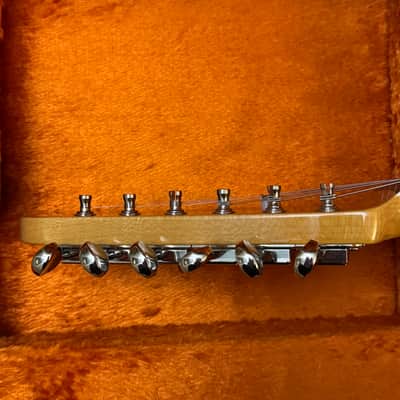
-Kluson Supreme 18:1 Staggered tuners ($70 upgrade). These are the best vintage style Kluson replacement tuners out right now and still retain that same classic look, but with a much finer tuning adjustment over the stock 14:1 tuners and also a better break angle over the nut on the D and G strings for better sustain. Not to mention these are genuine Klusons while the stock ones are not
The 60th Anniversary commemorative neck plate was retained as it is lightweight aluminum and is 1/4 the weight of your standard steel neck plate (about 0.5 oz vs 2 oz).
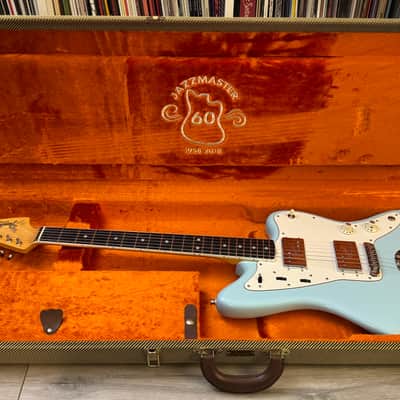
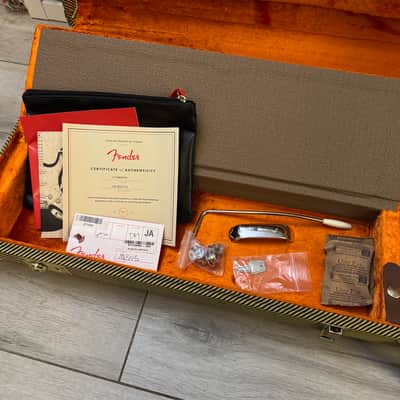
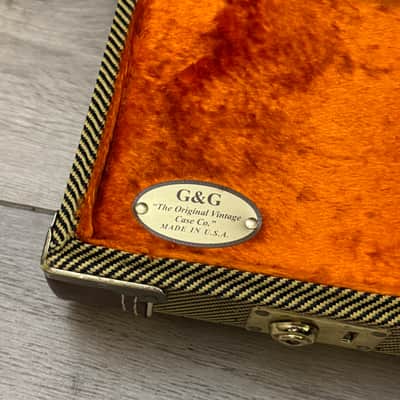
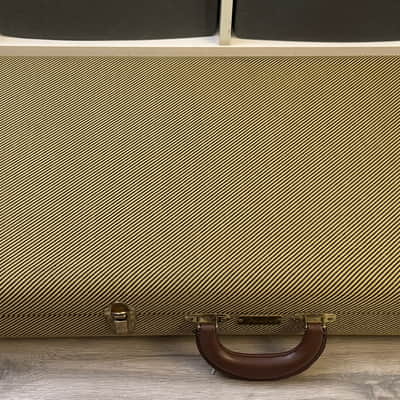
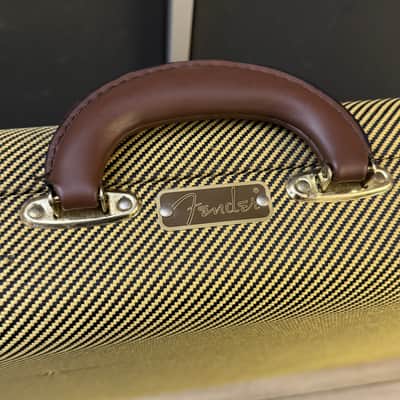
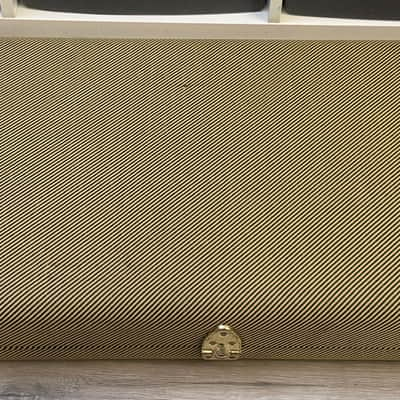
-Fender G&G Deluxe Limited Edition 60th Anniversary Jazzmaster hard case in tweed, brown leather ends/handle, embroidered logo and orange plus interior. This is the original case and only came with the two American 60th Anniversary models. Key included in the compartment
On top of these upgrades, it has also been cleaned, polished, oiled and conditioned the rosewood fretboard and fully setup with brand new D'Addario EXL110 (10-46) strings with enough relief in the neck balanced for both lead and rhythm and a light touch (5/64" string height on the low E and 4/64" on the high E strings). The saddles have been perfectly intonated and the bridge already has the 9.5" fretboard radius. The nut slots have been cleaned and filed for optimal contact and take off points for better sustain. The neck and bridge pickup heights are adjusted to 8/64" on the bass side and 8/64" on the treble side.
I fully stand by the work and believe this guitar is going to feel and play better than most Jazzmasters you're going to pull off the shelf new at the store and will put it against any of the American Vintage, Original, etc. versions any day of the week all because of things like the quality components and attention to detail in the setup. You're just not going to get that from a new Fender production model unless you perform all of these upgrades and do or pay for the work yourself. Why spend over $5000 on Custom Shop Jazzblaster? Why not just be done with it, have all the upgrades already completed with an awesome hard case and come out ahead with a better feeling, playing and sounding completely unique guitar? :)
Here's some additional specs:
- Body Finish Gloss Nitrocellulose Lacquer
- Body wood Alder
- Neck Material Maple
- Neck Binding 1-Ply White
- Neck Finish Gloss Nitrocellulose Lacquer
- Neck Shape Mid '60s "C"
- Scale Length 25.5" (648 mm)
- Fingerboard Material Rosewood
- Fingerboard Radius 9.5" (241 mm)
- Number of Frets 21
- Fret Size Vintage Tall
- Nut Material Bone
- Nut Width 1.650" (42 mm)
- Position Inlays White Pearloid Dot - 7mm
- Truss Rod Vintage-Style Heel Adjust
- Truss Rod Nut Vintage-Style Slotted
This item is sold As-Described
This item is sold As-Described and cannot be returned unless it arrives in a condition different from how it was described or photographed. Items must be returned in original, as-shipped condition with all original packaging.Learn More.
| Listed | 5 months ago |
|---|---|
| Condition | Excellent (Used) Excellent items are almost entirely free from blemishes and other visual defects and have been played or used with the utmost care.Learn more |
| Brand | |
| Model |
|
| Finish |
|
| Categories | |
| Year |
|
| Made In |
|
| Fretboard Material |
|
| Color Family |
|
| Series | |
| Body Shape |
|
| Pickup Configuration |
|
| Right / Left Handed |
|
| Model Family | |
| Number of Strings |
|
| Body Type |
|
| Offset Body |
|
| Bridge/Tailpiece Type |
|
| Neck Construction |
|
| Number of Frets |
|
Product safety information may be available here.

