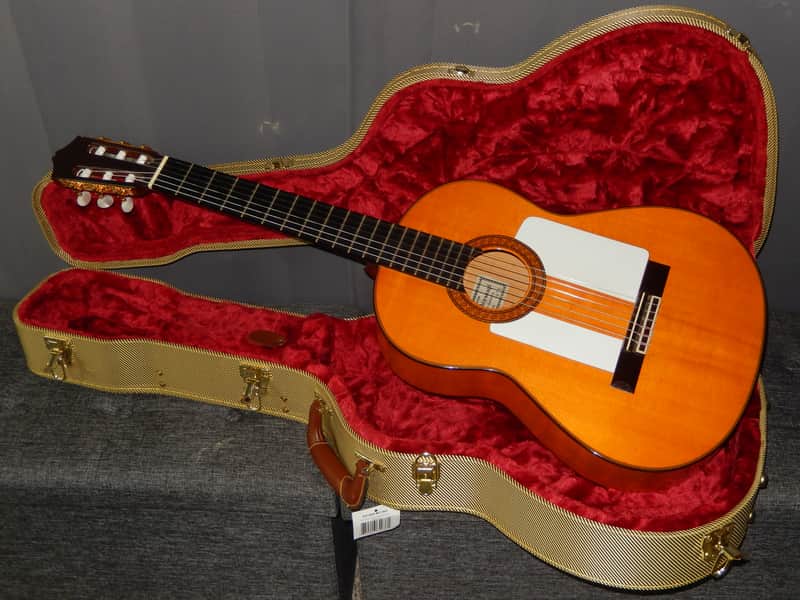
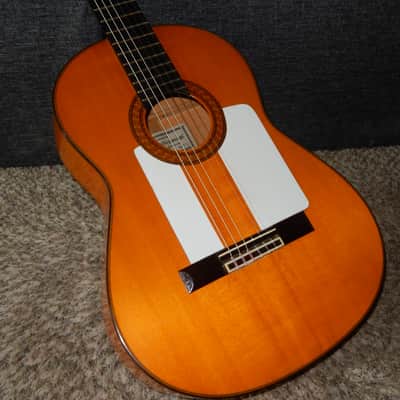
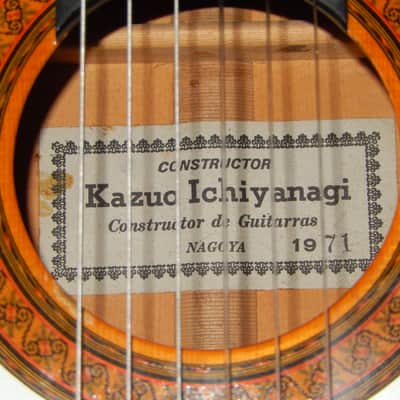
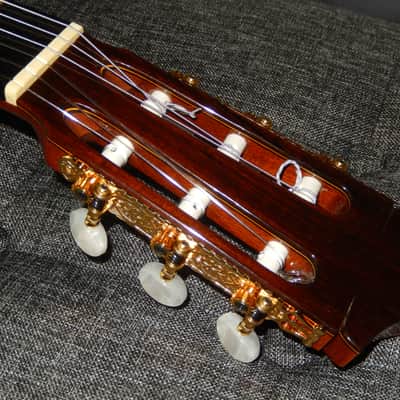
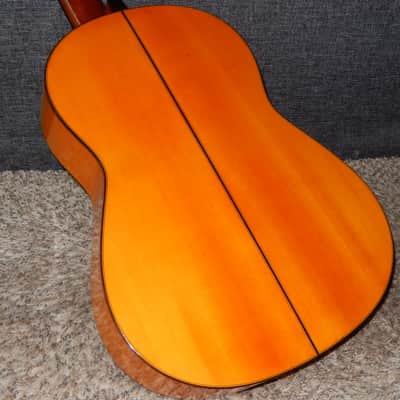
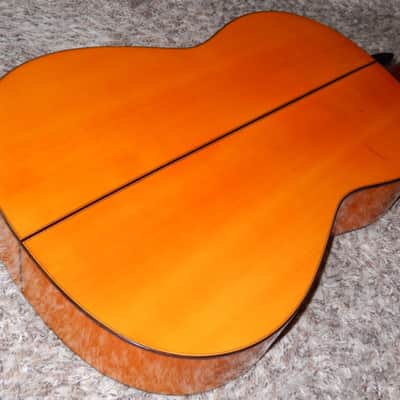
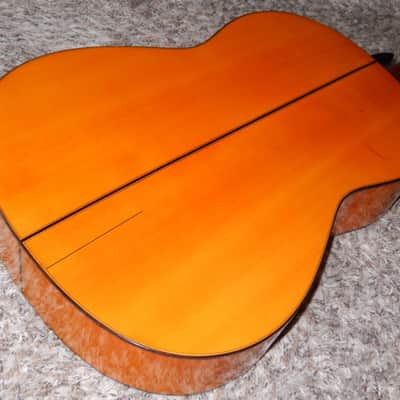
KAZUO ICHIYANAGI CUSTOM 1971 - MANUEL REYES CLASS FLAMENCO CONCERT GUITAR
Ce vendeur n'a pas défini de coût d'expédition pour la localisation France. Veuillez prendre contacter avec lui pour lui demander plus de détails sur l'expédition.


Nos utilisateurs évaluent Reverb
Kazuo Ichiyanagi Concert Flamenco 1971
As of today, Kazuo Ichiyanagi is unquestionably one of the highest regarded members of Japanese luthier’s elite.
Even though Kazuo started as independent luthier in mid 1960s, he was associated with Fernandes Co., where he was responsible for design and production of classical guitar lineup from 1969 until 1990. During that time, he was making limited number of guitars sold with his own label. Since his departure from Fernandes, Kazuo was running his own workshop being later helped by his son Kunihiko. In the early 2020’s Kazuo’s signature guitars were sold in Japan for prices between $5000 (Indian Rosewood b/s) and $15000USD (figured Brazilian Rosewood b/s). I have not seen any made later than 2022.
Guitar you are looking at was custom made in 1971 for the price of 150 000 yen, being very expensive instrument for average Japanese player of that era. It easily challenges flamenco guitars made by most famous Japanese luthiers like Masaru Kohno, Sakazo Nakade, Hiroshi Tamura or Toshihiro Kato. It also challenges flamenco guitars made during that era by leading Spanish luthiers.
This guitar absolutely deserves to be called a “Master Class Concert Guitar”. It offers great volume, super quick response combined with traditional flamenco tonality that is not too dry. Its basses are raspy, somewhat metallic but not too bright, its trebles are strong & brilliantly crisp with very high level of clarity, all notes are very well separated and enhanced by moderately long sustain.
Very importantly super straight neck and the neck/body angle on this guitar allows for very low action that doesn’t lead to terrible buzzes (at least when I play it). All these traits combined are making this guitar an exceptional choice for any player, but especially for experienced one who have tried many flamencos from “the market”.
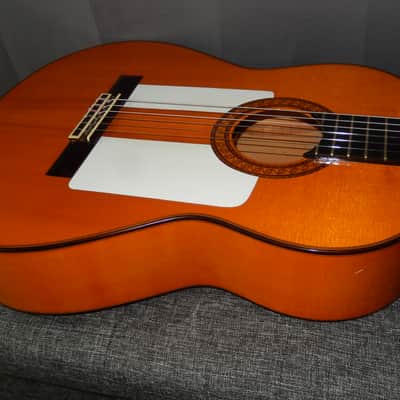
This guitar remains in “very good for its age” overall condition yet comes with a “repair history”.
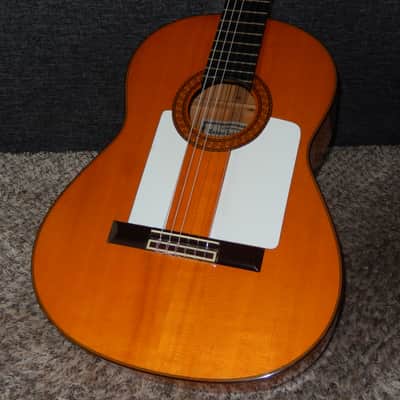
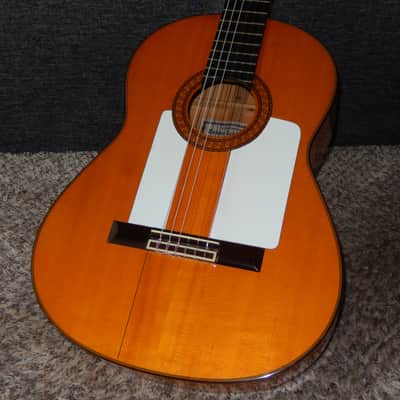
While it doesn’t have any structural flaws, its top bears multitude of light dents or scratches, with the scrape near the edge of the sound hole being most conspicuous. What is not easy that easy to notice (even with guitar in your hands) is cleanly repaired crack running from below the bridge to the bottom.
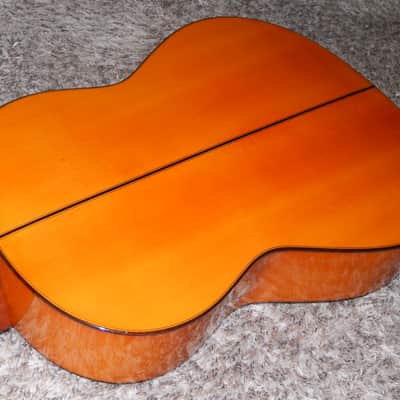
Its back and sides bear only few light scratches, with only one being “showy”. Hair-like crack on the back plate has been stabilized by glue applied form the top.
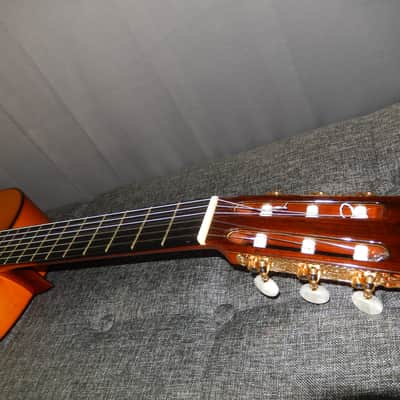
Very importantly its fingerboard and perfectly leveled frets remain in “near mint” condition, which suggests that this has been re-fretted sometimes in the past.
2 white protective tap plates are not original. They were installed (at least partially) over the original clear one (visible in the center). Most likely, after so many years of guitar’s existence, the edges of the original plate have become loose to the point that these nontransparent plates were the only logical solution.
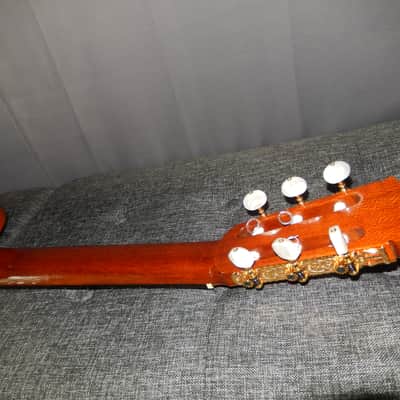
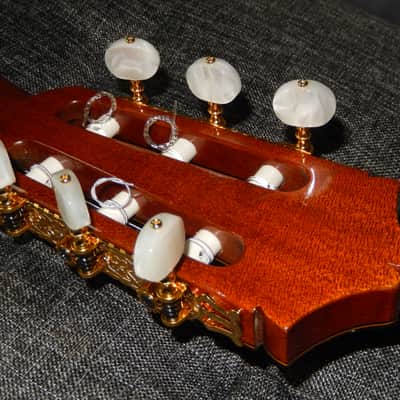
Because original tuners were damaged, I have replaced them with new Gotoh set (with 39mm peg spacing).
Specification:
Top: Solid Spruce/Shellac
Back& Sides: Solid Cypress/ Shellac
Neck: Mahogany
Fingerboard: Ebony
Nut width: 52mm
Scale: 660 mm
The action is set to 2.00 mm under E6 and 1.80 mm under E1, with practically no extra room on the saddle.
This guitar will be shipped in brand new hard-shell case.
WHEN YOU BUY ANY GUITAR, YOU MUST ANTICIPATE TAKING IT TO YOUR LOCAL GUITAR SHOP FOR FINAL ADJUSTMENTS CALLED “SETUP”. DEPENIDNG ON YOUR PLAYING TECHNIQUE, THIS SETUP ON USED GUITARS MAY INCLUDE NEW CUSTOM-MADE NUT AND SADDLE. IF YOU HEAR STRING BUZZ IT DOESN’T MEAN THAT GUITAR IS DEFECTIVE. IF YOU PLAY HARD ENOUGH ALL BASS STRINGS WILL BUZZ OVER THE FRETS, UNLESS THEY ARE SUSPENDED VERY FAR FROM THE FINGERBOARD. UNLESS YOU PLAY QUITE GENTLY, YOU CAN’T HAVE LOW ACTION AND NO BUZZES. KEEP IN MIND THAT CELLO-LIKE BASSES ON HIGH GRADE CLASSICAL GUITARS HAVE THEIR NATURAL “BUZZ”.
Real Value of Japanese Vintage Guitars
The key to understand value of vintage Japanese guitars is to acknowledge galloping price inflation throughout the late 1960s and 1970s with its peak of 25% in 1974.
During 1960s and most of 1970s model numbers of Japanese guitars were strictly connected with their prices in Japanese yen.
The same class guitar sold in 1970 for 100 000 yen (labelled as model 10), would be sold for 150 000 yen in 1972 (labelled as model 15), 200 000 yen in 1974 (labelled as model 20) and 300 000 yen in 1978 (labelled as model 30). Therefore, you shouldn’t be surprised that two Yamaha GC10 guitars made 10 years apart are two instruments of totally different class. The same rule applies to all guitar models made by all other Japanese makers.
Japanese inflation slowed down in the 1980s. By the early 1980s and during following decades model numbers were no longer strictly associated with their prices. Some Japanese guitar makers introduced model names instead of model numbers. For several economic reasons, since 1980s Japanese made guitars were becoming more expensive, while their exports slowing down. Today (2025) Japanese high end classical guitar models are priced at $20000USD level.
| Mis en ligne | il y a 7 mois |
|---|---|
| État | Très bon (occasion) Le matériel en état « Très Bon » fonctionne bien mais a quelques dommages cosmétiques.En savoir plus |
| Marque |
|
| Modèle |
|
| Finaliser |
|
| Catégories | |
| Année |
|
| Fabrication |
|
| Forme du corps |
|
Des informations concernant la sécurité des produits peuvent être disponibles ici.

