Ludwig "Pro-Beat" (1976) Complete




Ludwig "Pro-Beat" (1976) Complete
Il venditore non ha impostato il costo di spedizione per Italia. Per favore contatta e chiedigli il costo della spedizione.

I nostri utenti valutano Reverb
This pristine, ‘complete’, all original ‘survivor’ is a 4-Piece 1976 Ludwig ‘Pro-Beat’ (24X14, 16X16, 14X10, 13X9, 15X5 Ludwig 'super-sensitive' snare) that apparently received annual product ‘up-grades’ to refresh it through its first few years of life in order to keep it production and catalogue 'correspondingly' correct as it served as as a static retail-display and promotional tool mounted on a platform behind the counter in a small music store. It was never moved, let alone gigged or played! In fact, it was never sold, and is therefore technically NOS.
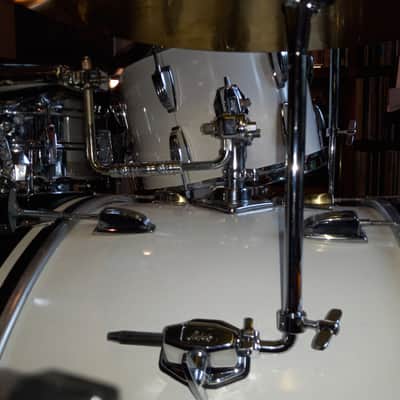
I bought it from a 'middleman' (a brand rep who told me about it and brokered a deal with the daughter of the deceased owner who had placed it in storage when their shop closed). It is therefore in mint-condition (meaning that it is better shape that any vintage kit should be), with ‘virtually’ no visible (or invisible) mechanically caused signs of wear or ‘damage’, and, what slight patina of weathering there is, is markedly less evident than you might ever expect of a set of this age.
The other significant advantage this kit enjoys as a result of being ‘vintage’ is the inclusion of the extremely strong, but otherwise light-weight and elegantly structured Atlas ‘tubular’ steel stands, which were discontinued shortly after introduction due to the high manufacturing cost, only to be resurrected just a few years later, as an ‘extra cost’ option and deluxe upgrade known as the ‘Hercules’ series). Initially Ludwig returned to the conventional flat-iron style stands in general use at the time by all manufacturers before ultimately being replaced by the heavy, dual-braced designs that took over a decade later.
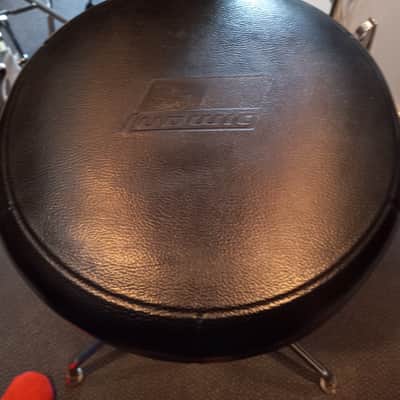
Note: All the cymbal stands, the throne, and hi-hat sport the ‘cool’ original metal feet that were introduced to prevent stage ‘hop’, a problem thought to come of the tendency for the more popular spongy rubber feet to bounce (which turned out to be a geometry problem not a materials one), but the metal feet do 'slide' if you don’t use a proper drum mat. No worries…this kit also comes with a bag-full of the Ludwig rubber replacement feet that Ludwig apparently ‘gave’ (imagine someone ‘giving’ something away) to purchasers ‘free for the asking’ around this time, when Ludwig, as a company, stopped innovating and started following, slowly transitioning to them (they are now discontinued and very expensive to acquire ‘vintage’).
I am including as a bonus (if you wish the additional shipping charge their weight will incur), and at no extra cost, a full-set (14” hats, 14”, 16” and 18” crash, an 8” shell-mounted splash and a 20” shell-mounted ride) of very serviceable first-generation Meinl pure ‘brass’ cymbals that are perfect for practice rooms and small venues: light and crisp with a rapid decay so you won’t washout acoustic instrument or develop practice room deafness.
Contact me if you have any questions.
Note: Included is an original polished steel Ludwig 'GoldTone' cowbell with custom shell rack-mount (as opposed to rim-mount) holder, a Ludwig 'rim-mount' cowbell holder, both the Ludwig wood and felt bass-drum beaters, a Ludwig stand-mount tom-tom hanger, a second vintage matching snare stand for duty as a tom-stand, and a host of other bonus Ludwig goodies.
Shipping Note: Flat rate shipping of $200 to the contiguous US. Expertly packed in two boxes.
[Preemptive Note: There is no 18” floor tom. I asked too when I purchased it, but apparently It was sold for $50 (!!!!) by the original retailer just shortly after taking delivery because there was no room for it on the display platform it was destined for. Be advised that today, an individual, matching, 70’s vintage, 18”, 3-ply floor-tom can still be found online, but…it will cost between $800 and $1000 if you insist that the shell match this kit’s condition.]
Provenance/Ludwig: The Early Years:
This particular kit wasn’t actually ‘found’ for having been forgotten in a barn as the folksy trope goes, but...it 'was' spared the indignity and ravages of time and abuse just the same for apparently spending its entire life ‘at elevation’, on a platform, as a static ‘Ludwig Brand’ display/feature, on a wall, behind a retail counter in a small family-owned music store (that ironically didn’t really sell drums). There too put, the staff came to forget over time that it was ‘actually’ stock to be sold, and so they failed to sell what grew, overtime, to become just part of the store’s decor as it were a 'big-game' trophy mounted on the wall, and part of the stores ‘implied’ musical theme.
And so it languished, waiting for me to eventually acquire it, when it came to pass that covid would finally strangulate the shops profitability. I had learned of the kit from a sales rep who very kindly passed on my name and number as being a 'motivated' purchaser, but years passed and nothing came of it. Years later, when the store owner passed away, the daughter (who has also since passed) finally reached out to me through the sales rep, and I bought the kit sight unseen, which had been boxed and stored at the time of the shop’s closing.
Recent Provenance:
Since my acquiring it, it has sat sulking (all the while looking ‘great’ mind you), lamenting my failure to renew my association with playing due to my concurrent development of the neurological condition known clinically as...‘exploding head syndrome’ (a form of auditory hallucination associated with sleep disorders, which may share ‘cause’ with the focal-dystonia that ended my professional career). That former condition, now thankfully being arrested, resolved, or at least dormant (even though the dystonia, for which there is no cure, persists) is not something I wish to revisit. Anyway, the short of it is that I was apparently ‘ill-advised’ and disinclined to re-expose myself to the renewed association with the sharp transient shock come of striking acoustic drums in my retirement. Whatever the cause and effect, when I stopped playing drums, my head soon stopped exploding! LOL!
Particular To This Kit:
Due to this kit being sighted ‘out of reach’ of the retail public during its adolescence and formative years, it has seen virtually zero ‘service’ despite its already long life. It served as little more than an ornament that, while never distinguishing itself in performance, has therefore suffered no personal attacks in the name of music. [Note: the new Remo 'Suede' heads I put on are still new, because they were only finger tightened at the time of purchase to avoid stretching them as they sat. FURTHER...they were protected from what little ‘exploration’ of service I dared to venture’ by application of the same 'dots' that Ludwig's applies to both is current silver and prior black dot heads. [Note: I acquired a dozen or so more new ‘dots’ that I will include with the kit.] This kit would have originally shipped with silver-dot heads (which by the way are newly available again from Ludwig) but I prefer the look and wear resistance of the black dots, because the sheen of the silver-dots scar almost immediately.
As far a mechanical wear goes, there are only 2 small mark on the shells: 1.) is a small rub mark at 1 o’clock on the top of the bass drum (see picture attached), where it seems to have happened that the lower rim of the larger 14” rack-tom had come over time to settle on it such that micro-vibrations were transmitted ‘from’ the wall the kit’s platform was 'hung' on (which backed a frequently used and springy stockroom stairway), and over which time a slight rub mark marred the surface of the wrap; but…at least with the tough ‘cortex’ (melamine) wrap, the solid color goes all the way through so its not so ‘obviously’ scarred, as would be the case with the ‘fancy’ patterned wraps. And 2.) there is a barely visible mark on the 14” rack-tom (see picture attached).
Because this display kit was out of the reach of customers no one could touch it, let alone play it, so too then its ‘joints’, fasteners, bolts and threads, never had to suffer mechanical use, abuse, or wear, nor the greater cumulative stress come of being gigged, toured, packed, moved, disassembled, reassembled, taken-down, set-up, or rough-housed in a trap case. As it was relayed to me, the only indignity of contact with humans it suffered was, as the store proprietor was said to have often joked, ‘a dusting once every 10 years, whether it needed it or not’. LOL! What little patina the hardware and cymbal-stands sport is come of the mild environmental agents and agencies that people in ‘dry’ mid-western climates enjoy in process of living and breathing.
The original, and relatively rare, ‘white’ cortex (popular with touring acts because, in addition to being the only color you don’t tire of, the color white best reflects ‘colored’ stage lights), Ludwig’s proprietary name for melamine, still looks new, showing no sign of yellowing for having ‘never’ been exposed to natural sunlight. Further, the wrap shows only the beginning of ‘lift’ at a single seam on the floor-tom. [Note: The seams of the cortex wrapped drums are always a little more visible because the material itself is that much thicker than the patterned vinyl wraps. On the plus side, commercial cortex/melamine was available in longer lengths, so the bass drum has only one seam instead of two, as is the case with patterned wraps.]
The tubular chrome ‘Atlas’ hardware shows very little sign of oxidation. Only one leg on ‘one’ of the cymbal-stands, and a leg on one of the 2 snare-stands (the 2nd is intended as a tom stand), and a leg on the throne, has weathering of the type to possibly suggest at the kits actual age of 50. The rep said that these three isolated legs were those most proximate to the increased humidity spewed forth by the electric kettle on the counter several feet beneath it, which saw decades of service boiling water to support the owner's ‘tea addiction’.
General Ludwig Information:
For those of you who don’t know about Ludwig sets of this vintage, this 70’s ‘survivor’ differs most notably from modern drums for its use of 3-ply maple construction (as opposed to 6 or more today) supplement by reinforcement ‘tone-rings’ at the bearing edge, in this case…it is finished internally with beautiful clear lacquer (some were finished internally with strange and visually-unappealing coatings that were meant to ‘seal’ the wood that Ludwig called ‘Granitone’ that looked like...weathered whitewash). So, in addition to being rich and resonant, and looking beautiful when clear heads are used, these shells (and for that matter…all the tubular stands) are only a fraction of the transport weight of modern ‘over-built’ shells and double-braced gear!
It is perhaps significant that Ludwig, along with several other manufacturers, has recently returned to this lighter shell design for its flagship ‘Legacy’ Maple line (others are following suit), BUT…it turns out that despite using 'less' material, they are ‘more’ expensive at almost $6000 US for a 4-piece ‘Legacy Maple’ shell-pack in ‘these’ sizes, to which you must of course add whatever period correct gear, stands, cymbals, throne (not to mention a quality snare drum), bringing the cost of a comparable but ultimately ‘imitation’ all-vintage pretender kit to $8K+, cymbals and taxes, and that's at a minimum!
The other significant advantage this kit enjoys as a result of being ‘vintage’ is the inclusion of the extremely strong, but otherwise light-weight and elegantly structured Atlas ‘tubular’ steel stands, which ironically were discontinued shortly after introduction due to the high manufacturing cost, only to be resurrected and made available just a few years later at ‘extra cost’, as a deluxe upgrade known as...the ‘Hercules’ series. Prior to the release of the Hercules series, Ludwig returned to the conventional flat-iron (non-reinforced) style stands in general use at the time by every other manufacturer (except Prmier), ultimately moving to the heavy, dual-braced designs that took over a decade later, and have persisted to this day at the expense of everybody’s back.
Note: All the cymbal stands, the throne, and the hi-hat sport the ‘cool’ original metal feet at the end of their tubular steel legs. They were introduced in attempt to prevent stage ‘hop’, a problem, they thought was come of the tendency for the newer style spongy rubber feet to bounce, which actually turned out to be a geometry problem not a materials one. These metal feet can be induced to slide on a wood stage if you don’t use a rubber drum mat, but no worries…this kit also comes with a bag-full of dozens of 70’s vintage OEM Ludwig rubber replacement feet, which Ludwig apparently ‘gave’ (imagine someone ‘giving’ something away) to purchasers who wanted them, ‘free for the asking’. Soon after, Ludwig, as a company, like so many other American manufacturers, stopped 'innovating' and started following Japanese trends, slowly transitioning to them. These feet are no long available new from Ludwig but are available for $20+/each ‘vintage’.
Because of the ‘extra’ tom that came with the Pro-Beat, you can easily re-configure this kit from a more conventional dual tom set-up, to a…‘Bonzo’ Bonham single tom ‘rock’ spec set using the extra snare-stand to replicate Bonham's ‘tom-free' bass drum shell (though Bonham would eventually move to 26” bass-drums). Or, you can use the single shell-mount in Buddy Rich configuration: this ‘display’ set was fitted with Ludwig’s hardware extras at the time of ordering (apparently when Ludwig was quite happy to supply whatever you ordered).
This bass-drum shell has the 2 shell-mounted cymbal arms meant to carry the 8” splash and 20” ride configuration that Buddy insisted on, thereby reducing the 2 of independent cymbal stand required and further reducing the kits footprint. Aesthetically, because of the strength of the Atlas ‘tubular’ stands (which allowed for stability even while set to a narrower base) this set-up uses 2 fewer stands, allowing for a narrower overall footprint for inviting the use of all elegant ‘straight’ cymbal stands, without the need of booms, making for more compact ergonomics and a more attractive setup with less clutter.
In addition to looking very cool, this setup can now be easily contained in less than a 4’ X 6’ perimeter platform/mat (as seen in the pictures) with room to spare, and that includes the throne too! From a playing perspective this compact kit allows for better flow and reach, AND…as a bonus, due to the flatter cymbal rake, the audience can actually ‘see’ you (rather than ‘imagine’ you) and you them ‘through’ the now ‘knife’ thin flat-set cymbal profile (which is the real reason Buddy did it), connecting you, for the first time, to both the band and the room. Congratulations! You’re a frontman now!
Possibly the most desirable feature on this kit is that it has not 1, but 2-sets (4 spurs) of factory-mounted, ‘tandem’ 3/8” bass-drum spurs (which wouldn’t become common or catalogue for a few years to come when they also changed over to 1/2” spurs on the 26” bass-drum). These would not become a catalogue item until the 80’s, but Ludwig would do it at this time for dealers, friends and family who requested it. On the matter of bass-drums, the mechanically quiet (yes) and quick, direct action Ludwig Speed-King Bass drum pedal comes with both original wood and felt beaters.
Note: At some point in the early 80’s, apparently to better keep this static ‘retail' display ‘catalogue’ current, all the t-handles on the cymbal stands were replaced with what must have been a 'used' or salvaged set of ‘plastic’ (only the grip portion is plastic for greater comfort) ‘rachet’ handles (as Ludwig then called them), which are long since discontinued and therefore also expensive and much sought after as replacement parts! The handles themselves ‘do’ show signs of having seen ‘service’ that is not shared by the stands themselves, but being 'black'...only upon close inspection. Further Note: It is a myth that the plastic-‘gripped’ handles break. I have never seen one broken in service (though their plastic covering may be caused to crack when impacting metal components in a poorly packed in a trap case). BUT…be forewarned, because of the comfort they afford the hand, they do ‘invite’ you to ‘over’ tighten them, thereby stripping the ‘metal’ threads (none of these are stripped). I will include the extras I have.
Know that the 'generic' Ludwig “LWG’ bass-drum banner (as opposed to the 'big-band' personalized vanity initial) that was originally applied to the front of the bass-drum head as a feature on the factory display, is new; the original logo was yellowed and peeling, likely due to the heat and humidity come from that same pesky electric kettle that teased the hardware to its patina. If you like, you could simply peel off the Ludwig initials and replace them with your own (as was the style ‘in the day’). Or, you could peel it off completely to use the second 'smaller' banner I purchased at the same time, OR...you could apply one of the various size 70’s font Ludwig bass-drum labels I have and will include at no extra cost.
Questo articolo è venduto "Come da descrizione”
Questo articolo è venduto "Come da descrizione" e non può essere restituito a meno che non arrivi in condizioni diverse da come è stato descritto o fotografato. Gli articoli devono essere restituiti nelle condizioni originali in cui sono stati spediti, con tutti gli imballi originali.Scopri di più.
| Pubblicato | un anno fa |
|---|---|
| Condizione | Eccellente (Usato) Gli articoli "Eccellenti" sono quasi completamente privi di difetti e altri difetti visivi e sono stati suonati o utilizzati con la massima cura.Scopri di più |
| Marchio | |
| Modello |
|
| Finish |
|
| Categorie | |
| Anno |
|
| Prodotto in |
|
Le informazioni sulla sicurezza del prodotto sono disponibili qui.


Protezione di Reverb
Resi semplici, transazioni sicure, assistenza di persone in carne e ossa
Scopri di più