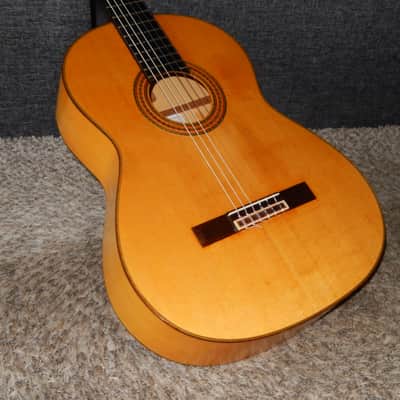
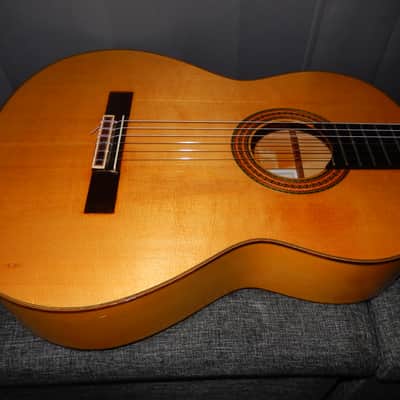
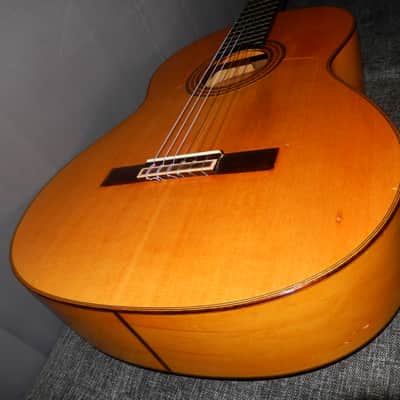
BARGAIN - YAMAHA GC10F 1968 - WORLD HIGHEST CLASS FLAMENCO CONCERT GUITAR
This seller has not set a shipping cost for France. Please contact them to ask about shipping.


Our users rate Reverb
YOU ARE LOOKING AT A WORLD CLASS INSTRUMENT PRICED AT THE BARGAIN LEVEL. CURRENTLY JAPANESE MADE BRAND NEW GUITARS OF THIS CLASS ARE PRICED MINIMUM $8000USD.
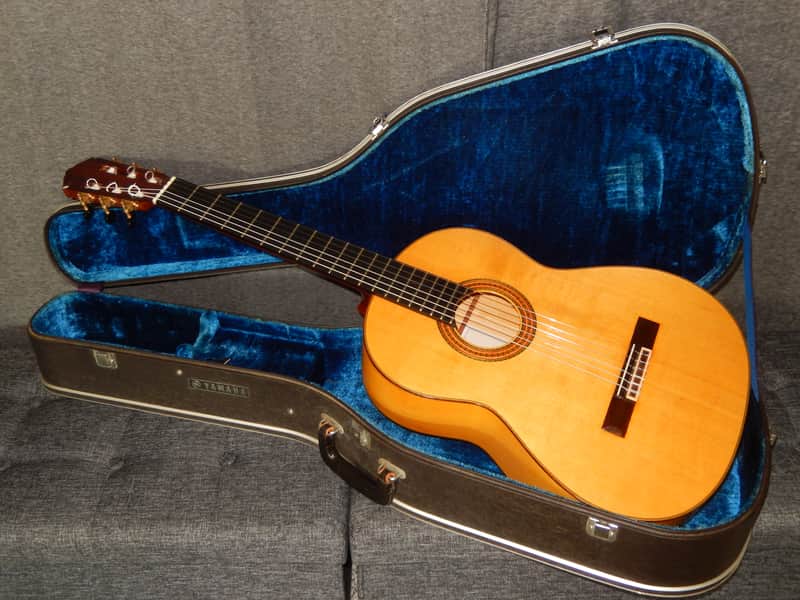
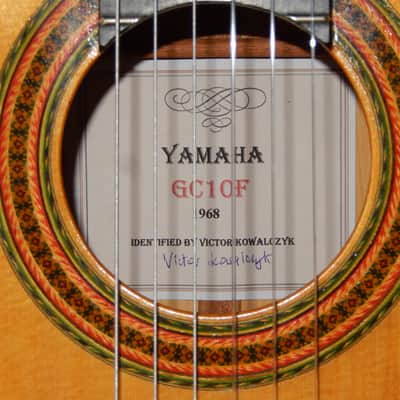
Yamaha GC10F 1968
For the lack of original label, I have installed my own label as “certificate of authenticity”. My identification was based on the statement from the person I bought this guitar from, my own expertise based on 11 years of extensive research and hands on experience with over 1000 Japanese made classical and flamenco guitars, including several Yamahas GCF and FC models.
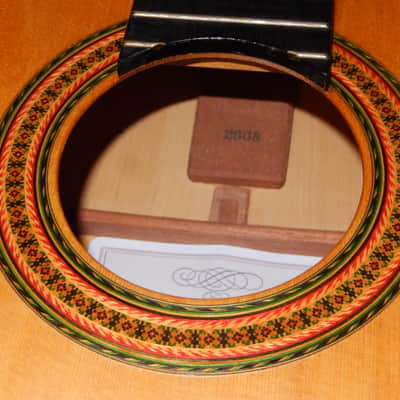
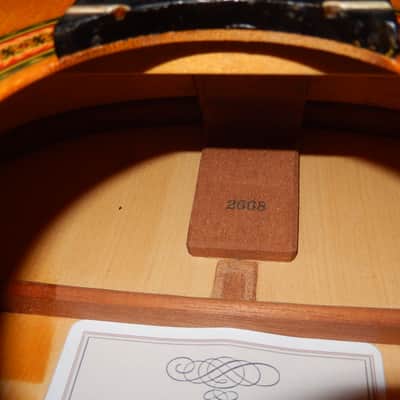
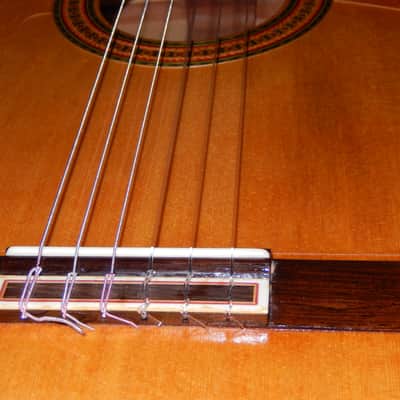
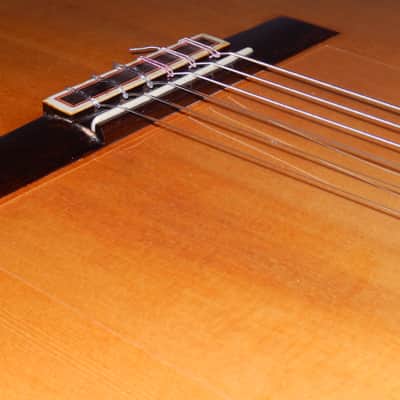
All these early Yamahas GCF models were made by Toshihiro Kato, while he wasn’t signing their labels until 1971. While flamenco models had their own serial numbers on the labels, their Spanish heels were numbered in the same system as they were numbered on classical guitars. Number 2668 points to year 1968. The original bridge decoration was changed in 1970 from 1 red line to 3 red lines running along the perimeter of tie block cap. While model GC5 and GC7F had French polished tops, only model GC10F had French polished back and sides.
This Yamaha guitar was made in 1968 by Toshihiro Kato, the best luthier Yamaha Corporation ever had. He was one of the best luthiers Japan ever had. If Kato had his own workshop, he could easily outcompete Masaru Kohno or Sakazo Nakade (top elite Japanese luthiers of that era). Thanks to his incredible talents Yamaha's Grand Concert guitars were so highly prized by many international players that Yamaha Co. could price them at the same level as Kohno was pricing his instruments. In fact, Yamaha guitars were often of much higher grade than similarly priced Kohno models.
The guitar you are looking at was one of the “original” Yamaha Grand Concert flamenco models released in 1968 under Eduardo Ferrer’s supervision. These models were GC5F, GC7F and GC10F (all with solid Spruce tops and solid Cypress b/s). Back then these guitars were totally underpriced if compared with guitars made by most prominent Japanese luthiers of that era (Sakazo Nakade, Masaru Kohno, Mitsuru and Hiroshi Tamura, and few others).
In 1968, Yamaha bosses, being fully aware of these prices and true value of their own guitars, had a very simple plan: attract potential buyers with lower prices and ASAP correct these prices. In just a couple of years Yamaha GCF guitars were highly regarded by players around the world. Even though in most cases Japanese model numbers were correlated with their prices in Japanese yen, there have been exceptions to these rules. While Yamaha classical guitar lineup was changed in 1971 and in 1974, flamenco models lineup remained unchanged until 1977, but their prices were upgraded each year. That was in times when Japanese annual inflation was at 20% level and peaked in 1974 to 25%.
While originally priced 50000 yen in 1968, by 1970 Yamaha GC5F was priced 70000 yen, Yamaha GC7F 90 000 yen, and Yamaha GC10F 120000 yen. By 1972 these prices were again 20% higher. By 1977 model GC10F was priced 200 000 yen and in 1978 was replaced by model FC20. For the same price one could buy Yamaha GC20M or Masaru Kohno 20 classical guitars (both made with solid figured Brazilian Rosewood b/s)
I hope that you are now getting closer to the real value of this Yamaha G10F guitar.
This truly magnificent guitar offers exceptional volume and response combined with a very traditional flamenco yet also quite romantic tonality. Its trebles are round, crisp yet also sweet. Basses are deep and raspy, yet quite clean. All notes are well balanced, with a high level of clarity and separation fantastic. The sustain is moderately long. With its current action this guitar is a joy to play.
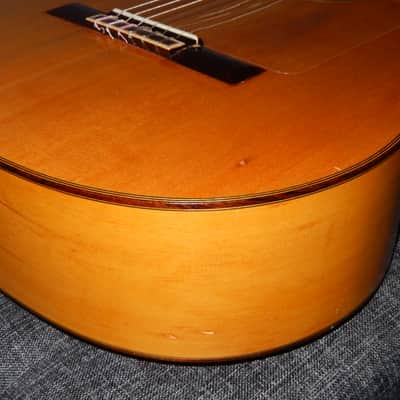
This guitar remains in at least “very good for its age” overall condition yet comes with several imperfections.
Its top bears a couple of small dents, a few light scratches and multitude of light fingernail marks in the area below E1 string that combined create a darker patch in that area yet none of them is deep. These fingernail marks are a result of playing without tap plate that must have detached itself some years earlier. I have installed brand new tap plate, and it all looks pretty good.
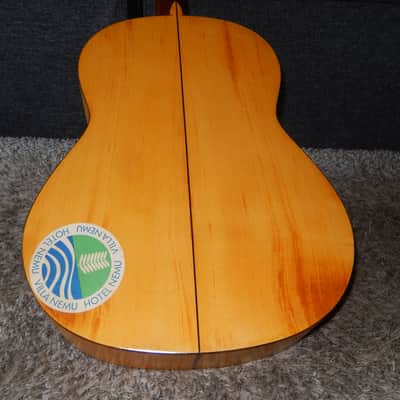
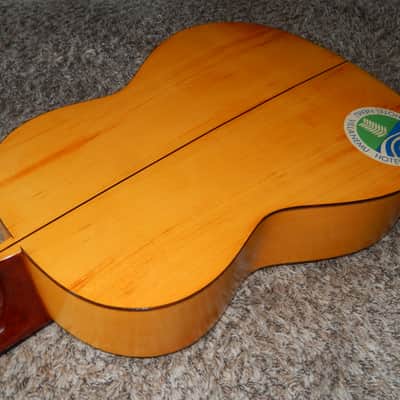
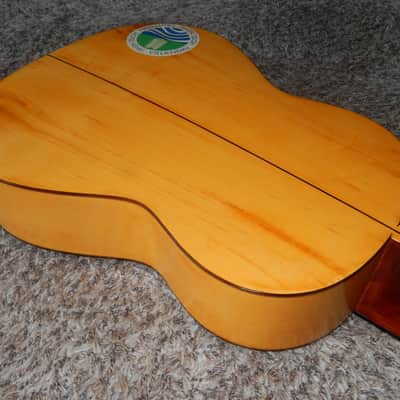
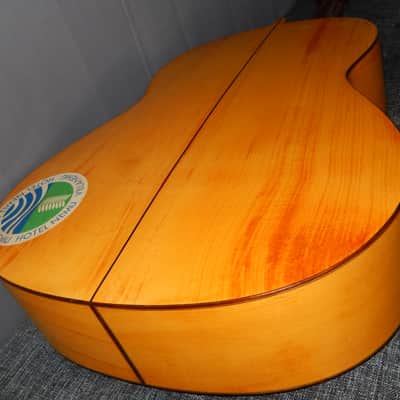
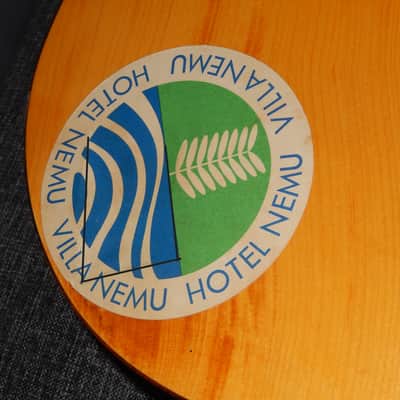
There are few dents on the side plates, while the back looks quite clean, except for that round sticker which covers a damage about which previous owner “forgot” to tell me. Under that sticker there is a small section of wood with cracks along its 3 edges and slightly pushed down towards the inside of the body. Yet it is not completely detached and feels quite stable. At first thought I was planning to remove this sticker yet decided not to do it, because I don’t have the tools to repair such damage in that area. I also know that such repair wouldn’t lead to any better sound or playability, while leaving it not repaired doesn’t pose any real threat to the longevity of this guitar. Only another punch in that spot could lead to more serious damage. So, I left the sticker and outlined these cracked edges in one of my pictures. I haven’t found any other damage outside nor inside the body.
Another minor imperfection is that the binding running on both sides of the fingerboard is not perfectly flush with the back of the neck. I don’t have an easy explanation for that, yet it really doesn’t lead to any discomfort while playing the guitar.
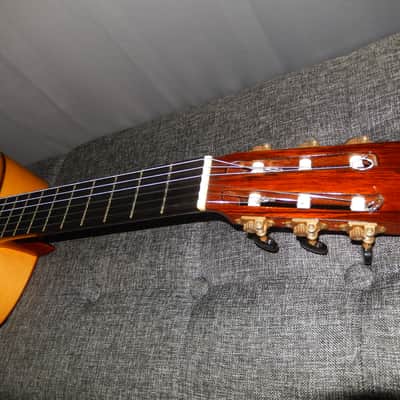
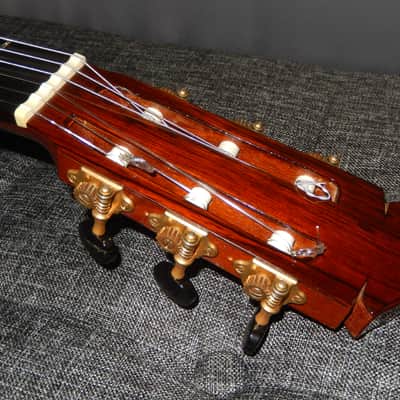
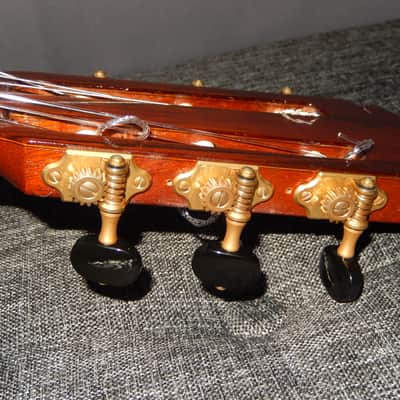
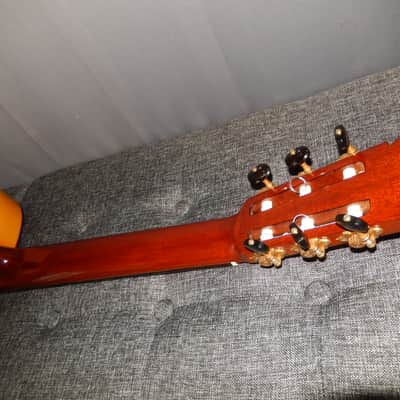
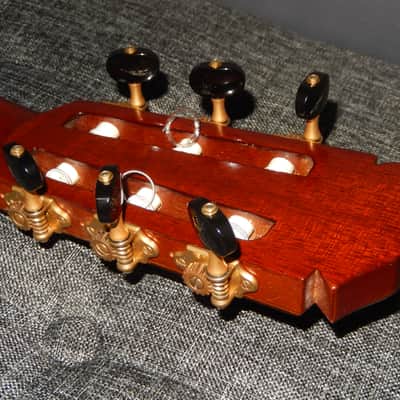
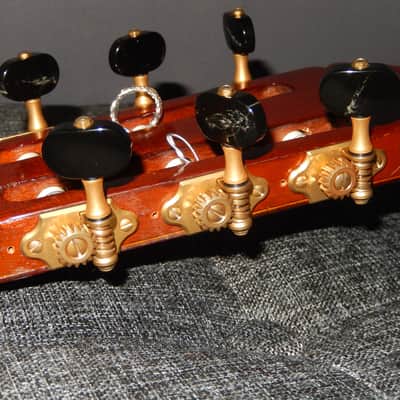
The original tuners were damaged and needed to be replaced. After removing them I saw few extra holes drilled underneath. I realized that someone was trying to install different tuners yet abandoned the project. The reason for that was that these original tuners were made with roller pegs spacing of 40mm, hence can’t be replaced by available on the market tuners with 39mm spacing. So, the solution was to install 6 single tuning keys instead. I have installed high quality Gotoh tuning keys with gear ratio 1:18 and they work very smoothly.
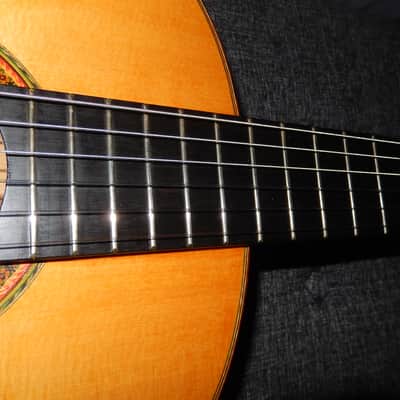
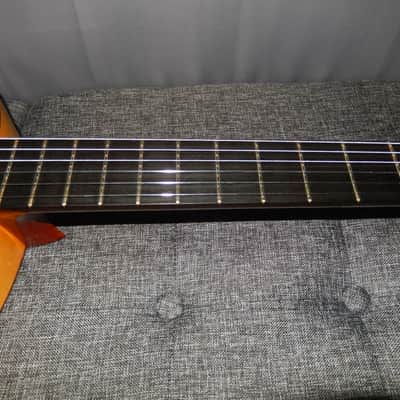
Very importantly the neck of this guitar neck is super straight, while fingerboard and levelled frets remain in very good condition.
It this guitar survived in “all perfect” condition I would have priced it $4500 knowing that it can easily outcompete many much higher priced instruments made by famous Spanish luthiers.
SPECIFICATIONS:
Top: Solid Yezo Spruce/7 braces fan/shellac
Back & sides: Solid Cypress/shellac
Neck: Honduras Mahogany
Fingerboard: Ebony
String Length: 662mm
Nut width: 52 mm
Action is set to 3.00 mm under E6 and 2.50 mm under E1 with about 1.50mm of extra room on the saddle.
The guitar will be shipped in a used Yamaha hard shell case.
THE ONLY PURPOSE OF THIS CASE IS TO PROTECT THE GUITAR DURING SHIPMENT. I WILL NOT PROVIDE ITS DETAILED DESCRIPTION OR MAKE ADDITIONAL PICTURES, NOR I WILL ACCEPT ANY COMPLAINTS. IF YOU DON’T LIKE THIS CASE YOU WILL NEED TO BUY A DIFFERENT ONE.
WHEN YOU BUY ANY GUITAR, YOU MUST ANTICIPATE TAKING IT TO YOUR LOCAL GUITAR SHOP FOR FINAL ADJUSTMENTS CALLED “SETUP”. DEPENIDNG ON YOUR PLAYING TECHNIQUE, THIS SETUP ON USED GUITARS MAY INCLUDE NEW CUSTOM-MADE NUT AND SADDLE. IF YOU HEAR STRING BUZZ IT DOESN’T MEAN THAT GUITAR IS DEFECTIVE. IF YOU PLAY HARD ENOUGH ALL BASS STRINGS WILL BUZZ OVER THE FRETS, UNLESS THEY ARE SUSPENDED VERY FAR FROM THE FINGERBOARD. UNLESS YOU PLAY QUITE GENTLY, YOU CAN’T HAVE LOW ACTION AND NO BUZZES. KEEP IN MIND THAT CELLO-LIKE BASSES ON HIGH GRADE CLASSICAL GUITARS HAVE THEIR NATURAL “BUZZ”.
History of modern era Yamaha Guitars.
During late1960s/early 1970s Japanese guitar makers were still trying hard to win as many international customers as possible. These were the years of significant international recognition of their, soon very highly regarded products. Yamaha was unquestioned leader among Japanese guitar exporters. Their guitars offered the highest possible level of craftsmanship with great deal of attention to even the tiniest details.
Yamaha started their fight for international clients in 1967 with new lineup of classical Grand Concert guitars made according to Spanish blueprints. They were: GC3 (solid Spruce top/ solid Indian Rosewood b/s) GC5, GC7 and GC10 (all 3 models with solid Spruce tops and solid Brazilian Rosewood b/s).
In 1968 Yamaha also introduced their lineup of great Grand Concert flamenco guitars. They were GC5F, GC7F and GC10F. The master luthier responsible for the production of these guitars was Toshihiro Kato. He was helped by Hiroshi Harada, who was making classical models GC3 and GC5. Both these luthiers were trained by Eduardo Ferrer, a Spanish luthier from Granada, Spain who being invited (and appropriately rewarded) by Yamaha co., travelled to Japan during years 1964-1967.
It is very important to explain that 1960s and 1970s were years of very rapid devaluation of Japanese yen (hence rapid inflation of prices for all products). Because during those years practically all guitar models had some numbers closely related to their prices in yen, these models were quite frequently upgraded (relabeled) to higher numbers reflecting their higher prices.
For that reason, mentioned above Yamaha’s classical GC guitars lineup, was changed in 1971. New (1971-1973) lineup included models GC3D, GC6D, GC8D, GC10D (all 4 models made with solid Spruce tops & solid Indian Rosewood b/s) GC12D, GC15D and GC20D (all 3 models with solid Spruce tops & solid Brazilian Rosewood b/s). It is worth mentioning that until 1974 all Yamaha classical GC models were made exclusively with Spruce tops.
In 1974 Yamaha’s classical GC guitar lineup was changed yet again. In that year, for the first time in its history, Yamaha decided to make classical guitars with cedar tops. This newly introduced GC classical guitar lineup included models: GC5M(S), GC7M(S), GC10M(S), GC15M(S), (all with Indian Rosewood b/s), GC20M(S), GC30A, GC30B (all with Brazilian Rosewood b/s). M=spruce. S=cedar, A=spruce, B=cedar
Yamaha GC10M was priced 100 000 yen in 1974, when starting yearly salary of Japanese college graduate was around 75 000 yen. Masaru Kohno 10 was priced the same 100 000 yen. Yamaha Co. didn't compete with Kohno by lowering prices of their guitars. Yamaha GC guitars simply offered more for the same price. You will never find Kohno 10 from that era that would sound even close to this Yamaha GC10M.
In 1974 Kohno top models were 15, 20 and 30 (all with Brazilian Rosewood b/s). Model 30 was priced 300 000 yen just like Yamaha GC30A(B). In 1977 Kohno changed his lineup adding models 40 and 50 (both with improved looks but sounding no different than his earlier model 30) and changing specifications of model 15 from Brazilian Rosewood b/s to Indian Rosewood b/s. Yamaha's kept their lineup unchanged until 1979. To keep their prices at the same level, Yamaha GC guitars made in 1979 were made with somewhat lower grade woods, different finishes and less impressive ornamental extras if compared with those made in 1974. Production of GCM and GCS models ended by the end of 1979. Between years 1980-1985, Yamaha's lineup was changed at least a few times.
In 1985 top models made at Yamaha's Hamamatsu workshop were GC70& GC60 (both with the same specifications as GC30A from 1979), GC40 (with the same specifications as GC20M from 1979).
Correct evaluation of a real grade of vintage Yamaha guitars can't be done just by looking at their model numbers. Yamaha GC10 from 1980 is simply no match to GC10M from 1975. Yamaha GC10D from 1973 is of equal grade with GC15M from 1975. Yamaha GC10 from 1970 is of equal grade with Yamaha GC20D from 1973 and GC40 from 1985.
Real Value of Japanese Vintage Guitars
The key to understand value of vintage Japanese guitars is to acknowledge galloping price inflation throughout the late 1960s and 1970s with its peak of 25% in 1974.
During 1960s and most of 1970s model numbers of Japanese guitars were strictly connected with their prices in Japanese yen.
The same class guitar sold in 1970 for 100 000 yen (labelled as model 10), would be sold for 150 000 yen in 1972 (labelled as model 15), 200 000 yen in 1974 (labelled as model 20) and 300 000 yen in 1978 (labelled as model 30). Therefore, you shouldn’t be surprised that two Yamaha GC10 guitars made 10 years apart are two instruments of totally different class. The same rule applies to all guitar models made by all other Japanese makers.
Japanese inflation slowed down in the 1980s. By the early 1980s and during following decades model numbers were no longer strictly associated with their prices. Some Japanese guitar makers introduced model names instead of model numbers. For several economic reasons, since 1980s Japanese made guitars were becoming more and more expensive, while their exports slowing down. Today (2025) Japanese high end classical guitar models are priced at $20000USD level.
This item is sold As-Described
This item is sold As-Described and cannot be returned unless it arrives in a condition different from how it was described or photographed. Items must be returned in original, as-shipped condition with all original packaging.Learn More.
| Listed | 3 years ago |
|---|---|
| Condition | Very Good (Used) Very Good items may show a few slight marks or scratches but are fully functional and in overall great shape.Learn more |
| Brand | |
| Model |
|
| Finish |
|
| Categories | |
| Year |
|
| Made In |
|
| Body Shape |
|
Product safety information may be available here.

