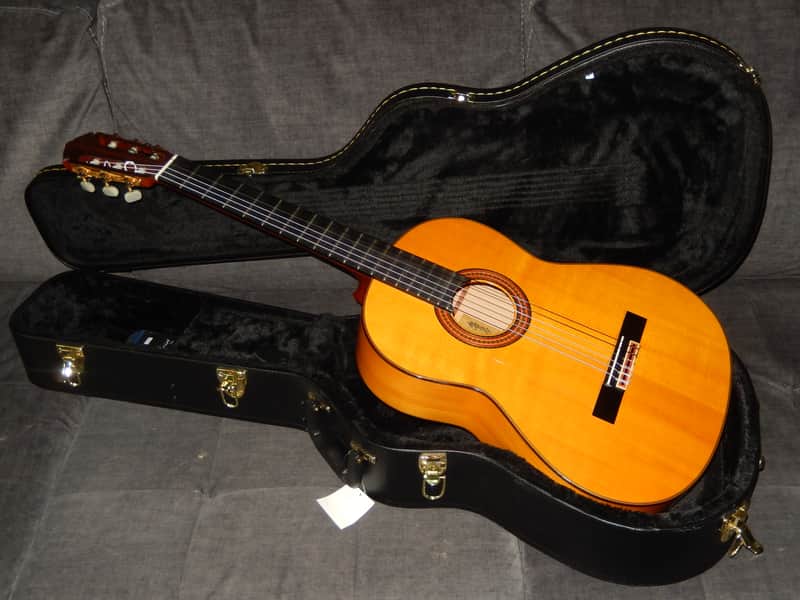
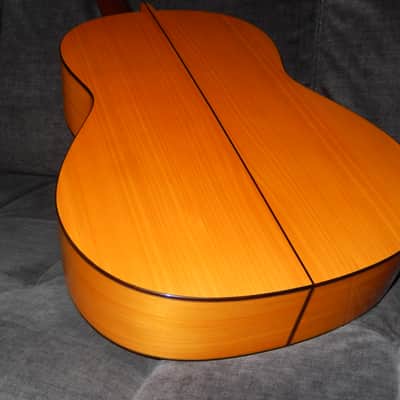
HER MAJESTY YAMAHA GC10F 1971 - TOSHIHIRO KATO'S FINEST FLAMENCO CONCERT GUITAR
This listing has ended
See similar gear from other Reverb sellers
Yamaha GRAND CONCERT GC10F 1971
This Yamaha guitar was made in 1971 by Toshihiro Kato, the best luthier Yamaha Corporation ever had. He was one of the best luthiers Japan ever had. If Kato had his own workshop, he could easily outcompete Masaru Kohno or Sakazo Nakade (top elite Japanese luthiers of that era). Thanks to his incredible talents Yamaha's Grand Concert guitars were so highly prized by many international players that Yamaha Co. could price them at the same level as Kohno was pricing his instruments. In fact, Yamaha guitars were often of much higher grade than similarly priced Kohno models.
Made by Toshihiro Kato flamenco guitars are of highest imaginable grade among all world class instruments. Model GC10F was the top of the line, followed by GC7F and GC5F. All these 3 flamenco models, made under Eduardo Ferrer’s guidance, were launched in 1968.
While Yamaha’s lineup of classical GC models has changed couple times between 1967 and 1974, the lineup of flamenco GC models remained unchanged until 1974 and only later changed to FC models. However, due to galloping inflation in Japanese economy, prices of these flamenco models were being upgraded year after year. Model GC5F that was originally priced 50 000yen, by 1970 was priced 65000yen, by 1973 was priced 80000yen, and by 1975 (relabeled to FC10) was priced 100 000yen. Model GC10F by 1975 was relabeled to FC20 and priced 200 000 yen. By 1985 Yamaha's top flamenco model was FC50 priced 500 000yen. Currently made (only by order) Yamaha FC50 is priced 850 000 yen.
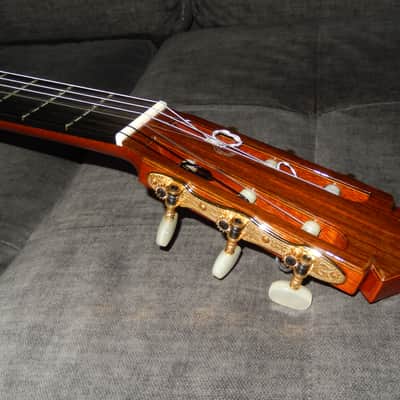
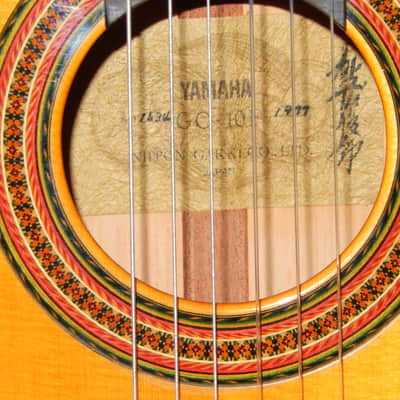
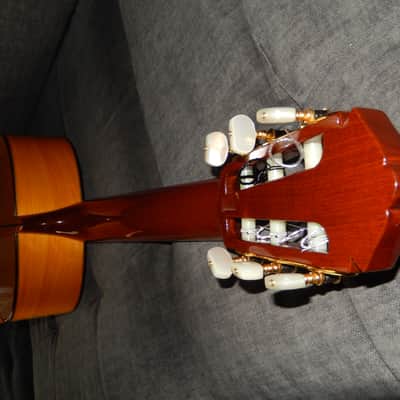
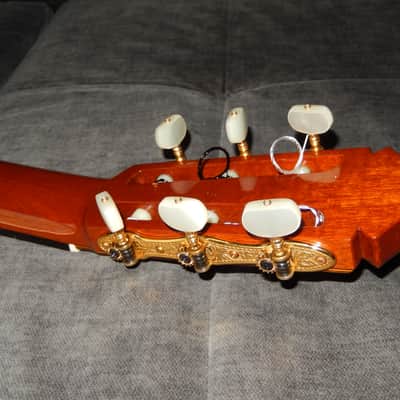
Although many of you may read the date on the label as 1977, this date is really 1971. Toshihiro’s pen was leaking that day. You can “clearly” see that that all other letters and digits on the label are smeared as well. When you try to do detailed research yourselves, you’ll find out that this design labels were used by Yamaha only till mid1971, replaced by new design labels with goldish ornaments and lettering, that tuners installed on this guitar were used by Yamaha only until mid1975. You will also discover that sometime around mid/late 1975 Yamaha flamenco guitars lineup was changed to FC models, which ended the era of models GC5F, GC7F,GC10F, and the only Yamaha flamenco models made in 1977 were: FC6, FC10, FC15 and FC20, sold with yet another design labels and unique headstock design, very different from earlier models. You may also realize that in 1977 Yamaha’s serial number system was totally different from the one used in 1971.
Yamaha GC10F was priced 125 000 yen in 1971, when starting yearly salary of Japanese college graduate was around 50 000 yen. During the same year the very top models among Japanese made classical guitars were priced up to 150 000yen.
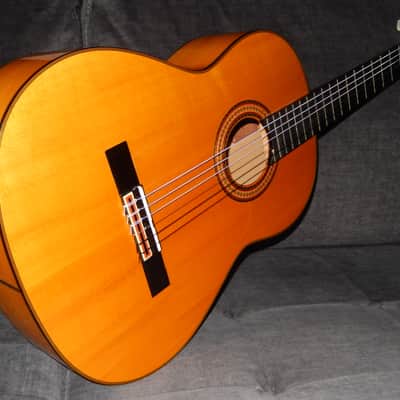
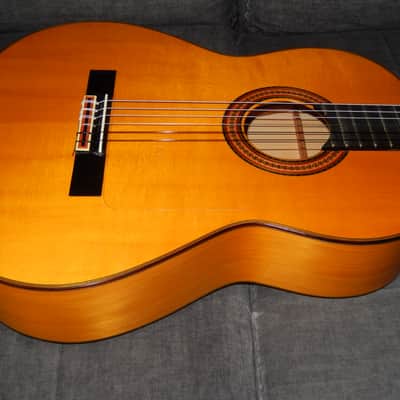
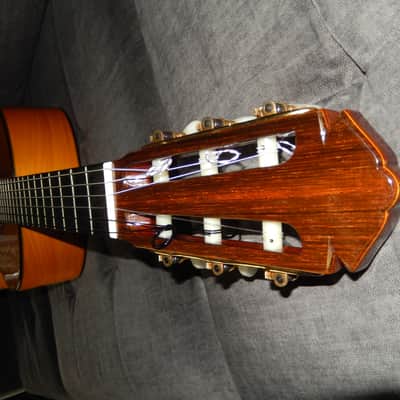
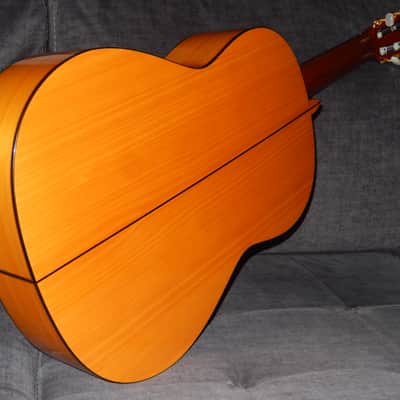
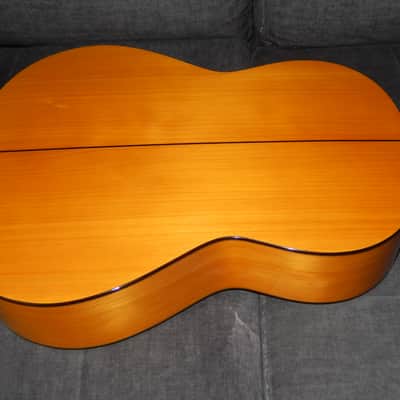
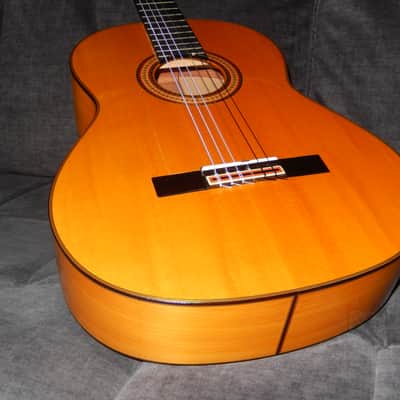
The overall condition of this guitar can be described as “at least excellent for its age”. Very minimal wear of its frets suggests that it was played, but for relatively short period of time. Obviously, its owner was extremally careful while handling this guitar. Its body remains in nearly mint condition, which is truly hard to imagine, while thinking about 48 years old flamenco guitar. Only very close inspection reveals few ultra tiny marks within its finishes and one tiny dent on the back of the headstock. These marks are too tiny to show on the photograph. It will take you few minutes before you find them yourself.
This truly magnificent guitar offers exceptional volume and response combined with modern style flamenco tonality. It is the opposite of loud and boxy sounding cheap flamencos that many unexperienced players consider as great. On this guitar you can play all traditional flamenco pieces as well as any romantic tune you can imagine. Its basses are deep but quite clean (mix of “rubber and steel”) with only a bit of overtones, while trebles are round, sweet and crispy. All notes are well balanced, with high level of note clarity and separation.
It is certainly one of those guitars with “replacement value” much higher than its retail price at any given moment in time. If you’d like to buy similar grade brand new “hand made in Spain” guitar, you will have to spend at least $15000.
SPECIFICATIONS:
Year(s) Sold: 1968-1974
Top: Solid German Spruce/7 braces fan/shellac
Back & sides: Solid Cypress/lacquer
Neck: Honduras Mahogany
Fingerboard: Ebony
String Length: 664mm
Nut width: 52 mm
Guitars action is set to 3.00 mm under E6 and 2.5 mm under E1 with still extra room on the saddle.
Strings: Philippe Bosset Elite Classical Flamenco, Normal Tension ELITN with Savarez Alliance Normal Tension G3
Guitar will be shipped in brand new black Musician's Gear hard shell case.
History of Modern Era Yamaha Guitars
Yamaha started their fight for international clients in 1967 with new lineup of classical Grand Concert guitars made according to Spanish blueprints. They were: GC3 (solid Spruce top/ solid Indian Rosewood b/s) GC5, GC7 and GC10 (all 3 models with solid Spruce tops and solid Brazilian Rosewood b/s).
In 1968 Yamaha also introduced their lineup of great Grand Concert flamenco guitars. They were GC5F, GC7F and GC10F. The master luthier responsible for production of these guitars was Toshihiro Kato. He was helped by Hiroshi Harada, who was making classical models GC3 and GC5. Both these luthiers were trained by Eduardo Ferrer, a Spanish luthier from Granada, Spain who being invited (and appropriately rewarded) by Yamaha co., travelled to Japan during years 1964-1967.
During early 1970s Japanese guitar makers were still trying hard to win as many international customers as possible. These were they years of significant international recognition of their, soon very highly regarded products. Yamaha was unquestioned leader among Japanese guitar exporters. Their guitars offered the highest possible level of craftsmanship with great deal of attention to even the tiniest details.
It is very important to explain that 1960s and 1970s were years of very rapid devaluation of Japanese yen (hence rapid inflation of prices for all products). Because during those years practically all guitar models had some numbers closely related to their prices in yen, these models were quite frequently upgraded (relabeled) to higher numbers reflecting their higher prices.
For that reason, mentioned above Yamaha’s classical GC guitars lineup, was changed in 1971. New (1971-1973) lineup included models GC3D, GC6D, GC8D, GC10D (all 4 models made with solid Spruce tops & solid Indian Rosewood b/s) GC12D, GC15D and GC20D (all 3 models with solid Spruce tops & solid Brazilian Rosewood b/s). It is worth to mention that until 1974 all Yamaha classical GC models were made exclusively with Spruce tops.
In 1974 Yamaha’s classical GC guitar lineup was changed yet again. In that year, for the first time in its history, Yamaha decided to make classical guitars with cedar tops. This newly introduced GC classical guitar lineup included models: GC5M(S), GC7M(S), GC10M(S), GC15M(S), (all with Indian Rosewood b/s), GC20M(S), GC30A, GC30B (all with Brazilian Rosewood b/s). M=spruce. S=cedar, A=spruce, B=cedar
Real Value of Japanese Vintage Guitars
The key to understand value of vintage Japanese guitars is to acknowledge galloping devaluation of Japanese yen in 1960s & 1970s. This devaluation was somewhat slower in 1980s. The best measure of this devaluation is Starting Yearly Salary of Japanese College Graduate (SYSJCG).
SYSJCG in in 1965 was 19 600 yen, in 1969 – 34 600 yen, in 1970 39 200 yen, in 1972 – 62 300 yen, in 1975 79 200 yen, in 1977 121 200 yen and in 1980 - 100 000 yen.
During 1960s and most of 1970s model numbers of Japanese guitars were strictly interconnected with their prices in Japanese yen. In late 1970s and during following decades model numbers were no longer strictly associated with their prices. Many Japanese guitar makers introduced model names instead of model numbers. Others were still using model numbers with addition of letter abbreviations or other symbols.
The best and only logical approach while evaluating real value (real grade) of vintage Japanese guitar is to compare its price in Japanese yen with SYSJCG during the year guitar was made.
Any guitar priced 100 000 in 1970 (labelled usually as No10) would be priced 200 000 yen in 1975 (relabeled to No20 or 2000), 300 000 yen in 1977 (labelled as No3, No30 or 3000). Starting in 1977 Masaru Kohno introduced his model No50 priced at 500 000 (skipping theoretical model 40). Soon other famous Japanese luthiers did the same. By 1983 Kohno started using model names instead numbers and was raising their prices as he was pleased. Naturally soon other Master luthiers did the same.
Knowing all of that, you can bet on that Masaru Kohno No50 made in 1982 is practically the same quality as Kohno No15 made in 1972, or Kohno no20 made in 1975 or Kohno No30 made in 1977. I know it for a fact.
The lowest grade models currently made by Matsuoka workshop are M75 and MH75. They are commonly considered as “beginner guitars”. Matsuoka model M30 made in 1973 is simply far, far better instrument. It is naturally better than model M50 made in 1977, model 80 made in 1982 or model M100 made in 1990. At present, the highest grade Matsuoka models are M300 and MH300. They absolutely stand no chance in competition with model M150 made in 1975… or model M200 made in 1977.
It is very important to mention that if modern era luthiers are using 40 years old woods to make a classical guitar, its price is at least $8000.
Returns
If you are not happy with your purchase you may return the guitar for a full refund of original payment less any shipping charges.
All you need to do is:
1. Notify me within 48 hours after receiving the guitar.
2. Pack guitar the same way I do it, using the same box and materials and ship it back to me within 24 hours after "return notification".
Naturally if you expect to receive a full refund, guitar has to be returned in the same condition as I ship it to you.
P.s. If you'd like to check my "modest" playing skills click on the links below:
Reverb Buyer Protection
Reverb has your back if your item is lost, damaged, or doesn't match its description. Simply report any issues within 7 days and we'll help you get a full refund.Learn more about Reverb Buyer Protection.
| Listed | 7 years ago |
|---|---|
| Condition | Excellent (Used) Excellent items are almost entirely free from blemishes and other visual defects and have been played or used with the utmost care.Learn more |
| Brand | |
| Model |
|
| Finish |
|
| Categories | |
| Year |
|
| Made In |
|
| Body Shape |
|
Product safety information may be available here.